


Fire
Keywords: warm · woody · sweet
Fire is an accord of the warm, woody, sweet family, and a fantasy or concept material. Wood smoke contains guaiacol, which is present as a result of the pyrolysis of lignin. Cade oil has a strong smoky smell.
- Olfactive family
- Woods · 363 entries of the glossary in this family Subfamily: Smoky woods · 39 entries in this subfamily Cluster: Smoky leather · 26 entries in this cluster
- Material
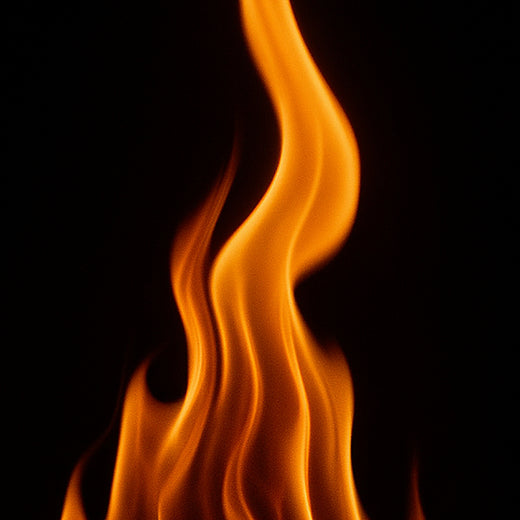
- Fantasy/Concept Imaginative accord evoking the smoky, warm, and resinous impression of flame and embers
- Pyramid
- Base Note
- Strength
- Medium Step 3 of 5 · shared by 1,462 of 2,149 graded entries Graded entries at each step, from 1 to 5: 4, 118, 1,462, 501, 40. 24 more sit between two steps.
- Producing countries
- N/A — olfactory concept
- Also called
- burning, flame, combustion
Fire · Facets
Entries of the glossary that carry each facet, of 3,979:
- woody 790
- smoky 166
- sweet 1,987
- amber 140
- warm 1,109
- resinous 199
- roasted 133
Editorial note We own no rights to this material, its name or its trademark. This entry is independent editorial journalism, published under freedom of expression.
Fire · Scent
Guaiacol has a characteristic sweet odor. The odour of labdanum is very rich, complex and tenacious. Descriptions of labdanum’s odour include amber, sweet, woody, powdery, fruity, animalic, ambergris, dry musk and leathery. The smell of frankincense oil is described as terpenic, incense, peppery, spicy, old wood, woody, pine, resinous and green. The birch bark oil used on Russia leather gave it a distinctive and pleasant aroma.
Evolution over time
Fire: scent over time.
- Immediately
Diffusive, smoky and sweet, with the character of wood smoke.
Scent words: sweet · woody · smoky - After a few hours
Leathery, balsamic and woody, with a phenolic edge.
Scent words: balsamic · woody · leather - After a few days
Tarry, burnt and ashy, with notes of charred pine and dark earth.
Scent words: earthy
- Tenacity
- Varies by formulation
Fire · In Perfumery
At the turn of the twentieth century, birch bark tar became a specialty fragrance material, used as a base note to impart a leathery, smoky note in fragrances. It is used especially in the leather and tobacco genre, and to a lesser extent in chypres. Labdanum is the main ingredient used to make the scent of amber in perfumery, as well as chypre fragrances. Frankincense is an aromatic resin used in incense and perfume. Cade oil is used in some cosmetics and in incense. Guaiacol contributes to the flavor of whiskey and roasted coffee.
Pyramid
Fire: Base. Entries of the glossary stored at each place of the pyramid, of 4,000 (35 store no place):
- Top 718
- Top · Heart 496
- Heart 1,644
- Heart · Base 513
- Base 594
Role in the formula
Fire: roles in the formula. Entries of the glossary that share each role, of 4,000:
- Modifier 1,168
- Lifting agent 568
- Blender 1,041
- Volume builder 780
- Freshness 720
Fire · Extraction & Chemistry
Birch bark tar is made by dry distillation of birch bark. Cade oil is the essential oil obtained through destructive distillation of the wood of Juniperus oxycedrus. The raw labdanum resin is usually extracted by boiling the leaves and twigs, an absolute is obtained by solvent extraction, and an essential oil is produced by steam distillation. The essential oil of frankincense is produced by steam distillation of the tree resin. In dry or destructive distillation, the raw materials are heated directly in a still without a carrier solvent such as water. This method is used to obtain fragrant compounds from fossil amber and fragrant woods where an intentional burned or toasted odor is desired.
- Appearance
- N/A — olfactory concept (not a physical material)
Fire · Did You Know?
A 5,000-year-old piece of chewing gum made from birch bark tar, still bearing tooth imprints, was found in Kierikki, Finland.
Fire · In Depth
Smoke is emitted when a material undergoes combustion or pyrolysis. Guaiacol and its derivatives are characteristic of wood smoke. Syringol and other methoxy phenols are further markers of wood smoke.
Origin and Production
Cade oil is obtained from the wood of Juniperus oxycedrus, a species of juniper native across the Mediterranean region. Labdanum is a sticky brown resin obtained from the shrubs Cistus ladanifer in the western Mediterranean and Cistus creticus in the eastern Mediterranean. Frankincense is an aromatic resin obtained from trees of the genus Boswellia. Birch bark tar is a substance derived from birch tree bark.
Chemistry and Scent Profile
Guaiacol is a phenolic compound containing a methoxy functional group. Its formula is C₆H₄(OH)(OCH₃). Birch bark tar is mainly composed of triterpenoid compounds of the lupane and oleanane family. The most characteristic molecules of birch bark tar are betulin and lupeol.
Explore all seven extraits in the Discovery Set.
Fire · History
Neanderthals produced tar through dry distillation of birch bark as early as 200,000 years ago. In the eighteenth century, birch bark tar oil was used alongside civet, castoreum and many other aromatic substances to scent the fine Spanish leather Peau d’Espagne. In ancient times, labdanum was collected by combing the beards and thighs of goats and sheep that had grazed on the cistus shrubs.
Fire · Technical Sheet
Identity
- Botanical
- N/A — olfactory concept
- Type
- Accord
- Category
- Accords and curiosities
Chemical data
- Formula
- N/A — olfactory concept
Physical properties
- Note
- N/A — olfactory concept, not a physical substance. Fire notes are recreated using blends of smoky, resinous, and woody molecules (e.g., guaiacol, cade oil, birch tar).
Performance and rules
- Available as
- fragrance accord
Fire · See Also
Entries related to Fire, by their place in the pyramid. « shared » marks a scent word Fire has too.
Base notes

Oud
woody (shared) · animalic · smoky (shared) Woods / Same subfamily / Natural
Vetiver
earthy · woody (shared) · smoky (shared) Woods / Same subfamily / Natural-
Ember
warm (shared) · woody (shared) · smoky (shared) Woods / Same subfamily / Fantasy/Concept 
Cuban Cigar
rich · woody (shared) · smoky (shared) Woods / Same subfamily / Fantasy/Concept
Teak Wood
woody (shared) · warm (shared) · rich Woods / Same subfamily / Natural
Guaiac Wood Oil
woody (shared) · smoky (shared) · balsamic Woods / Same subfamily / Natural
Gun Smoke
smoky (shared) · powdery · warm (shared) Woods / Same subfamily / Fantasy/Concept
Cedarwood
woody (shared) · dry · clean Woods / Natural-
Indian Woods
woody (shared) · rich · creamy Woods / Natural 
Ash
earthy · warm (shared) · woody (shared) Woods / Fantasy/Concept


Fire · Sources
- Wikipedia Birch tar
- Wikipedia Guaiacol
- Wikipedia Cade oil
- Wikipedia Wood smoke
- Wikipedia Labdanum
- Wikipedia Olibanum
- Wikipedia Perfume
- Wikipedia Smoke taint
Cite as PREMIEREPEAU Glossary, “Fire”, https://premierepeau.com/pages/glossary-terms/fire Updated 2026-11-19
