The fruit of the calabash can be harvested young to be eaten as a vegetable, or harvested mature and dried for use as a kitchen utensil, a beverage container or a musical instrument. When it is fresh, the fruit has a light green smooth skin and white flesh.
Explore all seven extraits in the Discovery Set.
Origin and Production
The calabash is native to tropical Africa and is cultivated across the tropics. Lagenaria contains six species, all of which are indigenous to tropical Africa. The best-known species of the genus is the calabash, or bottle gourd, which has been domesticated by humans and has spread beyond Africa. The generic name Lagenaria comes from the Latin lagena, meaning bottle or flask. The gourd family Cucurbitaceae has about 965 species in 101 genera. First flowers open in about 45 days from sowing, and the first crop is ready for harvest within two months. The fruits have a variety of shapes: they can be huge and rounded, small and bottle-shaped, or slim and serpentine, and they can grow to be over a metre long.
Flowers
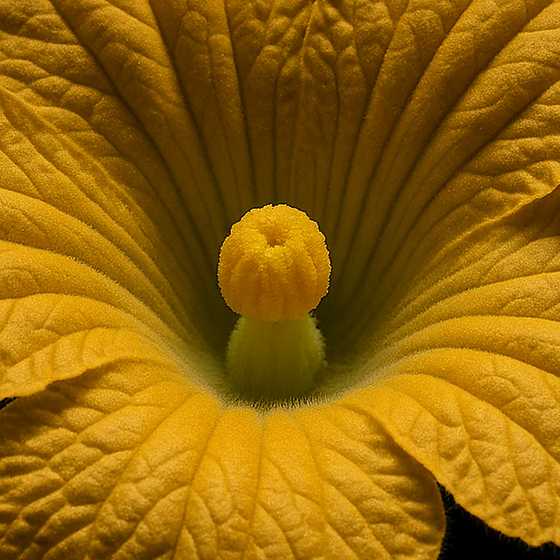
The male flowers have long peduncles, and the females have short ones with an ovary in the shape of the fruit. Sometimes the female flowers drop off without growing into a gourd due to the failure of pollination if there is no night pollinator (probably a kind of moth) in the garden. Hand pollination can be used to solve the problem. The flowers are borne singly on the axils of the leaves; they are white, 4 inches in diameter, with spreading petals. Pollen grains are around 60 microns in length. The foliage of the plant is covered with soft hairs.
Relation to Cucurbita
The young fruits of Lagenaria bottle gourds are eaten much like those of the Cucurbita species. Lagenaria belongs to the same family and subfamily as Cucurbita, but to a different tribe. The gourds used as utensils or vessels belong to Lagenaria and are native to Africa.
Chemistry
Like other members of the family Cucurbitaceae, gourds contain cucurbitacins that are known to be cytotoxic at a high concentration. The tetracyclic triterpenoid cucurbitacins present in fruits and vegetables of the cucumber family are responsible for the bitter taste. The domesticated bottle gourd genotypes are non-bitter, whereas wild forms are very bitter. Bitterness in the wild species is caused by accumulation of cucurbitacin I. A small number of cucurbitacin types, including B, D, G and H, are present in the fruit, and their concentrations usually stay below 130 ppm. In extreme cases, people have died from drinking the juice of gourds.
Vitamins, choline, flavonoids, minerals, proteins, terpenoids, and other phytochemicals are also found in the edible parts of the plant. Per 100 g, L. siceraria contains 14 Kcal energy, 3.39 g carbohydrates, 0.62 g protein, 0.2 g fat, and 0.5 g fiber.
Uses
The calabash is frequently used in southern Chinese cuisine in either a stir-fry dish or a soup. In Japan it is commonly sold in the form of dried, marinated strips known as kanpyō and is used as an ingredient for making makizushi. In Korea the inner flesh has traditionally been eaten as a vegetable, and the outside cut in half to make bowls. In Central America the seeds are toasted and ground with rice, cinnamon, allspice and other ingredients to make one type of horchata. In many parts of South Africa, young bottle gourd fruits are sold at retail stores.
Hollowed-out and dried calabashes are a very typical utensil in households across West Africa. They are used to clean rice, carry water, and as food containers. After drying, the fruit is used as resonance boxes for the kora and balafon. Drinking water, milk, honey, salt and perfume are among the goods stored and transported in dried bottle gourd fruits. The dried fruit has a hard shell which is ideal for making custom-made containers for decoration and other household uses. For instance, a dried fruit with a neck length between 8 and 15 cm is valued for making containers to serve traditional beer or water.