


Formic Acid
Keywords: pungent · fermented · acetic
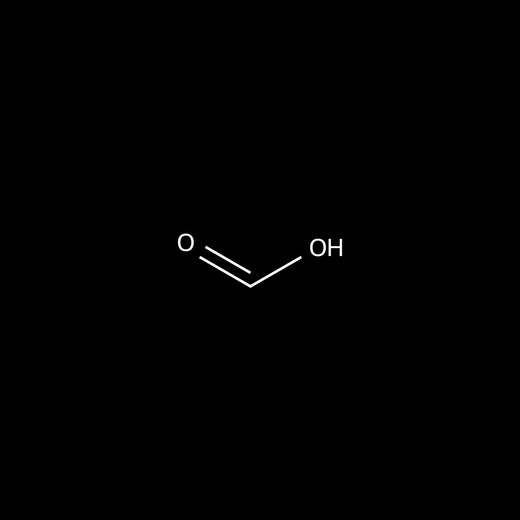
Formic Acid is the simplest carboxylic acid, containing a single carbon. It smells pungent and vinegar-like.
- Olfactive family
- Fruity · 717 entries of the glossary in this family Subfamily: Classic fruits · 435 entries in this subfamily Cluster: Mixed fruit notes · 356 entries in this cluster
- Pyramid
- Top Note
- Strength
- High Step 4 of 5 · shared by 507 of 2,161 graded entries Graded entries at each step, from 1 to 5: 4, 117, 1,469, 507, 40. 24 more sit between two steps.
- Also called
- C1 acid
Formic Acid · Facets
Entries of the glossary that carry each facet, of 3,979:
- pungent 90
- fermented 58
- acetic 3
- fruity 1,307
- vinegar 2
- sharp 44
Formic Acid · Scent
A pungent, penetrating, vinegar-like odour with fermented and fruity facets.
Formic Acid · In Perfumery
It is a fragrance ingredient with a pungent, acetic and vinegar-like character, and it is used as a solvent for perfumes.
Pyramid
Formic Acid: Top. Entries of the glossary stored at each place of the pyramid, of 4,000 (35 store no place):
- Top 718
- Top · Heart 501
- Heart 1,646
- Heart · Base 512
- Base 588
Formic Acid · In Depth
Identity
It is also a monocarboxylic acid. Its CAS number is 64-18-6, its formula is CH₂O₂ and its molecular weight is 46.025 g/mol.
Odour
It smells pungent, acetic and vinegar-like, with fermented, fruity and sharp facets. At 0.1 % in water it is pungent, vinegar-like and formyl. Its odour is penetrating and gives a stinging sensation on the mucous membranes. Its odour strength is high, and smelling it in a 0.1 % solution or less is recommended. Its substantivity is 16 hours at 100 %.
Occurrence in nature
It occurs in Apium graveolens, Artemisia jacutica, Blepharocalyx salicifolius, Capsicum annuum, Catharanthus roseus, Coffea arabica and Humulus lupulus, and in the venom of bee and ant stings.
Use in perfumery
It is a fragrance ingredient and is used as a solvent for perfumes. In cosmetics it is used as a preservative.
Use in flavours
It is used as a flavouring agent, a flavour enhancer and a preservative in foods.
Properties
It boils at 101 °C at 760 mmHg and melts at 8.3 °C. Its flash point is 68.89 °C and its logP is -0.54. It is soluble in water and insoluble in paraffin oil. It is a highly corrosive liquid. It is used in electroplating, brewing and mirror silvering, and in dyeing and finishing textiles, paper and leather. It is principally used as a preservative and antibacterial agent in livestock feed.
Safety and IFRA
No IFRA Standard covers this material itself, under the 51st Amendment now in force. Its INCI name is Formic acid and its sodium salt, and its EC numbers are 200-579-1 and 205-488-0. It is registered under REACH with the EC number 200-579-1. The Joint FAO/WHO Expert Committee on Food Additives found no safety concern at current levels of intake when it is used as a flavouring agent. The group acceptable daily intake of 0 to 3 mg/kg of body weight, set in 1979, was kept in 1997.
Formic Acid · Technical Sheet
Molecular weight
46.025 g/mol Heavier than 10 of the 546 other entries at the same place of the pyramid that store a weight
2,572 entries store a molecular weight. By place in the pyramid: Top 547, Top · Heart 411, Heart 888, Heart · Base 454, Base 272.
Identity
- Type
- Ingredient
- Category
- Aroma chemicals
Classification
- Chemical class
- Carboxylic acid
Chemical data
- Formula
- CH2O2
- CAS
- 64-18-6
- PubChem CID
- 284, compound record on PubChem
- InChIKey
- BDAGIHXWWSANSR-UHFFFAOYSA-N
- Appearance
- Colourless fuming liquid
Physical properties
- Boiling point
- 100 to 101 °C at 760 mmHg
- Melting point
- 8.2 to 8.4 °C at 760 mmHg
- Flash point
- 68.89 °C (156 °F)
- Vapour pressure
- 36.477001 mmHg at 25 °C (estimated)
- Log P
- -0.54
- Tenacity
- 16 hour(s) at 100 %
Performance and rules
- Odour threshold
- 7.7 ppm in air · Abraham et al. 2012
- IFRA status
- No IFRA Standard for the material itself (51st Amendment)
Formic Acid · See Also
Entries related to Formic Acid, by their place in the pyramid. « shared » marks a scent word Formic Acid has too.
Top notes

Ethyl formate
ethereal · fruity (shared) · cognac Fruity / Same subfamily / Natural & Synthetic / 74.08 g/mol
Acetic Acid
sour · pungent (shared) · apple Fruity / Same subfamily / 60.05 g/mol
Dihydromyrcenol
fresh · citrus · aromatic Citrus / Synthetic / 156.26 g/mol


Heart notes

Cinnamyl Formate
balsamic · fruity (shared) · floral Resinous / Heart · Base / Synthetic / 162.19 g/mol

Formic Acid · Sources
- PubChem Formic Acid
- ChEBI Formic Acid: chemical classification record
- Pyrfume Arctander, Perfume and Flavor Chemicals: odour descriptions (Pyrfume archive)
- Pyrfume Good Scents odour data (Pyrfume archive)
- Pyrfume Leffingwell odour data (Pyrfume archive)
- The Good Scents Company Information System Formic Acid: data sheet
- Wikidata (LOTUS natural products data) Formic Acid: organisms it is reported in, with the papers
- IFRA Standards, 51st Amendment
- European Commission, CosIng Formic Acid: cosmetic ingredient record
- European Chemicals Agency Formic Acid: substance record
Cite as PREMIEREPEAU Glossary, “Formic Acid”, https://premierepeau.com/pages/glossary-terms/formic-acid Updated 2026-11-18
