


Hops
Keywords: green · fresh · floral
Hops are the female flower cones (strobili) of the hop plant Humulus lupulus, a member of the Cannabaceae family. Their flavours and aromas may be described as grassy, floral, citrus, spicy, piney, lemony, grapefruit and earthy.
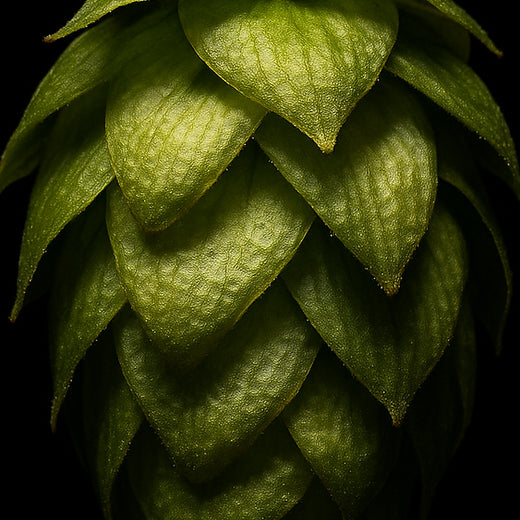
- Olfactive family
- Aromatic · 509 entries of the glossary in this family Subfamily: Herbal aromatics · 232 entries in this subfamily Cluster: Green-herbal notes · 155 entries in this cluster
- Material
- Natural Flower cones (strobiles)
- Pyramid
- Top · Heart · Volatility: Top · Heart Note
- Strength
- Medium Step 3 of 5 · shared by 1,462 of 2,148 graded entries Graded entries at each step, from 1 to 5: 4, 118, 1,462, 500, 40. 24 more sit between two steps.
- Also called
- Hop cones, seed cones, strobiles
Hops · Facets
Entries of the glossary that carry each facet, of 3,979:
- woody 792
- floral 1,546
- green 1,442
- earthy 660
- sweet 1,988
- herbal 757
- warm 1,108
- fresh 1,387
- citrus 487
- spicy 474
- piney 4
Hops · Scent
Myrcene contributes a pungent smell of fresh hops, together with humulene and caryophyllene. Myrcene also contributes a peppery, balsamic aroma in beer. Humulene and its reaction products in the brewing process give many beers a hoppy aroma.
Evolution over time
Hops: scent over time.
- Immediately
Grassy, floral, citrus, lemony and grapefruit aromas.
Scent words: citrus · floral - After a few hours
Spicy and piney aromas, with a pungent smell.
Scent words: spicy - After a few days
Earthy aromas.
Scent words: earthy
Hops · In Perfumery
Myrcene, a monoterpene found in hops, has a pleasant odor but is rarely used directly in the perfumery industry. It is a precursor to many fragrance materials, such as menthol, citral, citronellol, citronellal, geraniol, nerol and linalool.
Pyramid
Hops: Top · Heart. Entries of the glossary stored at each place of the pyramid, of 4,000 (36 store no place):
- Top 718
- Top · Heart 497
- Heart 1,641
- Heart · Base 514
- Base 594
Role in the formula
Hops: roles in the formula. Entries of the glossary that share each role, of 4,000:
- Modifier 1,167
- Signature note 897
- Lifting agent 567
- Blender 1,040
- Freshness 720
Hops · Terroir & Origins
- Producing countries
- United States, Germany, China, Czech Republic
Hops · Extraction & Chemistry
Steam-distilled hop oil is produced from leaf hops and contains the complete range of essential oils found in them. Essential oils from eight hop varieties unique to South Africa have been produced on an industrial scale by steam distillation. The oil is separated from the water-based hydrosol during the condensing phase. A ratio of 60:30 bract to leaf and cone gave an average yield of 0.8 g oil per 100 g of hop biomass.
Available as
Hops: available as.
- natural extract
- absolute
- essential oil
- Appearance
- Pale yellow to greenish amber clear liquid
Hops · Did You Know?
Young hop shoots sell for up to 1,000 euros per kilogram, and Belgium and Holland are the countries that appreciate them most. In Belgium they are affectionately called ‘the truffles of the North’.
Hops · In Depth
The plant
The hop plant is a vigorous climbing herbaceous perennial, usually trained to grow up strings when grown commercially. It is dioecious, with separate male and female plants, and only female plants are used for commercial production. The species is native to West Asia, Europe and North America. It is sometimes described as a bine rather than a vine because stiff downward-facing hairs let it climb. Hop cones contain lupulin, a yellowish, waxy substance described as an oleoresin, which gives flavour and aroma to beer.
Chemistry
Myrcene, humulene and caryophyllene together represent 80–90% of the essential oil in hops. Humulene was first found in the essential oils of hops, from which it derives its name. Its concentration varies among hop varieties and can be up to 40% of the essential oil. Farnesene is a major component in some hops. The composition of hop essential oils can differ between varieties and between years in the same variety.
Oils steam-distilled from eight South African hop varieties contained 208 identified compounds and consisted largely of terpenes. Myrcene (27.8–48.15%) was the most abundant monoterpene, while α-humulene (19.52–24.98%), β-caryophyllene (8.47–13.73%) and β-farnesene (2.08–7.57%) made up the majority of the sesquiterpenes. Hops also contain alpha acids, or humulones, which are thermally isomerized during wort boiling into iso-alpha acids that give a bitter flavour to beer.
A relative of cannabis
Cannabaceae is a small family of flowering plants, known as the hemp family, with about 170 species in about 11 genera. These include Cannabis (hemp), Humulus (hops) and Celtis (hackberries). The hop plant diverged from Cannabis sativa over 20 million years ago.
Uses
Hops are used chiefly as a bittering, flavouring and stability agent in beer, where they add floral, fruity or citrus flavours and aromas alongside bitterness. Bittering hops have higher concentrations of alpha acids and are responsible for the large majority of the bitter flavour of a beer.
Aroma hops are the primary contributors of hop aroma and nonbitter flavour. Steam-distilled hop oil can be added at various points in brewing, typically on the cold side of production, and gives beer a hop aroma that depends on the time of the addition. Hops are also used in herbal teas and in soft drinks such as julmust and Malta.
Both the young shoots and young flowers are edible and can be cooked like asparagus. Raw hop shoots taste bitter and astringent, but once cooked their flavour combines earthiness, somewhat like kale, with nuttiness and a slight hoppy note. Hops are toxic to dogs.
Related: Hashish
Hops · History
The first documented use of hops in beer is from the 9th century, though Hildegard of Bingen, 300 years later, is often cited as the earliest documented source. Before this period, brewers used a gruit, composed of a wide variety of bitter herbs and flowers. Early documents include mention of a hop garden in the will of Pepin the Short, father of Charlemagne. Archaeological findings place hop seeds in the Neolithic period, when hops were probably used only for medicinal purposes.
Hops · Technical Sheet
Identity
- Botanical
- Humulus lupulus
- Taxonomy
- Rosales order › Cannabaceae family › Humulus genus · GBIF
- Botanical records
- Humulus lupulus: POWO, Humulus lupulus · IPNI, Humulus lupulus · GBIF, Humulus lupulus · Wikidata, Humulus lupulus · Wikipedia, Humulus lupulus
- IPNI
- Humulus lupulus L., Sp. Pl. 2: 1028 (1753) — Carl Linnaeus (1707–1778)
- Type
- Ingredient
- Category
- Greens, herbs and fougeres
In Nature
- Growth form
- Climber · Herb · POWO
- Native range
- Northern Europe · Middle Europe · Southwestern Europe · Southeastern Europe · Eastern Europe · Northern Africa · Siberia · Middle Asia · 2 more regions · POWO
- Introduced to
- 54 regions · Northern America 32 · Temperate Asia 12 · Australasia 7 · Europe 1 · Tropical Asia 1 · Southern America 1
- Flowering
- peak in August–September · north of the equator · iNaturalist
- Recorded altitude
- 0–550 m · median 200 m · 63,727 records with an altitude · GBIF
- Wild or cultivated
- 39,055 native · 2,187 introduced · 653 cultivated among 428,317 records (the rest carry no such mark) · GBIF
- Recorded in
- 79 of 512 squares of the world grid; a brighter dot holds more records · GBIF
In Print
- Timeline
- first described 1753 · earliest aroma paper in Europe PMC, 1991
- In English books
- most mentioned in the 1980s · Google Books Ngram
Classification
- Chemical class
- Complex natural (essential oil)
Chemical data
- Structure
- Myrcene, Alpha-Humulene:
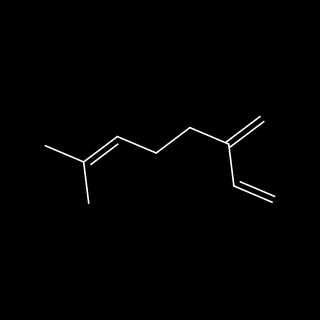
Myrcene
PubChem, Myrcene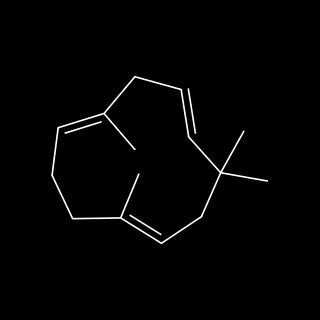
Alpha-Humulene
PubChem, Alpha-Humulene - CAS
- 8007-04-3
- INCI
- HUMULUS LUPULUS OIL · FRAGRANCE
- EC
- 232-504-3
- INCI names (CosIng)
- HUMULUS LUPULUS EXTRACT (ANTIMICROBIAL, ANTIPERSPIRANT, HAIR CONDITIONING, FRAGRANCE, SKIN CONDITIONING, SKIN PROTECTING)
Labelling
- EU allergens reported
- Limonene · Linalool · Geraniol · Citral · Farnesol · Pinene · Terpineol · Alpha-Terpinene · Beta-Caryophyllene · Benzaldehyde · Vanillin
Physical properties
- Flash point
- 118.00 °F. TCC (47.78 °C.)
- Specific gravity
- 0.86820 to 0.89230 at 25.00 °C.
- Density
- ca. 0.85 g/ml (20 °C)
- Strength
- Medium ,recommend smelling in a 1.00 % solution or less
- Tenacity
- 52 hour(s) at 100.00 %
Performance and rules
- IFRA status
- No IFRA Standard for the material itself (51st Amendment)
Hops · See Also
Entries related to Hops, by their place in the pyramid. “shared” marks a scent word Hops has too.
Top notes

Rosemary
aromatic · herbal (shared) · camphorous Aromatic / Top · Heart / Same subfamily / Natural
Black Pepper
spicy (shared) · warm (shared) · aromatic Aromatic / Natural


Heart notes

Clarycet
aromatic · green (shared) · fresh (shared) Aromatic / Same cluster / Synthetic
Mugwort
green (shared) · aromatic · camphorous Aromatic / Same cluster / Natural
Turnera Diffusa (Damiana)
spice-like · chamomile-like · aromatic Aromatic / Same cluster / Natural
Yarrow
green (shared) · floral (shared) · aromatic Aromatic / Same cluster / Natural
Sage
aromatic · herbal (shared) · amber Aromatic / Same subfamily / Natural
Immortelle
aromatic · honey · herbal (shared) Aromatic / Same subfamily / Natural
Tea
green (shared) · aromatic · dry Aromatic / Heart · Base / Same subfamily / Natural


Hops · Sources
Read the science
- Foods (2021) The Occurrence of Glycosylated Aroma Precursors in Vitis vinifera Fruit and Humulus lupulus Hop Cones and Their Roles in Wine and Beer Volatile Aroma Production
- Pharmaceuticals (Basel) (2022) Hemp (Cannabis sativa L., Kompolti cv.) and Hop (Humulus lupulus L., Chinook cv.) Essential Oil and Hydrolate: HS-GC-MS Chemical Investigation and Apoptotic Activity Evaluation
- Food Chem (2021) Aroma characterization of regional Cascade and Chinook hops (Humulus lupulus L.)
- GBIF Humulus lupulus
- Life (2025) Comparison of Major Compounds in Essential Oils Steam Distilled from Fresh Plant Material of South African Hop Varieties
- PubChem Myrcene
- IFRA Standards, 51st Amendment
- The Good Scents Company Hop oil
- Wikipedia Hops
- Wikipedia Humulus lupulus
- Wikipedia Lupulin
- Wikipedia Humulene
- Wikipedia Myrcene
- Wikipedia Cannabaceae
Cite as PREMIEREPEAU Glossary, “Hops”, https://premierepeau.com/
