


Fumaric Acid
Keywords: mushroom · musty · sour
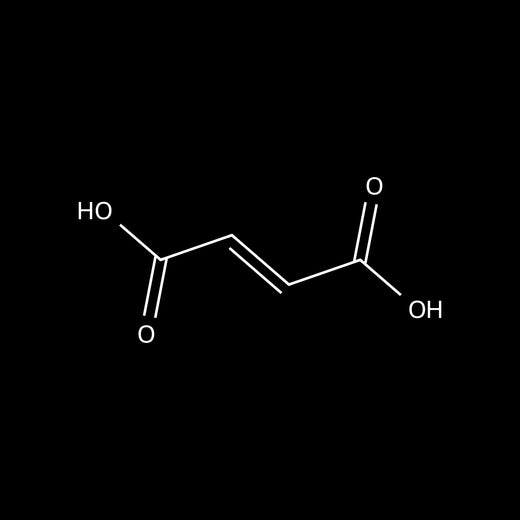
Fumaric Acid is a butenedioic acid whose carbon-carbon double bond has E geometry, and it is a white, virtually odourless crystalline solid.
- Olfactive family
- Earthy · 87 entries of the glossary in this family Subfamily: Earthy woods · 117 entries in this subfamily Cluster: Earthy fungal notes · 20 entries in this cluster
- Material
- Natural & Synthetic
- Pyramid
- Top Note
Fumaric Acid · Facets
Entries of the glossary that carry each facet, of 3,979:
- mushroom 56
- musty 129
- sour 45
Fumaric Acid · Scent
It is virtually odourless, with mushroom, musty and sour tones.
Fumaric Acid · In Perfumery
Its odour is virtually absent, with mushroom, musty and sour tones.
Pyramid
Fumaric Acid: Top. Entries of the glossary stored at each place of the pyramid, of 4,000 (35 store no place):
- Top 718
- Top · Heart 496
- Heart 1,644
- Heart · Base 513
- Base 594
Fumaric Acid · Extraction & Chemistry
It serves as a fortifier in paper size resins, unsaturated polyester resins and alkyd surface coating resins. It is also a chemical intermediate for plasticisers including dibutyl fumarate.
- Appearance
- White, odourless crystalline powder or granules
Fumaric Acid · In Depth
Identity
Fumaric Acid has the CAS number 110-17-8, the formula C₄H₄O₄ and a molecular weight of 116.07 g/mol. Its IUPAC name is (E)-but-2-enedioic acid. It is an intermediate metabolite in the citric acid cycle. It acts as a food acidity regulator, a fundamental metabolite, a geroprotector and an antipsoriatic.
Odour
Fumaric Acid is virtually odourless, and what scent there is reads as mushroom, musty and sour. Its taste is that of a fruit acid.
Occurrence in nature
Organisms that contain it include Aconitum japonicum, Adlumia fungosa, Amanita muscaria, Apium graveolens, Arabidopsis thaliana, Arbutus unedo, Asclepias syriaca and Brassica oleracea.
Production
It serves as a fortifier in paper size resins, unsaturated polyester resins and alkyd surface coating resins. It is also a chemical intermediate for plasticisers including dibutyl fumarate.
Use in flavours
It is used as an acidulant in gelatin desserts and dry beverage powders. It is a flavouring agent and an acidity regulator among food additives. A joint FAO and WHO expert committee found no safety concern at current levels of intake when it is used as a flavouring agent.
Properties
It forms needles, monoclinic prisms or leaflets from water. It sublimes at 200 °C and decomposes at 287 °C. Its flash point is 230 °C in a closed cup.
Safety and IFRA
Under the 51st Amendment, no IFRA Standard covers this material itself. Its INCI name is FUMARIC ACID, its cosmetic function is buffering and its EC number is 203-743-0. It is registered under REACH.
Fumaric Acid · Technical Sheet
Molecular weight
116.07 g/mol Heavier than 318 of the 546 other entries at the same place of the pyramid that store a weight; 1 weigh the same
2,572 entries store a molecular weight. By place in the pyramid: Top 547, Top · Heart 406, Heart 886, Heart · Base 455, Base 278.
Identity
- Type
- Ingredient
- Category
- Aroma chemicals
Classification
- Chemical class
- Carboxylic acid
Chemical data
- Formula
- C4H4O4
- CAS
- 110-17-8
- PubChem CID
- 444972, compound record on PubChem
- InChIKey
- VZCYOOQTPOCHFL-OWOJBTEDSA-N
Physical properties
- Boiling point
- 522 °C
- Melting point
- 549 °C
- Flash point
- 273 °C
Performance and rules
- Available as
- synthetic
- IFRA status
- No IFRA Standard for the material itself (51st Amendment)
Fumaric Acid · See Also
Entries related to Fumaric Acid, by their place in the pyramid. « shared » marks a scent word Fumaric Acid has too.


Fumaric Acid · Sources
- PubChem Fumaric Acid
- ChEBI Fumaric Acid: chemical classification record
- Pyrfume Arctander, Perfume and Flavor Chemicals: odour descriptions (Pyrfume archive)
- Pyrfume Leffingwell odour data (Pyrfume archive)
- Wikidata (LOTUS natural products data) Fumaric Acid: organisms it is reported in, with the papers
- IFRA Standards, 51st Amendment
- European Commission, CosIng Fumaric Acid: cosmetic ingredient record
- European Chemicals Agency Fumaric Acid: substance record
Cite as PREMIEREPEAU Glossary, “Fumaric Acid”, https://premierepeau.com/pages/glossary-terms/fumaric-acid Updated 2026-11-20
