


Glyoxal
Keywords: burnt · caramellic · mild
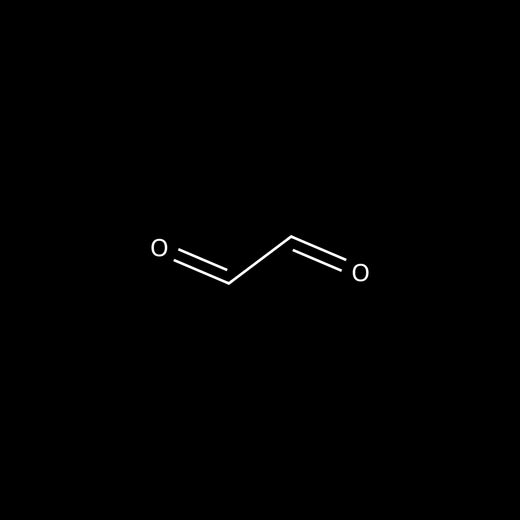
Glyoxal is the smallest possible dialdehyde, an ethane skeleton with oxo groups on both carbons. It smells mild and sour, with burnt and caramellic touches.
- Olfactive family
- Gourmand · 495 entries of the glossary in this family Subfamily: Caramel notes · 82 entries in this subfamily Cluster: Caramel-like gourmands · 81 entries in this cluster
- Material
- Natural & Synthetic
- Pyramid
- Top Note
- Strength
- Low Step 2 of 5 · shared by 118 of 2,149 graded entries Graded entries at each step, from 1 to 5: 4, 118, 1,462, 501, 40. 24 more sit between two steps.
Glyoxal · Facets
Entries of the glossary that carry each facet, of 3,979:
- burnt 75
- caramellic 112
- mild 15
- sour 45
Glyoxal · Scent
It smells mild and sour, with a burnt, caramellic side, and its odour strength is low.
Glyoxal · In Perfumery
Glyoxal is a low-strength material with a mild, sour, burnt and caramellic odour.
Pyramid
Glyoxal: Top. Entries of the glossary stored at each place of the pyramid, of 4,000 (35 store no place):
- Top 718
- Top · Heart 496
- Heart 1,644
- Heart · Base 513
- Base 594
Glyoxal · Extraction & Chemistry
Glyoxal is made by the oxidation of acetaldehyde with nitric acid. It is also made by the vapour-phase oxidation of ethylene glycol. It is used in the paper industry for sizing and in the textile industry for preventing shrinking and creasing. In cosmetics it acts as an antimicrobial.
- Appearance
- Colourless to pale yellow liquid, or a yellow crystalline solid
Glyoxal · In Depth
Identity
Glyoxal has the IUPAC name oxaldehyde and the CAS number 107-22-2. Its molecular formula is C₂H₂O₂ and its molecular weight is 58.04 g/mol.
Odour
Glyoxal smells mild and sour, with burnt and caramellic touches. Its odour strength is low. It is often met as a light yellow liquid.
Occurrence in nature
It occurs in Arabidopsis thaliana and Sesamum indicum.
Production
Glyoxal is made by the oxidation of acetaldehyde with nitric acid. It is also made by the vapour-phase oxidation of ethylene glycol.
It is used in the paper industry for sizing and in the textile industry for preventing shrinking and creasing. In cosmetics it acts as an antimicrobial.
Properties
Pure glyoxal forms yellow crystals that melt at 15 °C, and its vapour is green and burns with a violet flame.
It is also sold as a 40% aqueous solution, which is clear to slightly yellow. That solution melts at approximately −10 °C.
Glyoxal boils at 51 °C at 776 mmHg, and its flash point is above 100 °C.
It is soluble in anhydrous solvents, and its solubility in water is 1000000 mg/L at 20 °C. Its estimated logP is −0.549.
Safety and IFRA
The 51st Amendment is in force, and no IFRA Standard covers this material itself.
Its INCI name is Glyoxal and its EC number is 203-474-9. It is registered under REACH.
Glyoxal · Technical Sheet
Molecular weight
58.04 g/mol Heavier than 15 of the 546 other entries at the same place of the pyramid that store a weight.
2,572 entries store a molecular weight. By place in the pyramid: Top 547, Top · Heart 406, Heart 886, Heart · Base 455, Base 278.
Identity
- Type
- Ingredient
- Category
- Aroma chemicals
Chemical data
- Formula
- C2H2O2
- CAS
- 107-22-2
- PubChem CID
- 7860, compound record on PubChem
- InChIKey
- LEQAOMBKQFMDFZ-UHFFFAOYSA-N
- Wikidata
- Glyoxal: Q413465, item on Wikidata · Wikipedia, English article
Physical properties
- Boiling point
- 49 to 51 °C at 760 mmHg
- Melting point
- 14 to 16 °C at 760 mmHg
- Flash point
- 24 °F (−4.3 °C) (estimated)
- Vapour pressure
- 255 mmHg at 25 °C (estimated)
- Log P
- −0.549 (estimated)
Performance and rules
- Available as
- synthetic
- IFRA status
- No IFRA Standard for the material itself (51st Amendment)
Glyoxal · See Also
Entries related to Glyoxal, by their place in the pyramid.
Top notes

Methylglyoxal
pungent · sharp · caramel Gourmand / Same cluster / 72.06 g/mol

Glyoxal · Sources
- PubChem Glyoxal
- ChEBI Glyoxal: chemical classification record
- Pyrfume Good Scents odour data (Pyrfume archive)
- Pyrfume Leffingwell odour data (Pyrfume archive)
- The Good Scents Company Information System Glyoxal: data sheet
- Wikidata (LOTUS natural products data) Glyoxal: organisms it is reported in, with the papers
- IFRA Standards, 51st Amendment
- European Commission, CosIng Glyoxal: cosmetic ingredient record
- European Chemicals Agency Glyoxal: substance record
Cite as PREMIEREPEAU Glossary, “Glyoxal”, https://premierepeau.com/
