


Gold
Keywords: warm · rich · sweet
Gold is a chemical element with the symbol Au and atomic number 79. Gold-inspired fragrances tend to be warm and resinous and are generally part of the amber family.
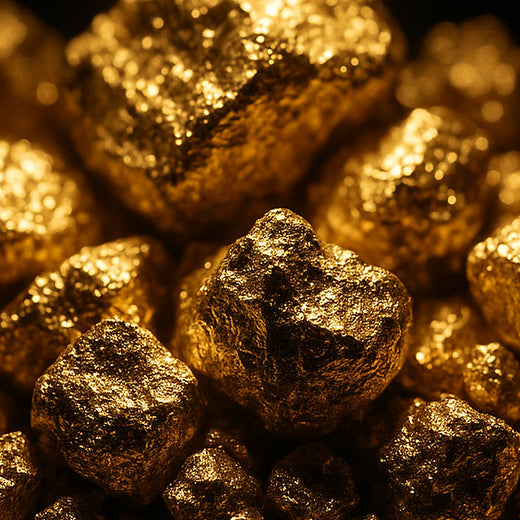
- Olfactive family
- Amber & musk · 134 entries of the glossary in this family Subfamily: Amber notes · 42 entries in this subfamily Cluster: Warm amber notes · 35 entries in this cluster
- Material
- Fantasy/Concept Chemical element (soft yellow metal)
- Pyramid
- Base Note
- Strength
- N/A — no measured strength for a fantasy accord Not on the graded scale
- Also called
- Aurum
Gold · Facets
Entries of the glossary that carry each facet, of 3,979:
- floral 1,551
- sweet 1,990
- amber 141
- warm 1,109
- creamy 404
- resinous 199
- rich 2
- vanilla 78
- woody 794
Editorial note We own no rights to this material, its name or its trademark. This entry is independent editorial journalism, published under freedom of expression.
Gold · Scent
The element gold has no odor. A 'gold' scent will generally have warm notes like vanilla, myrrh, tonka bean, benzoin, musk or sandalwood. Such scents feel rich and indulgent. Gold-inspired fragrances tend to be warm and resinous. One sweet and spicy reading places warm vanilla between amber and sandalwood, with hints of nutmeg, saffron and patchouli. A sweeter, almost gourmand reading builds on vanilla and amber, with a freshly baked warmth from nutmeg and coriander.
Evolution over time
Gold: scent over time.
- Immediately
N/A — no documented evolution for a fantasy accord
- After a few hours
N/A
- After a few days
N/A
Gold · In Perfumery
Gold-inspired fragrances are generally found from soft amber through to woody amber. They convey opulence through the use of frankincense, benzoin, myrrh and oud. One interpretation of the element is built on vanilla, sandalwood and an amber accord. Another gold-inspired scent sets vetiver, wood and patchouli in the base and fig and bergamot on top for a metallic sparkle. Saffron and agarwood give a metallic-inspired effect beside the central notes of amber and vanilla.
Pyramid
Gold: Base. Entries of the glossary stored at each place of the pyramid, of 4,000 (35 store no place):
- Top 718
- Top · Heart 501
- Heart 1,646
- Heart · Base 512
- Base 588
Role in the formula
Gold: roles in the formula. Entries of the glossary that share each role, of 4,000:
- N/A — no documented formula role 360
Gold · Terroir & Origins
- Producing countries
- China, Russia, Australia, Canada, United States, Ghana
No origin card: Canada, China, Ghana, Russian Federation, United States.
Gold Australian
Plantations de l'Ouest Australian — Australia
Facet scores, out of 100
- Woody 100 (also a facet of the entry)
- Musky 72
- Sweet 71 (also a facet of the entry)
- Fresh 41
- Powdery 40
- Green 29
Gold porte ici l'empreinte du terroir Australian. Le southern Mediterranean climate de Plantations de l'Ouest Australian révèle a material woody/ligneous et musky.
Le southern Mediterranean climate de l'Ouest Australian, avec ses hot, dry summers, favorise la concentration des essential oils.
- Harvest
- Récolte artisanale selon l'espèce
- Extraction
- Distillation à la vapeur du bois de cœur
- Climate
- Méditerranéen austral, étés chauds et secs
- Soil
- Sableux latéritique, acide
- Altitude
- 200 – 400 m
Gold · Extraction & Chemistry
Hard rock mining extracts gold encased in rock, rather than fragments in loose sediment, and produces most of the world's gold. Placer mining is a method of extracting gold from alluvial deposits such as sand, gravel, and sediment. The dominant method for refining gold is a cyanide extraction method, or gold cyanidation, introduced in the late 1800s. Cyanidation is used to extract gold from lower grade ores by converting gold into a water-soluble coordination complex. Ore grades as little as 0.5 parts per million (ppm) can be economical.
Available as
Gold: available as.
- synthetic accord
- fantasy note
Gold · Did You Know?
The top two floors of the Golden Pavilion in the temple of Kinkaku-ji in Kyoto, Japan, are entirely covered with 20 kg of 0.5 μm gold leaf. A centuries-old traditional artisan variety of green tea contains pieces of gold leaf, and 99% of this kind of tea is produced in Kanazawa, Japan.
Gold · In Depth
Aurum is the Latin word for gold and the source of its chemical symbol, Au. Gold is a precious metal that has been used for coinage, jewelry and other works of art throughout recorded history. It is a relatively rare element when compared to silver, though thirty times more common than platinum. Gold is a soft, yellow metal.
Origin and Production
Since the 1880s, South Africa has been the source of a large proportion of the world's gold supply. In 2007, China, with 276 tonnes, overtook South Africa as the world's largest gold producer. Global gold production is estimated at approximately 4,000-5,000 metric tons per year, with the majority coming from newly mined sources. Gold is also produced by mining in which it is not the principal product. The largest producing gold mine in the world, the Grasberg mine in Papua, Indonesia, is primarily a copper mine.
Chemical Properties
Gold is extremely inactive and is not attacked by acids, air or oxygen. It is insoluble in nitric acid alone, which dissolves silver and base metals. It dissolves in aqua regia and in alkaline solutions of cyanide. Gold also dissolves in mercury, forming amalgam alloys.
Uses
Gold leaf is gold hammered into thin sheets, usually around 0.1 μm thick, by a process known as goldbeating, for use in gilding. Most goldbeaters make 23 karat leaf. Gold leaf is also used in Buddhist art and various other Asian traditions to decorate statues and symbols.
Gold can be used in food and has the E number 175. Gold leaf is sometimes used to decorate food or drink, and it is flavorless. Metallic gold is generally considered inert to all body chemistry, and it has no taste and provides no nutrition. The isotope gold-198 is used in nuclear medicine, in some cancer treatments and for treating other diseases.
Gold as a Color
Gold, also called golden, is a color tone resembling the chemical element gold. In traditional usage the term is more often applied to metallic gold, whose shine a simple solid color cannot reproduce.
The Amber Family
The amber family is a large class of sweet, slightly animalic scents of ambergris or labdanum, often combined with vanilla, tonka bean, flowers and woods.
Explore all seven extraits in the Discovery Set.
Gold · History
Gold was discovered in the Middle East before 6000 BCE. The history of gold mining dates to at least 4700 BC. Five thousand years ago, Egyptian artisans recognized the extraordinary durability and malleability of gold and became the first goldbeaters and gilders.
Decorative use of gold flake goes back to medieval Europe as a decoration in food and drinks among nobility. In continental Europe, liquors with tiny floating pieces of gold leaf have been known since the late 16th century.
The discovery of gold in the Witwatersrand led to the Second Boer War and ultimately the founding of South Africa. The world gold standard was abandoned for a fiat currency system after the Nixon shock measures of 1971.
Gold · Technical Sheet
Molecular weight
196.96657 g/mol Heavier than 31 of the 271 other entries at the same place of the pyramid that store a weight
2,572 entries store a molecular weight. By place in the pyramid: Top 547, Top · Heart 411, Heart 888, Heart · Base 454, Base 272.
Identity
- Botanical
- N/A (chemical element Au, atomic number 79)
- Type
- Accord
- Category
- Accords and curiosities
Classification
- Chemical class
- Precious metal
Chemical data
- Formula
- Au
- CAS
- 7440-57-5
Physical properties
- Boiling point
- 2700 °C
- Melting point
- 1064.76 °C
- Flash point
- 32.00 °F. TCC ( 0.00 °C. ) (est)
Performance and rules
- IFRA status
- No IFRA Standard for the material itself (51st Amendment)
Gold · See Also
Entries related to Gold, by their place in the pyramid. « shared » marks a scent word Gold has too.
Top notes


Heart notes

Ambertonic™
amber (shared) · warm (shared) · musky Amber & musk / Heart · Base / Same cluster / Synthetic
Black Sesame
gourmand · nutty · roasted Gourmand / Natural & Synthetic


Base notes

Amberever
amber (shared) · warm (shared) · woody (shared) Amber & musk / Same cluster / Accord
Honey
gourmand · animalic · sweet (shared) Gourmand / Natural & Synthetic
Vanilla
gourmand · balsamic · warm (shared) Gourmand / Natural & Synthetic
Chocolate
gourmand · bitter · warm (shared) Gourmand / Natural
Lipstick
creamy (shared) · warm (shared) · floral (shared) Gourmand / Fantasy/Concept


Gold · Sources
- PubChem Gold
- IFRA Standards, 51st Amendment
- Wikipedia Gold
- Wikipedia Gold mining
- Wikipedia Gold leaf
- Wikipedia Gold (color)
- Wikipedia Aurum (disambiguation)
- Wikipedia Perfume
Cite as PREMIEREPEAU Glossary, “Gold”, https://premierepeau.com/pages/glossary-terms/gold Updated 2026-11-19
