


Indene
Keywords: animal like · terpenic · balsamic
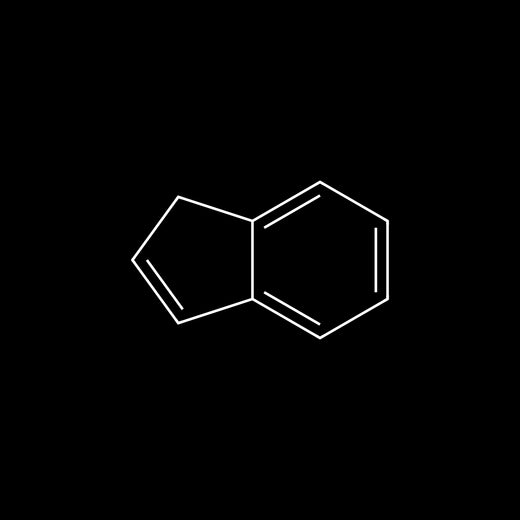
Indene is a colourless liquid, an ortho-fused bicyclic arene, with an animal-like, terpenic and balsamic odour.
- Olfactive family
- Resinous · 89 entries of the glossary in this family Subfamily: Sweet balsams · 56 entries in this subfamily Cluster: Classic resins · 66 entries in this cluster
- Material
- Natural & Synthetic
- Pyramid
- Heart-to-Base
- Also called
- 1H-Indene, Inden, Indene 10 |Ig/mL in Methanol, Indene [mi]
Indene · Facets
Entries of the glossary that carry each facet, of 3,979:
- animal like 4
- terpenic 29
- balsamic 343
Indene · Scent
Indene smells animal-like, terpenic and balsamic.
Indene · In Perfumery
Indene is a fragrance ingredient with an animal-like, terpenic and balsamic character.
Pyramid
Indene: Heart · Base. Entries of the glossary stored at each place of the pyramid, of 4,000 (35 store no place):
- Top 718
- Top · Heart 501
- Heart 1,646
- Heart · Base 512
- Base 588
Indene · Extraction & Chemistry
Indene is derived from coal tar. It can be made from acetylene over activated charcoal at 625 °C, or from tetrahydronaphthalene passed over a silica-alumina catalyst at 670 °C.
- Appearance
- Colourless liquid
Indene · Did You Know?
It is used to prepare coumarone-indene resins.
Indene · In Depth
Identity
Indene is an ortho-fused bicyclic arene made of a benzene ring fused with a cyclopentene ring. Its CAS number is 95-13-6, its molecular formula is C₉H₈ and its molecular weight is 116.16. Its IUPAC name is 1H-indene.
Odour
Indene has an animal-like, terpenic and balsamic odour.
Occurrence in nature
Indene occurs in Camellia sinensis, Terminalia chebula, Tuber borchii and Vaccinium macrocarpon.
Production
Indene is derived from coal tar. It can be made from acetylene over activated charcoal at 625 °C, or from tetrahydronaphthalene passed over a silica-alumina catalyst at 670 °C.
Use in perfumery
It is used as a fragrance ingredient, and its function in cosmetics is perfuming.
Properties
It boils at 182 °C at 760 mmHg and melts at -1.8 °C. Its density is 0.997 grams per cubic centimetre. It is insoluble in water and miscible with most organic solvents. It is soluble in ethanol and miscible with diethyl ether, naphtha, pyridine, carbon tetrachloride, chloroform and carbon disulfide.
Safety and IFRA
No IFRA Standard covers this material itself, as of the 51st Amendment. Its INCI name is INDENE and its EC number is 202-393-6. It is registered under REACH. Hazard statements for it include H226 (flammable liquid and vapour), H335 (may cause respiratory irritation) and H370 (causes damage to organs).
Indene · Technical Sheet
Molecular weight
116.16 g/mol Heavier than 4 of the 453 other entries at the same place of the pyramid that store a weight
2,572 entries store a molecular weight. By place in the pyramid: Top 547, Top · Heart 411, Heart 888, Heart · Base 454, Base 272.
Identity
- Type
- Ingredient
- Category
- Aroma chemicals
Classification
- Chemical class
- Hydrocarbon
Chemical data
- Formula
- C9H8
- CAS
- 95-13-6
- PubChem CID
- 7219, compound record on PubChem
- InChIKey
- YBYIRNPNPLQARY-UHFFFAOYSA-N
Physical properties
- Boiling point
- 182 °C @760
- Melting point
- -1.5 °C
- Flash point
- 173 °F
Performance and rules
- Available as
- synthetic
- IFRA status
- No IFRA Standard for the material itself (51st Amendment)
Indene · See Also
Entries related to Indene, by their place in the pyramid.
Top notes

Hivernal®
aldehydic · green · muguet Florals / Synthetic / 202 g/mol

Heart notes

Hivernal Neo
fresh · mineral Florals / Heart · Base / Synthetic / 202 g/mol
Lilyflore
synthetic · complex · particular Florals / Synthetic / 176.25 g/mol


Indene · Sources
- PubChem Indene
- ChEBI Indene: chemical classification record
- Wikidata (LOTUS natural products data) Indene: organisms it is reported in, with the papers
- European Commission, CosIng Indene: cosmetic ingredient record
- IFRA Standards, 51st Amendment
- European Chemicals Agency Indene: substance record
Cite as PREMIEREPEAU Glossary, “Indene”, https://premierepeau.com/pages/glossary-terms/indene Updated 2026-11-18
