


Isodecylaldehyde
Keywords: citrus · green · milky
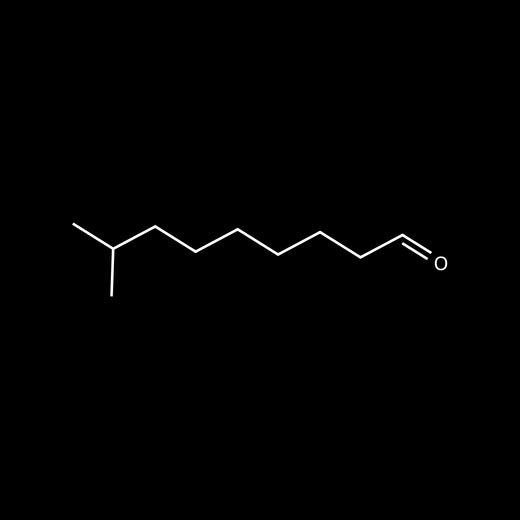
Isodecylaldehyde is the aldehyde 8-methylnonanal. It is a colourless liquid with a sweet, powerful odour of fruit with green notes.
- Olfactive family
- Florals · 783 entries of the glossary in this family Subfamily: Classic florals · 312 entries in this subfamily Cluster: Rose-like florals · 146 entries in this cluster
- Material
- Natural & Synthetic
- Pyramid
- Heart Note
Isodecylaldehyde · Facets
Entries of the glossary that carry each facet, of 3,979:
- citrus 488
- green 1,442
- milky 46
- sweet 1,987
- waxy 212
- floral 1,547
Isodecylaldehyde · Scent
Its odour is citrus, green and waxy with a milky, sweet floral side.
Isodecylaldehyde · In Perfumery
Its character is sweet fruit with green and citrus facets, and a waxy, milky floral side.
Pyramid
Isodecylaldehyde: Heart. Entries of the glossary stored at each place of the pyramid, of 4,000 (35 store no place):
- Top 718
- Top · Heart 496
- Heart 1,644
- Heart · Base 513
- Base 594
Isodecylaldehyde · Extraction & Chemistry
It is made industrially by passing propylene trimer vapours (nonene) over a cobalt catalyst in the presence of carbon monoxide and hydrogen. The DL-form is prepared by hydrogenation of citral in ethanol under pressure, with palladium and strontium carbonate or calcium carbonate. It also serves as an intermediate for pharmaceuticals, dyes, resins and isodecanol.
- Appearance
- Colourless, transparent liquid
Isodecylaldehyde · In Depth
Identity
Isodecylaldehyde is 8-methylnonanal, with CAS number 1321-89-7, the formula C₁₀H₂₀O and a molecular weight of 156.26.
Odour
It smells of citrus, green and waxy notes with a milky, sweet floral lift. Its odour is powerful, with a sweet character of fruit. Rose and woody are also among its odour words.
Occurrence in nature
It occurs in Zanthoxylum schinifolium.
Production
It is made industrially by passing propylene trimer vapours (nonene) over a cobalt catalyst in the presence of carbon monoxide and hydrogen. The DL-form is prepared by hydrogenation of citral in ethanol under pressure, with palladium and strontium carbonate or calcium carbonate. It also serves as an intermediate for pharmaceuticals, dyes, resins and isodecanol.
Use in flavours
It is used as a flavouring agent in food and beverages, with a somewhat green taste. Reported use levels are 0.44 ppm in non-alcoholic beverages, 3.2 ppm in ice cream and ices, 1.9 ppm in candy and 1.9 ppm in baked goods. The Joint FAO/WHO Expert Committee on Food Additives found no safety concern at current levels of intake when it is used as a flavouring agent.
Properties
It boils at 196 to 197 °C, and its density is 0.8227 to 0.8231 at 20 °C. Its refractive index is 1.4256 to 1.4260, and its vapour pressure is 0.29 mmHg. It floats on water and is insoluble in it, but it dissolves in alcohol.
Safety and IFRA
No IFRA Standard covers this material itself, as of the 51st Amendment. Its EC number is 215-328-1.
Isodecylaldehyde · Technical Sheet
Molecular weight
156.26 g/mol Heavier than 206 of the 885 other entries at the same place of the pyramid that store a weight; 18 weigh the same
2,572 entries store a molecular weight. By place in the pyramid: Top 547, Top · Heart 406, Heart 886, Heart · Base 455, Base 278.
Identity
- Type
- Ingredient
- Category
- Aroma chemicals
Classification
- Chemical class
- Aldehyde
Chemical data
- Formula
- C10H20O
- CAS
- 1321-89-7
- PubChem CID
- 14862, compound record on PubChem
- InChIKey
- WDMOXLRWVGEXJV-UHFFFAOYSA-N
- Wikidata
- Q27275375, item on Wikidata
Physical properties
- Boiling point
- 197 °C at 760 mmHg
- Density
- 0.8290 /mixed isomers/
- Refractive index
- 1.4256 – 1.4260
- Vapour pressure
- 0.29 mmHg
Performance and rules
- Available as
- synthetic
- IFRA status
- No IFRA Standard for the material itself (51st Amendment)
Isodecylaldehyde · See Also
Entries related to Isodecylaldehyde, by their place in the pyramid. « shared » marks a scent word Isodecylaldehyde has too.
Top notes

3,7-Dimethyloctanal
citrus (shared) · green (shared) · lemon Citrus / 156.26 g/mol
Aldehyde C-10 (Decanal)
aldehydic · waxy (shared) · citrus (shared) Citrus / Synthetic / 156.27 g/mol


Isodecylaldehyde · Sources
- PubChem Isodecylaldehyde
- The Good Scents Company Information System Isodecylaldehyde: data sheet
- Pyrfume Arctander, Perfume and Flavor Chemicals: odour descriptions (Pyrfume archive)
- Pyrfume Good Scents odour data (Pyrfume archive)
- Pyrfume Leffingwell odour data (Pyrfume archive)
- Wikidata (LOTUS natural products data) Isodecylaldehyde: organisms it is reported in, with the papers
- IFRA Standards, 51st Amendment
- European Chemicals Agency Isodecylaldehyde: substance record
Cite as PREMIEREPEAU Glossary, “Isodecylaldehyde”, https://premierepeau.com/
