


Isovaleric Acid
Keywords: cheesy · fruity · sour
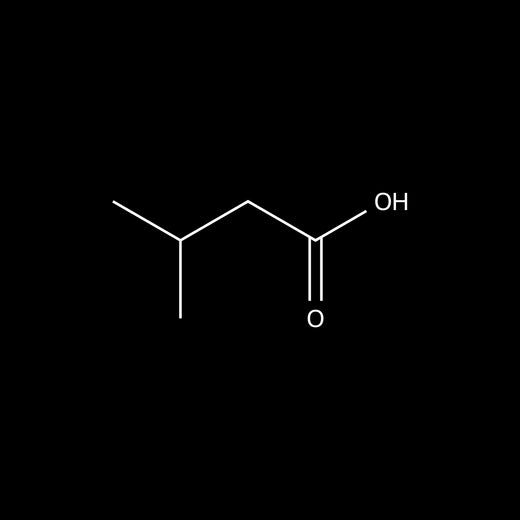
Isovaleric Acid is a branched-chain saturated fatty acid, 3-methylbutanoic acid, and a colourless liquid with a cheesy, sour odour.
- Olfactive family
- Gourmand · 494 entries of the glossary in this family Subfamily: Creamy gourmands · 93 entries in this subfamily Cluster: Classic gourmands · 182 entries in this cluster
- Material
- Natural & Synthetic
- Pyramid
- Top Note
- Strength
- High Step 4 of 5 · shared by 507 of 2,161 graded entries Graded entries at each step, from 1 to 5: 4, 117, 1,469, 507, 40. 24 more sit between two steps.
- Also called
- 3-Methylbutanoic acid, Isobutyl formic acid, 3-methyl-n-Butyric acid, 3-Methylbutyrate, 3-Methyl butyric acid, b-Methylbutyrate
Isovaleric Acid · Facets
Entries of the glossary that carry each facet, of 3,979:
- cheesy 80
- fruity 1,307
- sour 46
- acid 7
- herbal 755
- nutty 258
Isovaleric Acid · Scent
It smells cheesy, sour and fruity, with a herbal facet in extreme dilution.
Isovaleric Acid · In Perfumery
It is a fragrance ingredient whose odour is cheesy and sour, turning more agreeable and herbaceous in extreme dilution.
Pyramid
Isovaleric Acid: Top. Entries of the glossary stored at each place of the pyramid, of 4,000 (35 store no place):
- Top 718
- Top · Heart 501
- Heart 1,646
- Heart · Base 512
- Base 588
Isovaleric Acid · Extraction & Chemistry
It is made by the oxidation of isoamyl alcohol or of isovaleraldehyde. It can also be distilled from valerian together with other valeric acids.
- Appearance
- Colourless to pale yellow liquid
Isovaleric Acid · In Depth
Identity
Isovaleric Acid is also called 3-methylbutanoic acid, and its CAS number is 503-74-2. Its molecular formula is C₅H₁₀O₂ and its molecular weight is 102.13 g/mol. It is a short-chain, branched-chain saturated fatty acid and a mammalian and plant metabolite. It is a colourless liquid.
Odour
It smells cheesy and sour, with fruity, herbal and nutty facets. The odour is disagreeable and rancid, like cheese. In dilution in propylene glycol it smells sour, sweaty and like stinky feet and cheese, with a tropical touch. It is very diffusive and acrid, and in extreme dilution the odour becomes more agreeable and herbaceous. Its odour strength is high.
Occurrence in nature
It occurs in Achillea abrotanoides, Annona reticulata, Apium graveolens and several Artemisia species, among them Artemisia afra and Artemisia judaica.
Production
It is made by the oxidation of isoamyl alcohol or of isovaleraldehyde. It can also be distilled from valerian together with other valeric acids.
Use in perfumery
It is used as a fragrance ingredient in perfumes. In cosmetics its function is perfuming.
Use in flavours
It is a flavour ingredient in non-alcoholic beverages and foods. Its flavour profile is cheese and pungent, and it tastes acid. No safety concern arises at current levels of intake when it is used as a flavouring agent.
Properties
It boils at 176.5 °C at 760 mmHg and melts at -29.3 °C. Its flash point is 70 °C and its density is 0.931 at 20 °C. Its vapour pressure is 0.44 mmHg. It dissolves in water to 40700 mg/L at 20 °C and is soluble in alcohol, ether and chloroform. It is corrosive to metals and to tissue.
Safety and IFRA
No IFRA Standard covers this material itself, as of the 51st Amendment. Its INCI name is ISOVALERIC ACID. Its EC number is 207-975-3, and it is registered under REACH. It causes severe skin burns and eye damage (H314).
Isovaleric Acid · Technical Sheet
Molecular weight
102.13 g/mol Heavier than 202 of the 546 other entries at the same place of the pyramid that store a weight; 12 weigh the same
2,572 entries store a molecular weight. By place in the pyramid: Top 547, Top · Heart 411, Heart 888, Heart · Base 454, Base 272.
Identity
- Type
- Ingredient
- Category
- Aroma chemicals
Classification
- Chemical class
- Carboxylic acid
Chemical data
- Formula
- C5H10O2
- CAS
- 503-74-2
- PubChem CID
- 10430, compound record on PubChem
- InChIKey
- GWYFCOCPABKNJV-UHFFFAOYSA-N
Physical properties
- Boiling point
- 175 to 177 °C at 760 mmHg
- Melting point
- -29 °C at 760 mmHg
- Flash point
- 70.56 °C (159 °F)
- Density
- 0.923-0.928
- Vapour pressure
- 0.554 mmHg at 25 °C (estimated)
- Log P
- 1.16
- Tenacity
- 400 hour(s) at 100 %
Performance and rules
- Odour threshold
- 78 ppt in air · Abraham et al. 2012
- Available as
- synthetic
- IFRA status
- No IFRA Standard for the material itself (51st Amendment)
Isovaleric Acid · See Also
Entries related to Isovaleric Acid, by their place in the pyramid. « shared » marks a scent word Isovaleric Acid has too.
Top notes

Isocaproic acid
pungent · sour (shared) · cheesy (shared) Gourmand / Same cluster / 116.16 g/mol
2-Methylvaleric acid
sour (shared) · cheesy (shared) · acid (shared) Gourmand / Same cluster / 116.16 g/mol


Heart notes

2-Methylbutyl isovalerate
fruity (shared) · apple · earthy Fruity / 172.26 g/mol
Phenylethyl isovalerate
fruity (shared) · rose · balsamic Florals / Heart · Base / 206.28 g/mol
Octyl isovalerate
honey · rose · fatty Florals / Heart · Base / 214.34 g/mol


Isovaleric Acid · Sources
- PubChem Isovaleric Acid
- ChEBI Isovaleric Acid: chemical classification record
- Pyrfume Arctander, Perfume and Flavor Chemicals: odour descriptions (Pyrfume archive)
- Pyrfume Good Scents odour data (Pyrfume archive)
- Pyrfume Leffingwell odour data (Pyrfume archive)
- The Good Scents Company Information System Isovaleric Acid: data sheet
- Wikidata (LOTUS natural products data) Isovaleric Acid: organisms it is reported in, with the papers
- European Commission, CosIng Isovaleric Acid: cosmetic ingredient record
- IFRA Standards, 51st Amendment
- European Chemicals Agency Isovaleric Acid: substance record
Cite as PREMIEREPEAU Glossary, “Isovaleric Acid”, https://premierepeau.com/pages/glossary-terms/isovaleric-acid Updated 2026-11-18
