


Lily-of-the-Valley
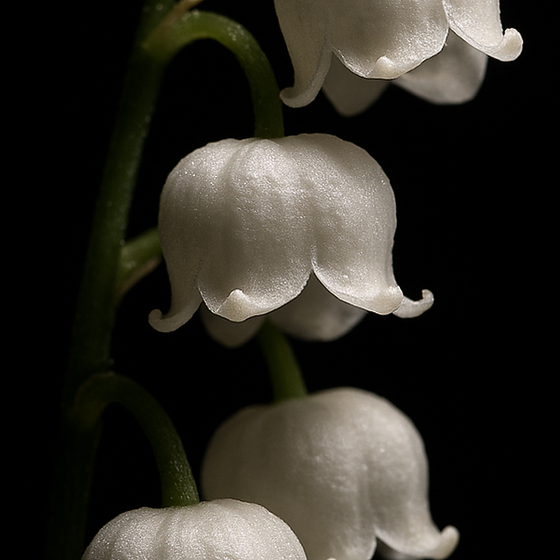
The smell of a shaded garden path in early May — cool, waxy, green, faintly metallic, gone before you can place it. No flower in perfumery is more famous or more absent: the scent exists only as a synthetic reconstruction.
Scent
The Full Story
Did You Know?
Every part of Convallaria majalis — leaves, stems, flowers, berries — contains at least 38 identified cardiac glycosides, including convallatoxin, a compound potent enough that as few as two leaves can constitute a lethal dose for a small child or pet. The flower that perfumery celebrates for its innocence is, botanically, one of Europe's most dangerous garden plants.
Extraction & Chemistry
Extraction method
No viable natural extraction exists. Convallaria majalis is a mute flower — steam distillation, solvent extraction, and supercritical CO₂ all fail to produce a commercially usable aromatic material. The flower's volatiles (benzyl alcohol, citronellol, geraniol, farnesol, dihydrofarnesol) are biosynthesised and released in real time; they are not stored in plant tissue, which is why post-harvest extraction yields are negligible. A lily-of-the-valley absolute (CAS 68916-82-5) technically exists but is produced in quantities so small that it has no commercial relevance in perfumery. All muguet notes in fine fragrance are synthetic accords built from molecules such as hydroxycitronellal (CAS 107-75-5), Bourgeonal (CAS 18127-01-0), and Lilyflore (CAS 285977-85-7).
- Formula
- Synthetic accord; key molecules: hydroxycitronellal C₁₀H₂₀O₂ (MW 172.27), Bourgeonal C₁₃H₁₈O (MW 190.28), Lilyflore C₁₂H₁₆O (MW 176.26)
- CAS
- 68916-82-5
- Botanical
- Convallaria majalis
- Appearance
- Colorless to pale yellow liquid
- Odour strength
- Medium
- Synonyms
- MUGUET MAY LILY CONVALLARIA
Hydroxycitronellal (CAS 107-75-5) is IFRA-restricted under Standard 043 (51st Amendment, 2023). Maximum use levels vary by product category. Lilial (CAS 80-54-6) is banned in the EU since March 2022 (CMR 1B, Regulation 2021/1902). Lyral / HICC (CAS 31906-04-4) is banned in the EU since August 2021 (Regulation 2017/1410). Lilyflore (CAS 285977-85-7) and Bourgeonal (CAS 18127-01-0) have no current IFRA restrictions.
- Note
- Convallaria majalis; natural absolute extremely rare and expensive; most lily-of-the-valley in perfumery is reconstructed synthetically
In Perfumery
Muguet is always a synthetic reconstruction — no commercially viable natural extract exists. Lilial and Lyral, formerly central to the accord, are now banned in the EU. Muguet functions as a heart note: radiant, diffusive, and structurally transparent. It is the backbone of white-floral soliflores and a brightening agent in chypres and fougères, where it lifts the composition without adding mass. The note bridges green-fresh openings and warm bases with an aqueous, soapy clarity that reads as clean rather than sweet. No PREMIEREPEAU fragrance currently features a dominant muguet accord, though traces of hydroxycitronellal appear in many modern fine fragrance formulations as a background modifier.