


Lishan Tea
Keywords: fresh · green · floral
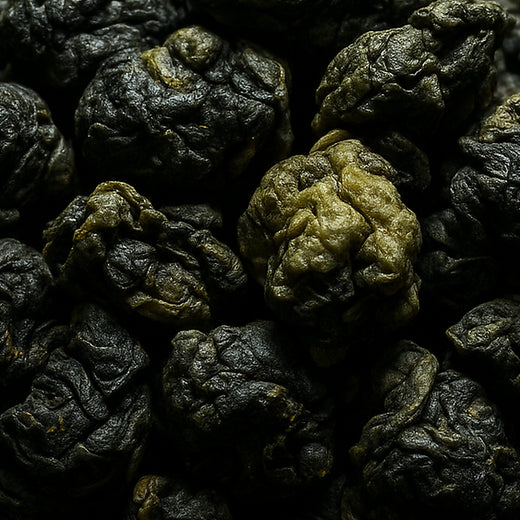
Lishan Tea: Lishan is a high-mountain oolong tea, one of several varieties grown in the mountains of central Taiwan. High mountain tea has floral and creamy notes.
- Olfactive family
- Green · 370 entries of the glossary in this family Subfamily: Green notes · 218 entries in this subfamily Cluster: Green leafy notes · 420 entries in this cluster
- Material
- Fantasy/Concept Tea leaves
- Pyramid
- Heart · Volatility: Heart Note
- Strength
- N/A — no measured strength for a fantasy accord Not on the graded scale
- Also called
- Li Shan, Lishan oolong
Family, subfamily and cluster: PREMIEREPEAU house classification, version 2026‑11.
Lishan Tea · Facets
Entries of the glossary that carry each facet, of 3,979:
- floral 1,546
- green 1,442
- sweet 1,988
- fresh 1,387
- creamy 401
Editorial note We own no rights to this material, its name or its trademark. This entry is independent editorial journalism, published under freedom of expression.
Lishan Tea · Scent
High-mountain teas are light oolong varieties with sweet, milky flavors and floral aromas. High Mountain green teas are tender, green and sweet, and some production processes also reveal notes of chestnut.
Evolution over time
Lishan Tea: scent over time.
- After a few hours
N/A — no documented evolution for a fantasy accord
- After a few days
N/A
Lishan Tea · In Perfumery
Pyramid
Lishan Tea: Heart. Entries of the glossary stored at each place of the pyramid, of 4,006 (42 store no place):
- Top 718
- Top · Heart 497
- Heart 1,641
- Heart · Base 514
- Base 594
Role in the formula
Lishan Tea: roles in the formula. Entries of the glossary that share each role, of 4,006:
- N/A — no documented formula role 361
PREMIEREPEAU collection: Extrait de parfum
Lishan Tea · Terroir & Origins
- Producing countries
- Taiwan
Lishan Tea · Extraction & Chemistry
Oxidation is stopped by moderate heating, called kill-green, which deactivates the oxidative enzymes.
Available as
Lishan Tea: available as.
- synthetic accord
- fantasy note
- Appearance
- Very similar in appearance to Alishan teas
Lishan Tea · Did You Know?
Lishan was the costliest Taiwanese tea during the 2000s, sometimes commanding prices of over US$200 per 600 grams.
Lishan Tea · In Depth
What it is
Lishan is one of the most commonly named mountain regions that produce high mountain oolongs in Taiwan. High-mountain tea is grown at altitudes higher than 1,000 metres above sea level. Lishan oolong is grown near Lishan mountain in the north-central region of Taiwan. It is grown at altitudes above 2,200 meters. Oolong is one of the teas made from the leaves of Camellia sinensis.
Growing conditions
Many high quality teas are grown at high elevations, up to 2,200 m, because the plants grow more slowly and acquire more flavour. Gaoshan tea leaves are usually hand harvested, and they grow slowly due to the thin air at high altitudes. The yield of gaoshan tea is relatively low every year. The high humidity and natural precipitation in the high mountain ranges of Nantou and Chiayi Counties make the region a suitable environment for growing tea plants.
Production
Winter gaoshan is harvested during late October, and spring gaoshan is harvested during the middle of June. It takes about 36 to 40 hours to process a batch of gaoshan tea. High mountain tea undergoes a wide range of fermentation degrees, from 8% to 85%, without further roasting.
Chemistry
Linalool and geraniol are the characteristic volatiles of high mountain tea. The contents of linalool and geraniol in high mountain tea were higher than those in the other teas studied. Linalool and geraniol are reported as key aromatic compounds responsible for the unique odor of oolong tea.
Explore all seven extraits in the Discovery Set.
Related: Yunnan Red Tea · Gyokuro Tea
Lishan Tea · History
Tea cultivation in Taiwan began in the 18th century. Since then, many of the teas grown in Fujian province have also been grown in Taiwan.
Lishan Tea · Technical Sheet
Identity
- Botanical
- Camellia sinensis
- Taxonomy
- Ericales order › Theaceae family › Camellia genus · GBIF
- Botanical records
- Camellia sinensis: POWO, Camellia sinensis · IPNI, Camellia sinensis · GBIF, Camellia sinensis · Wikidata, Camellia sinensis · Wikipedia, Camellia sinensis · IUCN Data deficient (DD), Camellia sinensis
- IPNI
- Camellia sinensis (L.) Kuntze, Trudy Imp. S.-Peterburgsk. Bot. Sada 10: 195 (1887) — Carl Ernst Otto Kuntze (1843–1907) · ≡ Thea sinensis L. (1753)
- Type
- Accord
- Category
- Greens, herbs and fougeres
- Note
- High-mountain oolong tea from Lishan, Taiwan.
In Nature
- Native range
- China · Indian Subcontinent · Indo-China · POWO
- Introduced to
- 20 regions · Africa 6 · Tropical Asia 6 · Temperate Asia 5 · Southern America 3
- Flowering
- peak in October–November · north of the equator · iNaturalist
- Sample origins in GC-MS studies
- China (2 papers; one: Food Sci Biotechnol 2021, China) · Hainan (1 paper; one: Food Chem 2025, Hainan) · Sichuan (1 paper; one: Eur Food Res Technol 2019, Sichuan)
- Recorded altitude
- 50–1,500 m · median 700 m · 1,310 records with an altitude · GBIF
- Wild or cultivated
- 130 native · 148 introduced · 80 cultivated among 10,046 records (the rest carry no such mark) · GBIF
- Recorded in
- 85 of 512 squares of the world grid; a brighter dot holds more records · GBIF
- Also from this genus
- Camellia: Assam Tea · Duck Poo Oolong · Earl Grey Tea · Fermented Tea · Genmaicha · Green Tea Flower · Gyokuro Tea · Jin Xuan Tea Leaves · 13 more entries
In Print
- Timeline
- first described 1753 · earliest aroma paper in Europe PMC, 1985
- In English books
- most mentioned in the 2010s · Google Books Ngram
Chemical data
- Formula
- Key odorants: linalool (C₁₀H₁₈O), nerolidol (C₁₅H₂₆O), indole (C₈H₇N)
- Most reported compounds
- Gallocatechin Gallate (67 papers; one: Phytotherapy Research 1991, Gallocatechin Gallate) · Catechin (63 papers; one: Phytotherapy Research 1991, Catechin) · Epicatechin-3-Gallate (59 papers; one: Phytotherapy Research 1991, Epicatechin-3-Gallate) · (−)-Gallocatechin (58 papers; one: Phytotherapy Research 1991, (−)-Gallocatechin) · Caffeine (53 papers; one: Phytotherapy Research 1991, Caffeine) · LOTUS
- INCI names (CosIng)
- CAMELLIA SINENSIS LEAF OIL (ANTIOXIDANT, SKIN CONDITIONING)CAMELLIA SINENSIS SEED OIL (HUMECTANT, SKIN CONDITIONING)CAMELLIA SINENSIS CALLUS CULTURE EXTRACT (SKIN CONDITIONING, PERFUMING)CAMELLIA SINENSIS CALLUS EXTRACT (SKIN PROTECTING)CAMELLIA SINENSIS EXTRACT (ANTIOXIDANT, BLEACHING, SKIN CONDITIONING)CAMELLIA SINENSIS FLOWER EXTRACT (SKIN CONDITIONING, PERFUMING)CAMELLIA SINENSIS LEAF BUD EXTRACT (HUMECTANT)CAMELLIA SINENSIS LEAF CELL EXTRACT (ANTIOXIDANT, SKIN PROTECTING)
- Compound classes reported
- Monoterpenoids 2 % · Flavonoids 26 % · Triterpenoids 24 % · of 387 compounds reported, 34 % of them esters · LOTUS
Labelling
- EU allergens reported
- Limonene · Linalool · Geraniol · Benzyl Alcohol · Benzyl Benzoate · Linalyl Acetate · Pinene · Terpineol · Alpha-Terpinene · Terpinolene · Beta-Caryophyllene · Carvone · Menthol · Benzaldehyde · Methyl Salicylate · Rose Ketones
Performance and rules
- IFRA status
- No IFRA Standard for the material itself (51st Amendment)
Lishan Tea · See Also
Entries related to Lishan Tea, by their place in the pyramid. “shared” marks a scent word Lishan Tea has too.
Top notes

Shishito Pepper
green (shared) · spicy · vegetal Aromatic / Same cluster / Natural & Synthetic
Black Pepper
spicy · warm · aromatic Aromatic / Natural


Heart notes

Jin Xuan Tea Leaves
creamy (shared) · green (shared) · fresh (shared) Aromatic / Same cluster / Natural
Ti Leaf (Cordyline)
green (shared) · fresh (shared) · tropical Aromatic / Same cluster / Natural
Tieguanyin Tea
floral (shared) · green (shared) · fresh (shared) Aromatic / Same cluster / Natural
Tea
green (shared) · aromatic · dry Aromatic / Heart · Base / Natural
Duck Poo Oolong
floral (shared) · creamy (shared) · tea Florals / Natural


Base notes

Tobacco
warm · sweet (shared) · leathery Aromatic / Natural

Lishan Tea · Sources
Read the science
- Foods (2023) Aroma Identification and Classification in 18 Kinds of Teas (Camellia sinensis) by Sensory Evaluation, HS-SPME-GC-IMS/GC × GC-MS, and Chemometrics
- Food Chem (2025) Study on dynamic changes in characteristic volatile compounds uncovers aroma development of Hainan Dayezhong (Camellia sinensis var. assamica) black tea
- Food Chem (2025) Insight into volatile metabolites and key odorants in black teas processed from Jianghua Kucha tea germplasm (Camellia sinensis var. assamica cv. Jianghua)
- International Plant Names Index (IPNI) Camellia sinensis (L.) Kuntze
- Current Research in Food Science (2023) Comparative study of the volatile fingerprints of roasted and unroasted oolong tea by sensory profiling and HS-SPME-GC-MS
- IFRA Standards, 51st Amendment
- Wikipedia High-mountain tea
- Wikipedia Oolong
- Wikipedia Camellia sinensis
- Wikipedia Taiwanese tea
- Wikipedia Tea processing
Cite as PREMIEREPEAU Glossary, “Lishan Tea”, https://premierepeau.com/

