


Malva
Keywords: flowering plant
Malva is a genus of herbaceous or woody, annual, biennial and perennial plants in the family Malvaceae. It is one of several closely related genera in the family to bear the common English name mallow.
- Olfactive family
- Florals · 779 entries of the glossary in this family Subfamily: Green florals · 143 entries in this subfamily Cluster: Green-fresh florals · 135 entries in this cluster
- Material
- Natural Plant
- Pyramid
- Heart · Volatility: Heart Note
- Strength
- Medium Step 3 of 5 · shared by 1,473 of 2,156 graded entries Graded entries at each step, from 1 to 5: 4, 119, 1,473, 498, 39. 23 more sit between two steps.
- Producing countries
- Europe, North Africa, Asia
- Also called
- common mallow, high mallow, tall mallow, cheeses
Family, subfamily and cluster: PREMIEREPEAU house classification, version 2026‑11.
Malva · Facets
Entries of the glossary that carry each facet, of 3,979:
- floral 1,546
- green 1,442
- sweet 1,988
- warm 1,108
- fresh 1,387
Malva · Scent
When chewed, the flowers of Malva sylvestris have practically no smell.
Evolution over time
Malva: scent over time.
- After a few hours
Wild flower, soft and floral.
Scent words: floral - After a few days
Light honey over a soft vegetal background.
Scent words: honeyed
Malva · In Perfumery
Pyramid
Malva: Heart. Entries of the glossary stored at each place of the pyramid, of 4,006 (42 store no place):
- Top 718
- Top · Heart 497
- Heart 1,641
- Heart · Base 514
- Base 594
Role in the formula
Malva: roles in the formula. Entries of the glossary that share each role, of 4,006:
- Diffusion enhancer 248
- Modifier 1,167
- Signature note 897
- Lifting agent 567
- Blender 1,040
- Freshness 720
PREMIEREPEAU collection: Extrait de parfum
Malva · Extraction & Chemistry
The cosmetic extract of Malva sylvestris is an organic plant extract.
Available as
Malva: available as.
- essential oil
- absolute
- plant extract
- Appearance
- Colorless to pale yellow liquid
Malva · Did You Know?
Malva · In Depth
Malva is widespread throughout the temperate, subtropical and tropical regions of Africa, Asia and Europe. The flowers are from 0.5 to 5 cm in diameter, with five pink, lilac, purple or white petals. Malva sylvestris is the type species of the genus. The English name mallow comes from Latin malva.
Explore all seven extraits in the Discovery Set.
The plant
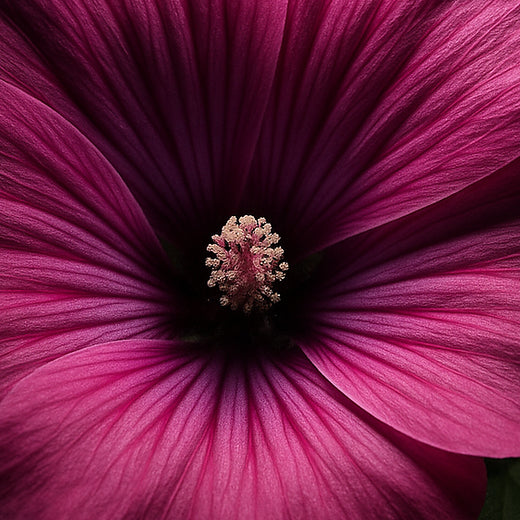
Common mallow is a herbaceous perennial with an erect or decumbent branched stem up to 1.5 metres tall. Its flowers are reddish-purple with dark stripes and occur in axillary clusters of 2 to 4 along the main stem. There are 5 petals, each up to 2 cm long. When chewed, the flowers taste similar to mucilage. The seeds are brown to brownish green when ripe, about 2.5 mm long and wide.
Chemistry
Malva sylvestris contains malvin and malonylmalvin. It also contains the naphthoquinone malvone A, which is also a phytoalexin. Many members of the Malvaceae, including Malva sylvestris, contain mucilage, especially in the fruit. Reported compounds of the plant include tannins, polysaccharides, flavonols, essential oil, coumarins and terpenoids.
Traditional and food uses
The seeds are used internally in a decoction or herbal tea as a demulcent, and the leaves may be used in poultices as an emollient for external applications. Leaves of various species of Malva have been used in traditional Austrian medicine internally as tea or externally as baths for treatment of disorders of the skin, gastrointestinal tract and respiratory tract.
The leaves of Malva species can also be chewed to soothe coughs or sore throats. The leaves and flowers of Malva sylvestris have been used for centuries in traditional medicine to treat ailments such as cough, cold, diarrhoea and constipation.
Malva sylvestris has traditionally been used around the world as a wild food plant. In Morocco, Tunisia and Palestine, the leaves are steamed with garlic and tomatoes and eaten as an appetizer or salad. Many species of Malva are edible as leaf vegetables and commonly foraged. The species has long been used as a natural yellow dye. A tincture of the flowers can make a sensitive test for alkalis.
Cosmetic extract
An organic plant extract of Malva sylvestris is rich in mucilages, polysaccharides and tannins.
Family context
Malvaceae is a family of flowering plants estimated to contain 244 genera with 4225 known species. Hibiscus, with 434 species, is among the genera with the largest numbers of species. Most Malvaceae species are herbaceous plants or shrubs, but some are trees or lianas. The marsh mallow, Althaea officinalis, is a species of flowering plant used in herbalism and as an ornamental plant.
Cultivation
Malva is cultivated by sowing the seeds directly outdoors in early spring. Very easily grown, short-lived perennials are often grown as ornamental plants. Some Malva species are invasive weeds, particularly in the Americas.
Malva · History
The use of Malva sylvestris in traditional medicine dates back to around 3000 BC. Archaeological studies in Syria reveal some fossils of Malva sylvestris seeds in dental stones. In 1859, the colour mauve was named after the French name for this plant. The flowers were spread on doorways and woven into garlands or chaplets for celebrating May Day.
Malva · Technical Sheet
Identity
- Botanical
- Malva sylvestris
- Taxonomy
- Malvales order › Malvaceae family › Malva genus · GBIF
- Botanical records
- Malva sylvestris: POWO, Malva sylvestris · IPNI, Malva sylvestris · GBIF, Malva sylvestris · Wikidata, Malva sylvestris · Wikipedia, Malva sylvestris
- IPNI
- Malva sylvestris L., Sp. Pl. 2: 689 (1753) — Carl Linnaeus (1707–1778)
- Type
- Ingredient
- Category
- Flowers
- Note
- N/A – limited commercial extraction
In Nature
- Growth form
- Herb · POWO
- Native range
- Northern Europe · Middle Europe · Southwestern Europe · Southeastern Europe · Eastern Europe · Northern Africa · Macaronesia · Siberia · 5 more regions · POWO
- Introduced to
- 100 regions · Northern America 52 · Southern America 13 · Temperate Asia 9 · Australasia 9 · Tropical Asia 8 · Africa 6 · Europe 2 · Antarctic 1
- Flowering
- peak in May–August · north of the equator · iNaturalist
- Sample origins in GC-MS studies
- Türkiye (1 paper; one: J Sci Food Agric 2026, Türkiye) · Italy (1 paper; one: Industrial crops and products 2017, Italy)
- Recorded altitude
- 0–750 m · median 200 m · 25,964 records with an altitude · GBIF
- Wild or cultivated
- 8,259 native · 44,132 introduced · 209 cultivated among 354,970 records (the rest carry no such mark) · GBIF
- Recorded in
- 120 of 512 squares of the world grid; a brighter dot holds more records · GBIF
- Also from this botanical family
- Malvaceae: Althaea · Ambrette · Ambrette (Musk Mallow) · Cacao Blossom · Cacao Butter · Cacao Pod · 11 more entries
In Print
- Timeline
- first described 1753 · earliest aroma paper in Europe PMC, 2013
- In English books
- most mentioned in the 1870s · Google Books Ngram
Classification
- Chemical class
- Complex natural (essential oil)
Chemical data
- Formula
- Complex natural mixture (key constituents: malvin; malonylmalvin; malvone A)
- Most reported compounds
- Camphor (1 paper; one: Chem Nat Compd 1994, Camphor) · Carveol (1 paper; one: Chem Nat Compd 1994, Carveol) · Oleic Acid (1 paper; one: Chem Nat Compd 1994, Oleic Acid) · Stearic Acid (1 paper; one: Chem Nat Compd 1994, Stearic Acid) · LOTUS
- CAS
- 84082-57-5
- Odour-active compounds (GC-olfactometry)
- Beta-Damascenone · Phenylacetaldehyde · Ocimene (J Oleo Sci 2013)
- EC
- 282-003-9
- INCI names (CosIng)
- MALVA SYLVESTRIS CALLUS EXTRACT (ANTIMICROBIAL, ANTIOXIDANT, HAIR CONDITIONING, HUMECTANT, SKIN CONDITIONING, SKIN PROTECTING)MALVA SYLVESTRIS CALLUS LYSATE EXTRACT (ANTIOXIDANT, SKIN PROTECTING)MALVA SYLVESTRIS EXTRACT (ASTRINGENT, SKIN CONDITIONING – EMOLLIENT, SKIN CONDITIONING, SMOOTHING, SOOTHING)MALVA SYLVESTRIS FLOWER EXTRACT (SKIN CONDITIONING)MALVA SYLVESTRIS FLOWER/LEAF EXTRACT (SKIN CONDITIONING)MALVA SYLVESTRIS FLOWER/LEAF/STEM EXTRACT (SKIN CONDITIONING)MALVA SYLVESTRIS LEAF EXTRACT (SKIN CONDITIONING)MALVA SYLVESTRIS LEAF/STEM EXTRACT (SKIN CONDITIONING – MISCELLANEOUS)
- Compound classes reported
- Monoterpenoids 9 % · Sesquiterpenoids 3 % · Fatty acids and conjugates 56 % · Flavonoids 16 % · of 32 compounds reported · LOTUS
Labelling
- Forms in the EU cosmetic inventory
- Malva: MALVA SYLVESTRIS FLOWER · MALVA SYLVESTRIS FLOWER POWDER · MALVA SYLVESTRIS FLOWER/LEAF/STEM WATER · MALVA SYLVESTRIS LEAF POWDER · MALVA SYLVESTRIS LEAF WATER · MALVA SYLVESTRIS SEED
Performance and rules
- IFRA status
- No IFRA Standard for the material itself (51st Amendment)
Malva · See Also
Entries related to Malva, by their place in the pyramid. “shared” marks a scent word Malva has too.
Heart notes

Cardamom Flower
floral (shared) · spicy · sweet (shared) Florals / Same cluster / Fantasy/Concept
Sweet Pea
floral (shared) · sweet (shared) Florals / Same cluster / Fantasy/Concept
Mignonette
floral (shared) · sweet (shared) · green (shared) Florals / Same cluster / Natural
Jasmine
floral (shared) Florals / Natural
Rose
floral (shared) · honeyed · waxy Florals / Natural
Tuberose
floral (shared) · narcotic · creamy Florals / Natural
Violet
floral (shared) · violet Florals / Natural & Synthetic
Queen of the Night Flower
floral (shared) · rich · sweet (shared) Florals / Fantasy/Concept
Hollyhock
floral (shared) · powdery · sweet (shared) Florals / Fantasy/Concept


Base notes

Rose Mallow
floral (shared) · sweet (shared) · musk-like Florals / Fantasy/Concept
Baobab
woody · rich · nutty Woods / Natural
Other entries · Place in the pyramid not stored

Carnation
floral (shared) · spicy · clove Florals / Natural

Malva · Sources
- GBIF Malva sylvestris
- International Plant Names Index (IPNI) Malva sylvestris L.
- Naunyn-Schmiedeberg’s Archives of Pharmacology (2023) The phytochemical profiling, pharmacological activities, and safety of Malva sylvestris: a review
- Phytochemistry (2006) Malvone A, a phytoalexin found in Malva sylvestris (family Malvaceae)
- Chemistry of Natural Compounds (1975) Anthocyanins of Malva silvestris
- IFRA Standards, 51st Amendment
- Wikipedia Malva sylvestris
- Wikipedia Malva
- Wikipedia Malvaceae
- Wikipedia Althaea officinalis
- Wikipedia Marshmallow
Cite as PREMIEREPEAU Glossary, “Malva”, https://premierepeau.com/
