


Phenylpyruvic acid
Keywords: burnt · caramellic · chocolate
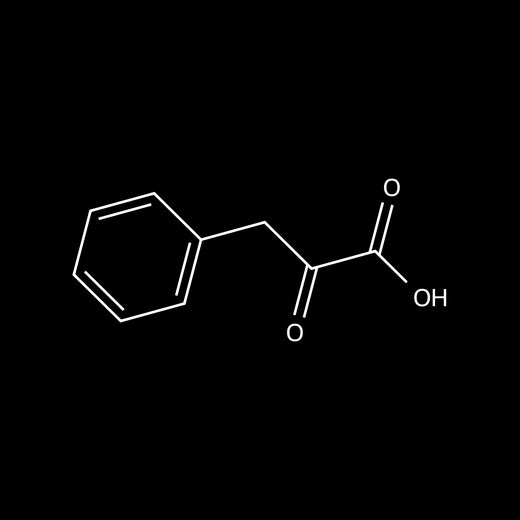
Phenylpyruvic acid is a 2-oxo monocarboxylic acid that is 3-phenylpropanoic acid substituted by an oxo group at position 2. It forms a white crystalline powder with a sweet honey odour.
- Olfactive family
- Gourmand · 472 entries of the glossary in this family Subfamily: Caramel notes · 81 entries in this subfamily Cluster: Caramel-like gourmands · 80 entries in this cluster
- Pyramid
- Heart · Volatility: Heart Note
- Strength
- Medium Step 3 of 5 · shared by 1,462 of 2,148 graded entries Graded entries at each step, from 1 to 5: 4, 118, 1,462, 500, 40. 24 more sit between two steps.
Phenylpyruvic acid · Facets
Entries of the glossary that carry each facet, of 3,979:
- burnt 75
- caramellic 95
- chocolate 39
- fennel 5
- herbaceous 49
- minty 104
Phenylpyruvic acid · Scent
The odour is sweet and honeyed, with burnt, caramellic and chocolate facets.
Phenylpyruvic acid · In Perfumery
It contributes a sweet honey note with burnt, caramellic and chocolate facets.
Pyramid
Phenylpyruvic acid: Heart. Entries of the glossary stored at each place of the pyramid, of 4,000 (36 store no place):
- Top 718
- Top · Heart 497
- Heart 1,641
- Heart · Base 514
- Base 594
Phenylpyruvic acid · In Depth
Identity
Phenylpyruvic acid has the systematic name 2-oxo-3-phenylpropanoic acid. Its CAS number is 156-06-9 and its molecular weight is 164.16 g/mol. It is an intermediate metabolite in the phenylalanine pathway. It is a chromogenic compound and an inhibitor of pyruvate carboxylase (EC 6.4.1.1).
Odour
The odour is sweet and honeyed, with burnt, caramellic and chocolate facets. At 100 % it smells sweet, acidic and honey-like, with almond, weedy, phenolic and green notes.
Its odour strength is medium, and smelling it in a solution of 10 % or less is recommended. Its substantivity is 146 hours at 1 % in propylene glycol.
Occurrence in nature
It occurs in Aloe africana, Arabidopsis thaliana, Caenorhabditis elegans, Escherichia coli, Homo sapiens and Hyoscyamus niger.
Properties
It is hygroscopic. It melts at 154 °C and boils at 299 to 300 °C. It is soluble in water, at 112 mg/mL, and soluble in ethanol. Its flash point is above 100 °C and its estimated logP is 0.142.
Use in flavours
It is used as a flavouring agent. At 80 ppm in water it tastes sweet, phenolic, grassy and honeyed, with a vegetable note. The Joint FAO/WHO Expert Committee on Food Additives found no safety concern at current levels of intake when it is used as a flavouring agent.
Safety and IFRA
No IFRA Standard covers this material itself, as of the 51st Amendment. Its EC number is 205-847-1. It causes skin irritation and serious eye irritation in 100% of hazard submissions, and may cause respiratory irritation in 66.7%.
Phenylpyruvic acid · Technical Sheet
Molecular weight
164.16 g/mol Heavier than 289 of the 860 other entries at the same place of the pyramid that store a weight.
2,515 entries store a molecular weight. By place in the pyramid: Top 537, Top · Heart 403, Heart 861, Heart · Base 452, Base 262.
Identity
- Type
- Ingredient
- Category
- Aroma chemicals
Classification
- Chemical class
- Carboxylic acid
Chemical data
- Formula
- C9H8O3
- CAS
- 156-06-9
- PubChem CID
- 997, compound record on PubChem
- InChIKey
- BTNMPGBKDVTSJY-UHFFFAOYSA-N
- Wikidata · Wikipedia
- Phenylpyruvic acid: Q425030, item on Wikidata · Wikipedia, English article
Physical properties
- Appearance
- White to pale yellow crystalline powder
- Boiling point
- 299 to 300 °C at 760 mmHg
- Melting point
- 154 °C
- Flash point
- > 100 °C (> 212 °F)
- Vapour pressure
- 0.001 mmHg at 25 °C (estimated)
- Log P
- 0.142 (estimated)
- Tenacity
- 146 hours at 1 %
Performance and rules
- IFRA status
- No IFRA Standard for the material itself (51st Amendment)
Phenylpyruvic acid · See Also
Entries related to Phenylpyruvic acid, by their place in the pyramid. “shared” marks a scent word Phenylpyruvic acid has too.
Top notes

Pyruvic Acid
sour · burnt (shared) · caramel Gourmand / Same cluster / 88.06 g/mol

Heart notes

Dimethyl phenethyl carbinyl isobutyrate
fruity · tropical · herbal Fruity / Heart · Base / Synthetic / 234.33 g/mol
1-Ethyl-1-methyl-3-phenylpropyl acetate
floral · green · hyacinth Florals / Heart · Base / Synthetic / 220.31 g/mol
2-(3-Phenylpropyl)
pyridine
earthy · green · herbal Earthy / Heart · Base / Synthetic / 197.27 g/mol


Phenylpyruvic acid · Sources
- PubChem Phenylpyruvic acid
- ChEBI Phenylpyruvic acid: chemical classification record
- The Good Scents Company Information System Phenylpyruvic acid: data sheet
- Pyrfume Good Scents odour data (Pyrfume archive)
- Pyrfume Leffingwell odour data (Pyrfume archive)
- Wikidata (LOTUS natural products data) Phenylpyruvic acid: organisms it is reported in, with the papers
- IFRA Standards, 51st Amendment
- European Chemicals Agency Phenylpyruvic acid: substance record
Cite as PREMIEREPEAU Glossary, “Phenylpyruvic acid”, https://premierepeau.com/
