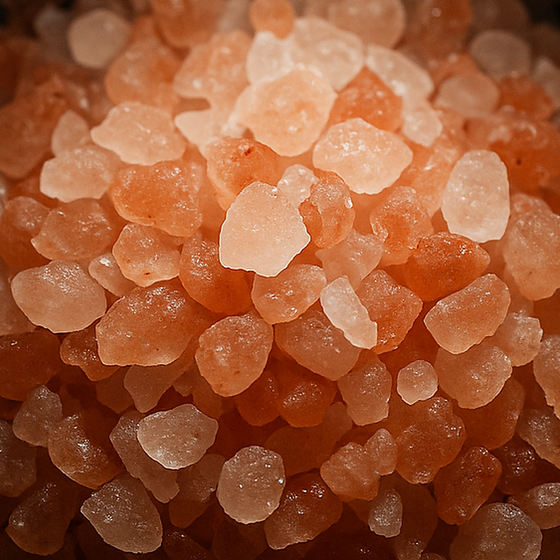
Pink Himalayan Salt

NaturalPOPULAR & WEIRDfresh · mineral

Seven perfumesOne of them is looking at you

HeartPyramid
—Strength
—Tenacity
1Origins
Specimen
Pink Himalayan Salt perfume ingredient
Heart
N/A — mineral
Definition

Pink Himalayan salt is rock salt (halite) mined in the Punjab region of Pakistan, often with a pinkish tint due to trace minerals. Salt is imperceptible to the nose.

FRESH MINERAL BRINY
Himalayan salt, Khewra salt
Type
Ingredient
Olfactive family
Aquatic
Subfamily
Fresh aquatics
Cluster
Marine-oceanic notes
Source
mineral deposit
Chemical class
ionic compound
Instruments
Pyramid
TTop
HHeart
BBase
Producing countries
Pakistan

Scent

Sodium chloride is odorless as solid rock and has a faint salty odor when powdered. The salt note of perfumery is mineralic, ozonic and slightly briny, and is often described as reminiscent of sea air, sun-warmed skin and wet stones. A sea salt accord is a clean and dry salt note with ambergris effects.

The Full Story

Origin

Pink Himalayan salt is rock salt that is mostly mined at the Khewra Salt Mine in Khewra, Jhelum District, Punjab, Pakistan. The Khewra Salt Mine is the world's second largest salt mine and produces more than 350,000 tons a year of about 99% pure halite. The salt comes from a thick layer of Ediacaran to early Cambrian evaporites of the Salt Range Formation. Rock salt comes from mines resulting from the presence of oceans hundreds of millions of years ago, and the pink salt of the Himalayas is one example.

Composition

Samples of Khewra salt were between 96% and 99% sodium chloride, with traces of calcium, iron, zinc, chromium, magnesium and sulfates, each below 1%. Some salt crystals from this region are off-white to transparent, while the trace minerals in some veins of salt give it a pink, reddish, or beet-red color. The pink salt of the Himalayas owes its color to the iron it contains. Himalayan salt does not have lower sodium than conventional table salt; the levels are similar. Sodium chloride is an ionic compound with the formula NaCl, a 1:1 ratio of sodium and chloride ions, and it occurs as the mineral halite.

Uses

Its main use is as a food additive in place of refined table salt; it is also used for cooking, food presentation, decorative lamps and spa treatments. Slabs of salt are used as serving dishes, baking stones and griddles. Salt from Khewra is also used to make decorative items such as lamps, vases, ashtrays and statues. There is no scientific basis for the health benefits claimed for it.

Explore all seven extraits in the Discovery Set.

—

Related: Aqual · Aquozone · Calone · Calone 1951 · Coral Limestone · Crustaceans · Diving Suit · Fish

Did You Know?

Pink Himalayan salt is up to 20 times more expensive than table salt or sea salt, due mainly to marketing costs. Himalayan salt is also used to make tequila shot glasses.

Extraction & Chemistry

Extraction method

Himalayan salt is mined from the Salt Range mountains. It is primarily exported in bulk, and processed in other countries for the consumer market.

Formula
Complex natural mixture (key constituents: sodium chloride NaCl; calcium; iron; zinc; chromium; magnesium; sulfates)
CAS
7647-14-5 (sodium chloride)
Botanical
N/A — mineral
Appearance
Off-white, transparent, pink, reddish or beet-red crystalline salt
Synonyms
Himalayan salt, Khewra salt
IFRA status
See note

No IFRA Standard for the material itself (51st Amendment)

Physical properties
Melting point
800.7 °C
Specific gravity
2.17
Refractive index
1.544

In Perfumery

Perfumers recreate the salty sensation, which belongs in principle to the realm of taste, with other materials. Seaweed extract is one of the materials chosen for this. Ambergris provides marine facets. Ambergris has dropped out of use because of its scarcity, its price and the vegan trend, and molecules such as Ambrox replace it. Ambroxide has a scent with woody, musky and slightly salty nuances, and it is used for creating ambergris notes and as a fixative. Calone is the most famous of the artificial molecules evoking the smell of sea spray. Calone is used mainly as a facet and rarely in overdose, because too much of it can create a nauseating metallic effect. A sea salt accord adds body and volume, lifts top notes and gives a salty drydown to a perfume.

Role in the formula
01modifier
02lifting agent
03blender
04volume builder
05freshness
Available as
crystals coarse salt slabs

See Also

6 notes