


Propylparaben
Keywords: woody · sweet · floral
Propylparaben is the propyl ester of 4-hydroxybenzoic acid, a paraben that forms colourless or white crystals. It is odourless or has a faint aromatic odour.
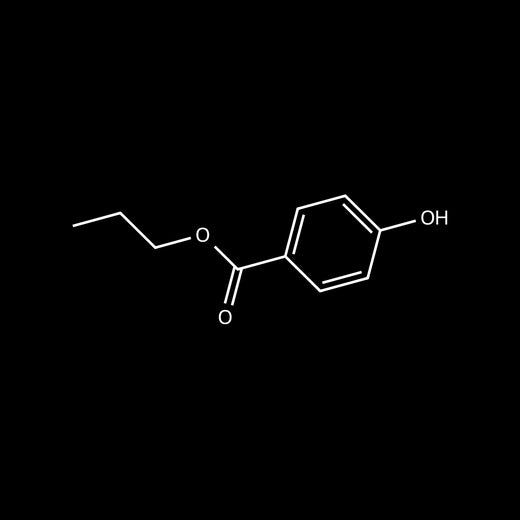
- Olfactive family
- Woods · 365 entries of the glossary in this family Subfamily: Classic woods · 131 entries in this subfamily Cluster: Earthy woods · 240 entries in this cluster
- Material
- Synthetic
- Pyramid
- Heart · Volatility: Heart Note
Propylparaben · Facets
Entries of the glossary that carry each facet, of 3,979:
- woody 791
- sweet 1,988
- floral 1,546
- herbaceous 49
- smoky 166
- burnt 75
Propylparaben · Scent
Arctander calls it virtually odourless; The Good Scents Company describes it as sweet, smoky and woody when neat.
Propylparaben · In Perfumery
It is used as a preservative in cosmetics and is virtually odourless.
Pyramid
Propylparaben: Heart. Entries of the glossary stored at each place of the pyramid, of 4,000 (35 store no place):
- Top 718
- Top · Heart 496
- Heart 1,644
- Heart · Base 513
- Base 594
Propylparaben · Extraction & Chemistry
It is produced by esterifying p-hydroxybenzoic acid with n-propanol in the presence of sulfuric acid, followed by distillation.
- Appearance
- Colourless or white crystals or powder
Propylparaben · In Depth
Identity
Propylparaben has the systematic name propyl 4-hydroxybenzoate, the CAS number 94-13-3, the formula C₁₀H₁₂O₃ and a molecular weight of 180.20 g/mol. It is a benzoate ester and a phenol of the paraben class.
Odour
Arctander calls propylparaben virtually odourless, and PubChem says it is odourless or has a faint odour. The Good Scents Company describes the undiluted material as sweet, smoky, burnt and woody, with a hawthorn note. It is tasteless and numbs the tongue.
Occurrence in nature
It has been found in Ailanthus altissima, Anastatica hierochuntica, Andrographis paniculata, Lessertia frutescens, Mangifera indica and Ophiocordyceps sinensis, and in Homo sapiens.
Production
It is produced by esterifying p-hydroxybenzoic acid with n-propanol in the presence of sulfuric acid, followed by distillation.
Use in perfumery
It is used in cosmetics, personal care products, fragrances and pharmaceuticals. It is an antimicrobial preservative in cosmetics, typically found in water-based creams, lotions, shampoos and bath products. It is most active against moulds and yeasts and less effective against bacteria.
Use in flavours
In food it is an antimicrobial agent, flavouring agent or adjuvant.
Properties
It melts at 96 to 97 °C and boils at 294 to 295 °C at 760 mmHg. Its density is 1.287 g per cubic centimetre at 20 °C. It dissolves in water to 463 mg/L at 20 °C, and is soluble in ethanol and ethyl ether. Its logP is 3.04 and its flash point is 124.44 °C.
Safety and IFRA
No IFRA Standard covers this material itself in the 51st Amendment. Its INCI entry is Propyl 4-hydroxybenzoate and its salts, grouped with the butyl ester, and its function is preservative. It is registered under REACH, with the EC number 202-307-7. Most hazard notifications state that it causes skin irritation and serious eye irritation, and may cause respiratory irritation.
Propylparaben · Technical Sheet
Molecular weight
180.20 g/mol Heavier than 580 of the 862 other entries at the same place of the pyramid that store a weight; 12 weigh the same.
2,517 entries store a molecular weight. By place in the pyramid: Top 536, Top · Heart 403, Heart 863, Heart · Base 452, Base 263.
Identity
- Type
- Ingredient
- Category
- Aroma chemicals
Chemical data
- Formula
- C10H12O3
- CAS
- 94-13-3
- PubChem CID
- 7175, compound record on PubChem
- InChIKey
- QELSKZZBTMNZEB-UHFFFAOYSA-N
- Wikidata · Wikipedia
- Propylparaben: Q511627, item on Wikidata · Wikipedia, English article
Physical properties
- Boiling point
- 294 to 295 °C at 760 mmHg
- Melting point
- 96 to 97 °C
- Flash point
- 124.44 °C (256 °F)
- Density
- 1.287 g/cm³ at 20 °C
- Vapour pressure
- 0.001 mmHg at 25 °C (estimated)
- Log P
- 3.04
Performance and rules
- Available as
- synthetic
- IFRA status
- No IFRA Standard for the material itself (51st Amendment)
Propylparaben · See Also
Entries related to Propylparaben, by their place in the pyramid. “shared” marks a scent word Propylparaben has too.
Heart notes

Butylparaben
herbaceous (shared) · phenolic · faint Aromatic / Synthetic / 194.23 g/mol

Propylparaben · Sources
- PubChem Propylparaben
- ChEBI Propylparaben: chemical classification record
- Pyrfume Arctander, Perfume and Flavor Chemicals: odour descriptions (Pyrfume archive)
- The Good Scents Company Information System Propylparaben: data sheet
- Wikidata (LOTUS natural products data) Propylparaben: organisms it is reported in, with the papers
- IFRA Standards, 51st Amendment
- European Commission, CosIng Propylparaben: cosmetic ingredient record
- European Chemicals Agency Propylparaben: substance record
Cite as PREMIEREPEAU Glossary, “Propylparaben”, https://premierepeau.com/
