


Butylparaben
Keywords: herbaceous · phenolic · faint
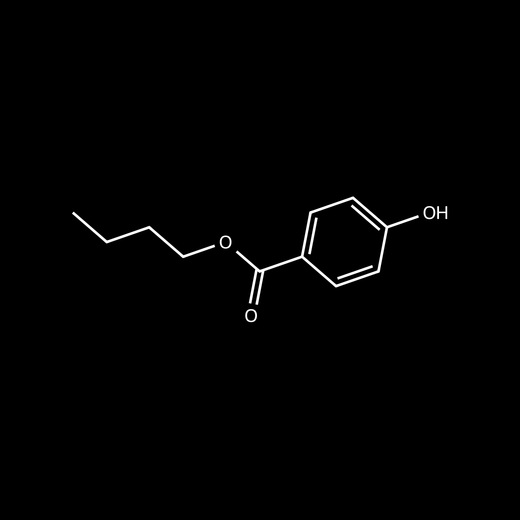
Butylparaben is butyl 4-hydroxybenzoate, a white crystalline solid with little or no odour and, at most, a very faint phenolic note.
- Olfactive family
- Aromatic · 510 entries of the glossary in this family Subfamily: Herbal aromatics · 230 entries in this subfamily Cluster: Green-herbal notes · 155 entries in this cluster
- Material
- Synthetic
- Pyramid
- Heart · Volatility: Heart Note
- Strength
- Low Step 2 of 5 · shared by 119 of 2,156 graded entries Graded entries at each step, from 1 to 5: 4, 119, 1,473, 498, 39. 23 more sit between two steps.
- Also called
- Butyl p-hydroxy benzoate
Family, subfamily and cluster: PREMIEREPEAU house classification, version 2026‑11.
Butylparaben · Facets
Entries of the glossary that carry each facet, of 3,979:
- herbaceous 49
- phenolic 94
- faint 4
Butylparaben · Scent
It is nearly odourless, with a very faint phenolic and herbaceous trace.
Butylparaben · In Perfumery
It is a fragrance ingredient and a preservative in cosmetics.
Pyramid
Butylparaben: Heart. Entries of the glossary stored at each place of the pyramid, of 4,006 (42 store no place):
- Top 718
- Top · Heart 497
- Heart 1,641
- Heart · Base 514
- Base 594
Butylparaben · Extraction & Chemistry
It is prepared by esterifying p-hydroxybenzoic acid with butyl alcohol in the presence of an acid catalyst, such as sulfuric acid, and an excess of the alcohol.
- Appearance
- White crystals or a crystalline powder
Butylparaben · In Depth
Identity
Butylparaben has the CAS number 94-26-8, the formula C₁₁H₁₄O₃ and a molecular weight of 194.23 g/mol. Its systematic name is butyl 4-hydroxybenzoate, and it is also called n-butyl-p-hydroxybenzoate.
Odour
Butylparaben has little or no odour, with a faint phenolic and herbaceous trace. Smelled at 100 %, it is very faint. Its odour strength is low.
Occurrence in nature
It occurs in Carica papaya and Strychnos cathayensis.
Production
It is prepared by esterifying p-hydroxybenzoic acid with butyl alcohol in the presence of an acid catalyst, such as sulfuric acid, and an excess of the alcohol.
Use in perfumery
It is a fragrance ingredient, and in cosmetics it also serves as a preservative.
Use in flavours
It is a flavouring agent and a food preservative.
Properties
It forms small, colourless crystals or a crystalline powder. It melts at 68.5 °C and boils at 156 to 157 °C at 3.5 mmHg. It is insoluble in water, with 207 mg/L dissolving at 20 °C, soluble in ethanol, ether, acetone and propylene glycol, and slightly soluble in oils. Its flash point is 128.89 °C, its logP is 3.57 and its vapour pressure is 0.00018 mmHg at 25 °C.
Safety and IFRA
No IFRA Standard covers this material itself. Its INCI name is BUTYLPARABEN, its functions are fragrance and preservative and its EC number is 202-318-7. It appears in Annex V, entry 12a, of the EU Cosmetics Regulation. It is registered under REACH. Its hazard classes include Skin Irrit. 2, Eye Dam. 1, Eye Irrit. 2A, STOT SE 3 and Aquatic Chronic 3, and its signal word is Danger.
Butylparaben · Technical Sheet
Molecular weight
194.23 g/mol Heavier than 803 of the 860 other entries at the same place of the pyramid that store a weight; 9 weigh the same.
2,515 entries store a molecular weight. By place in the pyramid: Top 537, Top · Heart 403, Heart 861, Heart · Base 452, Base 262.
Identity
- Type
- Ingredient
- Category
- Aroma chemicals
Chemical data
- Formula
- C11H14O3
- CAS
- 94-26-8
- PubChem CID
- 7184, compound record on PubChem
- InChIKey
- QFOHBWFCKVYLES-UHFFFAOYSA-N
- Wikidata · Wikipedia
- Butylparaben: Q3302873, item on Wikidata · Wikipedia, English article
Labelling
- EU cosmetics annexes
- CosIng, Annex V, entry 12 a · preservative Maximum concentration:
“- 0,14% (as acid) for the sum of the individual concentrations – 0,8% (as acid) for mixtures of substances mentioned in entry 12 and 12a, here the sum of the individual concentrations of butyl and propylparaben and their salts does not exceed 0,14%”
Wording of conditions:“For leave-on products designed for children under three years of age: “Do not use on the nappy area””
Other:“Not to be used in leave-on products designed for application on the nappy area of children under three years of age.”
Physical properties
- Boiling point
- 156 to 157 °C at 3.5 mmHg
- Melting point
- 68.5 °C
- Flash point
- 128.89 °C (264 °F)
- Vapour pressure
- 0.00018 mmHg at 25 °C
- Log P
- 3.57
Performance and rules
- Available as
- synthetic
- IFRA status
- No IFRA Standard for the material itself (51st Amendment)
Butylparaben · See Also
Entries related to Butylparaben, by their place in the pyramid. “shared” marks a scent word Butylparaben has too.
Top notes

Triplal
green · herbal · fresh Aromatic / Same cluster / Synthetic / 138.21 g/mol
Myrcene
herbal · spicy · peppery Aromatic / Same cluster / Semi-synthetic / 136.23 g/mol
4-Hydroxybenzoic Acid
caramel · nutty · phenolic (shared) Gourmand / Top · Heart / Synthetic / 138.12 g/mol


Heart notes

Papaya
fruity · tropical · musky Fruity / Natural
Propylparaben
woody · sweet · floral Woods / Synthetic / 180.2 g/mol


Base notes

Evernyl
earthy · woody · warm Aromatic / Same cluster / Synthetic / 196.2 g/mol

Butylparaben · Sources
- PubChem Butylparaben
- The Good Scents Company Information System Butylparaben: data sheet
- Pyrfume Arctander, Perfume and Flavor Chemicals: odour descriptions (Pyrfume archive)
- Pyrfume Good Scents odour data (Pyrfume archive)
- Pyrfume Leffingwell odour data (Pyrfume archive)
- Wikidata (LOTUS natural products data) Butylparaben: organisms it is reported in, with the papers
- IFRA Standards, 51st Amendment
- European Commission, CosIng Butylparaben: cosmetic ingredient record
- European Chemicals Agency Butylparaben: substance record
Cite as PREMIEREPEAU Glossary, “Butylparaben”, https://premierepeau.com/
