


Solomon’s Seal
Keywords: herbaceous perennial · Polygonatum
Solomon’s seal is a common name of the genus Polygonatum, whose species include Polygonatum odoratum, the angular or scented Solomon’s seal. Polygonatum odoratum has scented flowers.
- Olfactive family
- Florals · 779 entries of the glossary in this family Subfamily: Green florals · 143 entries in this subfamily Cluster: Green-fresh florals · 135 entries in this cluster
- Material
- Natural Flowers
- Pyramid
- Heart · Volatility: Heart Note
- Strength
- Medium Step 3 of 5 · shared by 1,473 of 2,156 graded entries Graded entries at each step, from 1 to 5: 4, 119, 1,473, 498, 39. 23 more sit between two steps.
- Also called
- Angular Solomon’s seal, scented Solomon’s seal, King Solomon’s-seal, sealwort
Family, subfamily and cluster: PREMIEREPEAU house classification, version 2026‑11.
Solomon’s Seal · Facets
Entries of the glossary that carry each facet, of 3,979:
- floral 1,546
- green 1,442
- earthy 660
- sweet 1,988
- fresh 1,387
Editorial note We own no rights to this material, its name or its trademark. This entry is independent editorial journalism, published under freedom of expression.
Solomon’s Seal · Scent
The flowers of Polygonatum odoratum are scented, and the Latin epithet odoratum means “scented”.
Evolution over time
Solomon’s Seal: scent over time.
- Immediately
Earthy and floral with subtle sweetness
Scent words: floral · earthy - After a few hours
Softens into a more rounded, gentle floral
Scent words: floral - After a few days
Fades to a warm, earthy base
Scent words: warm · earthy
Synthetic accord. Varies by composition.
Solomon’s Seal · In Perfumery
Pyramid
Solomon’s Seal: Heart. Entries of the glossary stored at each place of the pyramid, of 4,006 (42 store no place):
- Top 718
- Top · Heart 497
- Heart 1,641
- Heart · Base 514
- Base 594
Role in the formula
Solomon’s Seal: roles in the formula. Entries of the glossary that share each role, of 4,006:
- Diffusion enhancer 248
- Modifier 1,167
- Signature note 897
- Lifting agent 567
- Blender 1,040
Available as
Solomon’s Seal: available as.
- synthetic accord
- fantasy note
- rhizome
- root
PREMIEREPEAU collection: Extrait de parfum
Solomon’s Seal · Terroir & Origins
- Producing countries
- China, Europe, Japan, Korea
Solomon’s Seal · Did You Know?
One explanation for the common name Solomon’s seal is that the roots bear depressions which resemble royal seals. Another is that the cut roots resemble Hebrew characters.
Solomon’s Seal · In Depth
Botany
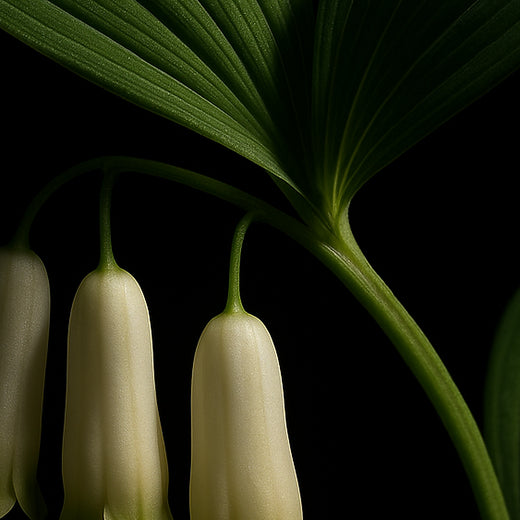
Polygonatum odoratum is a colonizing herbaceous perennial growing to 85 cm tall by 30 cm wide, with alternate, simple leaves on arching stems. The scented tubular flowers are white with green tips and hang from the underside of the stems in spring. It is cultivated in moist, shaded situations, where it spreads by underground stolons.
Name and range
The Latin specific epithet odoratum means “scented”. The genus name Polygonatum comes from Greek words meaning “many” and “knee joint”, in reference to the jointed rhizomes. The species is native to Europe, the Caucasus, Siberia, the Russian Far East, China, Mongolia, Korea and Japan. In the United Kingdom it is one of three native species of the genus Polygonatum. The genus is distributed throughout the temperate Northern Hemisphere, and most of its approximately 63 species occur in Asia.
Food and medicine
In Korea, the root of the plant is used to make tea. Polygonatum odoratum is used in traditional Chinese medicine and Traditional Korean medicine. The young shoots may be boiled and served like asparagus. The stems, leaves and berries are thought to be toxic if consumed in large quantities.
Explore all seven extraits in the Discovery Set.
Solomon’s Seal · History
Polygonatum species have been used in China as a traditional medicinal and edible substance for over 2,000 years. Their properties were first described in ancient texts such as the Shennong’s Classic of Materia Medica and later elaborated in the Compendium of Materia Medica.
Solomon’s Seal · Technical Sheet
Identity
- Botanical
- Polygonatum odoratum
- Taxonomy
- Asparagales order › Asparagaceae family › Polygonatum genus · GBIF
- Botanical records
- Polygonatum odoratum: POWO, Polygonatum odoratum · IPNI, Polygonatum odoratum · GBIF, Polygonatum odoratum · Wikidata, Polygonatum odoratum · Wikipedia, Polygonatum odoratum
- IPNI
- Polygonatum odoratum (Mill.) Druce, Ann. Scott. Nat. Hist. 1906, 226 — George Claridge Druce (1850–1932) · ≡ Convallaria odorata Mill. (1768)
- Type
- Accord
- Category
- Flowers
- Note
- Solomon’s Seal (Polygonatum odoratum) is a flowering plant used rarely in perfumery. No widely commercialized essential oil or absolute exists with standardized physical data. The plant has a delicate, green-floral, slightly lily-like scent profile.
In Nature
- Growth form
- Shrub · POWO
- Native range
- Northern Europe · Middle Europe · Southwestern Europe · Southeastern Europe · Eastern Europe · Northern Africa · Siberia · Russian Far East · 5 more regions · POWO
- Flowering
- peak in May–June · north of the equator · iNaturalist
- Recorded altitude
- 200–1,400 m · median 650 m · 23,911 records with an altitude · GBIF
- Wild or cultivated
- 8,809 native · 110 introduced · 164 cultivated among 169,547 records (the rest carry no such mark) · GBIF
- Recorded in
- 55 of 512 squares of the world grid; a brighter dot holds more records · GBIF
In Print
- In English books
- most mentioned in the 2000s · Google Books Ngram
Classification
- Chemical class
- Fantasy note (accord)
Chemical data
- Formula
- N/A — no commercial essential oil (contains steroidal saponins)
- INCI names (CosIng)
- POLYGONATUM ODORATUM EXTRACT (SKIN CONDITIONING)POLYGONATUM ODORATUM RHIZOME EXTRACT (SKIN CONDITIONING)POLYGONATUM ODORATUM ROOT EXTRACT (SKIN CONDITIONING)POLYGONATUM ODORATUM RHIZOME POWDER (SKIN CONDITIONING)
Physical properties
- Appearance
- N/A — no commercial essential oil or absolute
Performance and rules
- IFRA status
- No IFRA Standard for the material itself (51st Amendment)
Solomon’s Seal · See Also
Entries related to Solomon’s Seal, by their place in the pyramid. “shared” marks a scent word Solomon’s Seal has too.
Heart notes

Hyacinth
floral (shared) · rich · earthy (shared) Florals / Same cluster / Natural
Ornithogalum
floral (shared) · fresh (shared) · green (shared) Florals / Same cluster / Fantasy/Concept
Jasmine
floral (shared) Florals / Natural
Rose
floral (shared) · honeyed · waxy Florals / Natural
Orange Blossom
floral (shared) · honeyed · citrus Florals / Natural
Alumroot
floral (shared) · sweet (shared) Florals / Fantasy/Concept
Lily-of-the-Valley Leaves
fresh (shared) · green (shared) · floral (shared) Florals / Fantasy/Concept


Base notes

Iris
powdery · earthy (shared) · violet Florals / Natural


Solomon’s Seal · Sources
- GBIF Polygonatum odoratum
- International Plant Names Index (IPNI) Polygonatum odoratum (Mill.) Druce
- Frontiers The antitumor potential of Polygonatum spp.: a narrative review of traditional uses, bioactive metabolites, and multi-targeted mechanisms
- IFRA Standards, 51st Amendment
- Wikipedia Polygonatum odoratum
- Wikipedia Polygonatum
Cite as PREMIEREPEAU Glossary, “Solomon’s Seal”, https://premierepeau.com/
