


Sorbyl acetate
Keywords: pineapple · sweet · apple
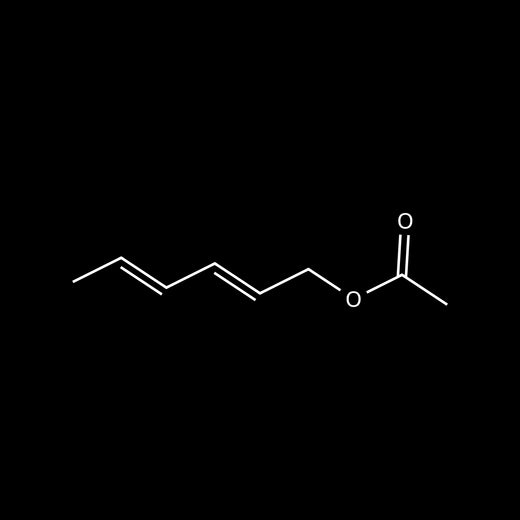
Sorbyl acetate is an acetate ester of hexa-2,4-dien-1-ol with a powerful, sweet pineapple aroma.
Sorbyl acetate · Facets
Entries of the glossary that carry each facet, of 3,979:
- pineapple 122
- sweet 1,988
- apple 171
- fruity 1,301
- pear 67
- winey 129
Sorbyl acetate · Scent
Sorbyl acetate · In Perfumery
It is used for perfuming in cosmetics, and it brings a powerful, sweet pineapple and fruity character.
Pyramid
Sorbyl acetate: Top · Heart. Entries of the glossary stored at each place of the pyramid, of 4,000 (36 store no place):
- Top 718
- Top · Heart 497
- Heart 1,641
- Heart · Base 514
- Base 594
Sorbyl acetate · In Depth
Identity
Its IUPAC name is [(2E,4E)-hexa-2,4-dienyl] acetate and its CAS number is 1516-17-2. Its molecular formula is C₈H₁₂O₂ and its molecular weight is 140.18 g/mol. It is an acetate ester and an olefinic compound, formally obtained from acetic acid and hexa-2,4-dien-1-ol, and it is a plant metabolite.
Odour
It smells of pineapple, sweet apple and pear, with fruity and winey facets. It also has fresh green, oily and herbal facets, with pumpkin and fresh parsley notes. Its aroma is powerful.
Use in perfumery
It is used for perfuming in cosmetics.
Use in flavours
It is a flavouring agent with a green flavour profile. Its taste is fresh, green, herbal, soapy and metallic. A joint expert committee of the FAO and WHO found no safety concern at current levels of intake when it is used as a flavouring agent.
Properties
It boils at 100 °C at 20 mmHg. Its density is 0.928 to 0.932 and its refractive index is 1.470 to 1.476. It is practically insoluble in water and soluble in ethanol.
Safety and IFRA
No IFRA standard covers this material itself. Its INCI name is 2,4-hexadienyl acetate. Its EC number is 216-163-8 and it is registered under REACH. It causes serious eye damage.
Sorbyl acetate · Technical Sheet
Molecular weight
140.18 g/mol Heavier than 225 of the 402 other entries at the same place of the pyramid that store a weight; 4 weigh the same.
2,515 entries store a molecular weight. By place in the pyramid: Top 537, Top · Heart 403, Heart 861, Heart · Base 452, Base 262.
Identity
- Type
- Ingredient
- Category
- Aroma chemicals
- Also called
- (2E,4E)-2,4-hexadien-1-ol 1-acetate, (E,E)-sorbyl acetate, (2E,4E)-2,4-hexadien-1-yl acetate
Classification
- Olfactive family
- Fruity · 698 entries of the glossary in this family
- Subfamily
- Classic fruits · 423 entries in this subfamily
- Cluster
- Orchard fruit notes · 55 entries in this cluster
- Chemical class
- Ester
Chemical data
- Formula
- C8H12O2
- CAS
- 1516-17-2
- PubChem CID
- 5363491, compound record on PubChem
- InChIKey
- PXVKYPFROMBALG-VNKDHWASSA-N
- Wikidata
- Sorbyl acetate: Q27261148, item on Wikidata
Physical properties
- Appearance
- Colourless liquid
- Boiling point
- 100 °C (20 mmHg)
- Density
- 0.928–0.932
- Refractive index
- 1.470–1.476
Performance and rules
- Pyramid
- Top · Heart Note
- IFRA status
- No IFRA Standard for the material itself (51st Amendment)
Sorbyl acetate · See Also
Entries related to Sorbyl acetate, by their place in the pyramid. “shared” marks a scent word Sorbyl acetate has too.
Heart notes

Ethyl cyclopent-2-en-1-ylacetate
fruity (shared) · pineapple (shared) · green Fruity / Same subfamily / 154.21 g/mol
Sorbyl isobutyrate
fruity (shared) · pineapple (shared) · galbanum Fruity / 168.23 g/mol


Sorbyl acetate · Sources
- PubChem Sorbyl acetate
- ChEBI Sorbyl acetate: chemical classification record
- Pyrfume Good Scents odour data (Pyrfume archive)
- Pyrfume Leffingwell odour data (Pyrfume archive)
- European Commission, CosIng Sorbyl acetate: cosmetic ingredient record
- The Good Scents Company Information System Sorbyl acetate: data sheet
- IFRA Standards, 51st Amendment
- European Chemicals Agency Sorbyl acetate: substance record
Cite as PREMIEREPEAU Glossary, “Sorbyl acetate”, https://premierepeau.com/
