


Spinach
Keywords: leafy green · vegetable
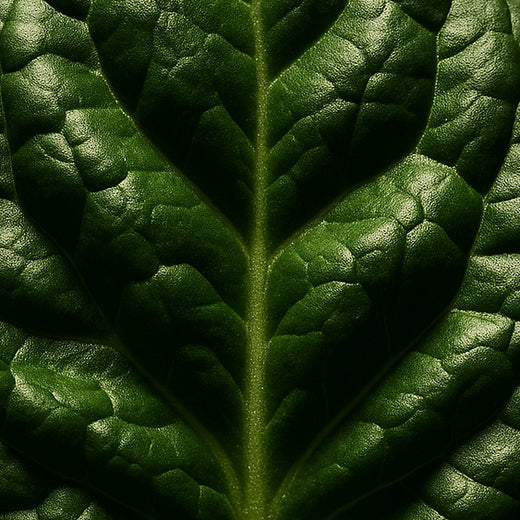
Spinach (Spinacia oleracea) is a leafy green flowering plant whose leaves are a common vegetable.
- Olfactive family
- Green · 370 entries of the glossary in this family Subfamily: Green notes · 218 entries in this subfamily Cluster: Green leafy notes · 420 entries in this cluster
- Material
- Natural Leaves
- Pyramid
- Heart · Volatility: Heart Note
- Strength
- Medium Step 3 of 5 · shared by 1,473 of 2,156 graded entries Graded entries at each step, from 1 to 5: 4, 119, 1,473, 498, 39. 23 more sit between two steps.
- Also called
- Common spinach
Family, subfamily and cluster: PREMIEREPEAU house classification, version 2026‑11.
Spinach · Facets
Entries of the glossary that carry each facet, of 3,979:
- green 1,442
- earthy 660
- fresh 1,387
- mineral 72
- rotten 2
- fishy 43
Spinach · Scent
Stored baby spinach develops off-odors, with rotten and fishy the strongest odors perceived after storage. The rotten group contained the alcohols 1-pentanol, (Z)-3-hexen-1-ol and 1-octen-3-ol, and the sulfur compounds methanethiol and dimethyl disulfide. Dimethyl sulfide was one compound responsible for the fishy notes of stored baby spinach, and amines with low odor thresholds may also be involved.
Evolution over time
Spinach: scent over time.
- After a few hours
Rotten and fishy odors, the strongest perceived in stored baby spinach.
Spinach · In Perfumery
Pyramid
Spinach: Heart. Entries of the glossary stored at each place of the pyramid, of 4,006 (42 store no place):
- Top 718
- Top · Heart 497
- Heart 1,641
- Heart · Base 514
- Base 594
Role in the formula
Spinach: roles in the formula. Entries of the glossary that share each role, of 4,006:
- Diffusion enhancer 248
- Modifier 1,167
- Signature note 897
- Lifting agent 567
- Blender 1,040
- Volume builder 780
Available as
Spinach: available as.
- essential oil
- expressed oil
- fresh leaf
- frozen
- canned
PREMIEREPEAU collection: Extrait de parfum
Spinach · Terroir & Origins
- Producing countries
- China, United States, Japan, Turkey
Spinach · Did You Know?
The story that a decimal-point error inflated the iron content of spinach is itself a myth, since there was never such an error. Popeye’s creator Elzie Sagar attributed spinach’s value to vitamin A, not iron.
Spinach · In Depth
Botany
Spinach is native to Central and Western Asia. It belongs to the order Caryophyllales, family Amaranthaceae, subfamily Chenopodioideae. Common spinach was long considered to be in the family Chenopodiaceae, but in 2003 that family was merged into the Amaranthaceae. It is an annual plant, rarely biennial, growing as tall as 30 cm. The leaves are alternate, simple, ovate to triangular, and very variable in size. The flowers mature into a small, hard, dry, lumpy fruit cluster containing several seeds.
Culinary use
The leaves are eaten fresh, cooked or after storage by preservation techniques like canning, freezing or dehydration. The taste differs considerably between cooked and raw. Raw spinach is 91% water, 4% carbohydrates and 3% protein, with negligible fat. It is a rich source of vitamin A, vitamin C, manganese and folate, with an especially high content of vitamin K. Spinach contains oxalates, which may inhibit absorption of calcium and iron in the stomach and small intestine.
Volatile compounds
In a study of intact baby spinach stored under a modified atmosphere of low oxygen and high carbon dioxide, off-odors were detected after 14 days. Analysis by gas chromatography-mass spectrometry and olfactometry then found 39 main compounds with olfactory activity in that stored spinach. The 39 compounds were identified as alcohols associated with lipid peroxidation, sulfur compounds from amino acid degradation, and alkanes from lipid autoxidation or carotenoid degradation.
Production
In 2024, world production of spinach was 31 million tonnes, with China alone accounting for 92% of the total.
Explore all seven extraits in the Discovery Set.
Related: Tea · Shishito Pepper · Black Pepper · Galbanum Oil · Seaweed
Spinach · History
Spinach became a common vegetable in the Arab Mediterranean and arrived in the Iberian Peninsula by the latter part of the 12th century. The English word spinach appeared in the late 14th century from the Old French word espinache. Spinach is mentioned in the first known English cookbook, the Forme of Cury (1390).
Spinach · Technical Sheet
Identity
- Botanical
- Spinacia oleracea
- Taxonomy
- Caryophyllales order › Amaranthaceae family › Spinacia genus · GBIF
- Botanical records
- Spinacia oleracea: POWO, Spinacia oleracea · IPNI, Spinacia oleracea · GBIF, Spinacia oleracea · Wikidata, Spinacia oleracea · Wikipedia, Spinacia oleracea
- IPNI
- Spinacia oleracea L., Sp. Pl. 2: 1027 (1753) — Carl Linnaeus (1707–1778)
- Type
- Ingredient
- Category
- Greens, herbs and fougeres
- Note
- Spinach (Spinacia oleracea) absolute (CAS 68917-48-6). Key odorants: trimethylamine, hexanal, (Z)-3-hexenal. Dark green semi-solid. In perfumery, used as an ultra-green leafy note.
In Nature
- Growth form
- Herb · POWO
- Native range
- Middle Asia · Western Asia · Indian Subcontinent · POWO
- Introduced to
- 46 regions · Northern America 14 · Temperate Asia 11 · Europe 8 · Africa 5 · Tropical Asia 4 · Southern America 3 · Pacific 1
- Sample origins in GC-MS studies
- Iran (1 paper; one: Journal of food safety 2021, Iran)
- Recorded altitude
- 0–1,300 m · median 450 m · 790 records with an altitude · GBIF
- Wild or cultivated
- 52 native · 233 introduced · 1,675 cultivated among 10,070 records (the rest carry no such mark) · GBIF
- Recorded in
- 92 of 512 squares of the world grid; a brighter dot holds more records · GBIF
- Also from this botanical family
- Amaranthaceae: Celosia · Tumbleweed
In Print
- Timeline
- first described 1753 · earliest aroma paper in Europe PMC, 2021
- In English books
- most mentioned in the 1980s · Google Books Ngram
Classification
- Chemical class
- Complex natural (essential oil)
Chemical data
- Formula
- Complex natural mixture (key constituents: trimethylamine (CH₃)₃N; hexanal C₆H₁₂O)
- Most reported compounds
- Polypodine B (5 papers; one: Lipids 1991, Polypodine B) · Quercetin (4 papers; one: J Sci Food Agric 2000, Quercetin) · Kaempferol (4 papers; one: J Sci Food Agric 2000, Kaempferol) · Beta-Carotene (3 papers; one: J Agric Food Chem 1992, Beta-Carotene) · LOTUS
- CAS
- 68917-48-6
- INCI names (CosIng)
- SPINACIA OLERACEA LEAF EXTRACT (SKIN CONDITIONING)SPINACIA OLERACEA LEAF CHLOROPLASTS (COLORANT, SKIN CONDITIONING – MISCELLANEOUS)SPINACIA OLERACEA LEAF POWDER (SKIN CONDITIONING)SPINACIA OLERACEA LEAF VESICLES (SKIN CONDITIONING – MISCELLANEOUS)
- Compound classes reported
- Flavonoids 35 % · Steroids 10 % · of 89 compounds reported, 12 % of them esters · LOTUS
Physical properties
- Appearance
- Leafy green plant with ovate to triangular leaves 2–30 cm long
Performance and rules
- IFRA status
- No IFRA Standard for the material itself (51st Amendment)
Spinach · See Also
Entries related to Spinach, by their place in the pyramid. “shared” marks a scent word Spinach has too.
Top notes

Shishito Pepper
green (shared) · spicy · vegetal Aromatic / Same cluster / Natural & Synthetic
Galbanum Oil
green (shared) · bitter · resinous Aromatic / Same cluster / Natural
Black Pepper
spicy · warm · aromatic Aromatic / Natural
Seaweed
marine · phenolic · dry Aquatic / Top · Heart / Natural


Heart notes

Tea
green (shared) · aromatic · dry Aromatic / Heart · Base / Natural

Spinach · Sources
- GBIF Spinacia oleracea
- International Plant Names Index (IPNI) Spinacia oleracea L.
- FAO AGRIS Off-odor compounds responsible for quality loss of minimally processed baby spinach stored under MA of low O2 and high CO2 using GC–MS and olfactometry techniques
- IFRA Standards, 51st Amendment
- Wikipedia Spinach
Cite as PREMIEREPEAU Glossary, “Spinach”, https://premierepeau.com/
