


Sundew
Keywords: carnivorous plant
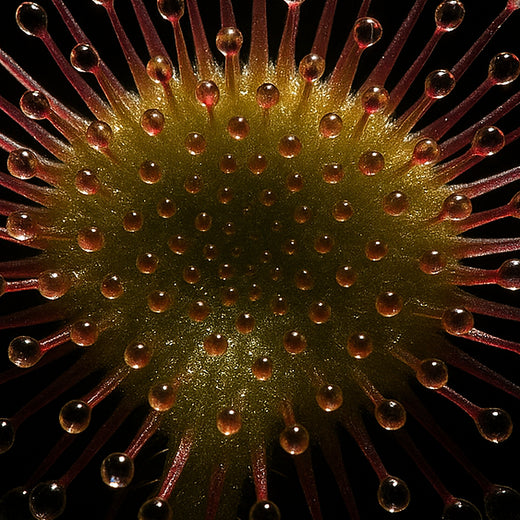
Sundew is the common name of Drosera, one of the largest genera of carnivorous plants, in the family Droseraceae. Its glandular trichomes end in glistening drops of mucilage that resemble drops of morning dew.
- Olfactive family
- Aromatic · 509 entries of the glossary in this family Subfamily: Green notes · 318 entries in this subfamily Cluster: Green leafy notes · 420 entries in this cluster
- Material
- Fantasy/Concept Leaves and flowering tops
- Pyramid
- Heart · Volatility: Heart Note
- Strength
- Medium Step 3 of 5 · shared by 1,462 of 2,148 graded entries Graded entries at each step, from 1 to 5: 4, 118, 1,462, 500, 40. 24 more sit between two steps.
- Also called
- Drosera, sundews
Sundew · Facets
Entries of the glossary that carry each facet, of 3,979:
- floral 1,546
- green 1,442
- sweet 1,988
- fresh 1,387
Sundew · Scent
Evolution over time
Sundew: scent over time.
- Immediately
Fresh dewy-green with mineral wetness
Scent words: fresh · green · mineral - After a few hours
Sweet honey-trap quality emerges
Scent words: sweet · honeyed - After a few days
Faint green-sweet trace, atmospheric
Scent words: green · sweet
Sundew · In Perfumery
The secondary metabolites of Drosera can be used in the pharmaceutical, cosmetics and food industries.
Pyramid
Sundew: Heart. Entries of the glossary stored at each place of the pyramid, of 4,000 (36 store no place):
- Top 718
- Top · Heart 497
- Heart 1,641
- Heart · Base 514
- Base 594
Role in the formula
Sundew: roles in the formula. Entries of the glossary that share each role, of 4,000:
- Modifier 1,167
- Signature note 897
- Lifting agent 567
- Blender 1,040
- Naturalizer 162
- Freshness 720
- Olfactory concept fewer than 40 entries
Sundew · Terroir & Origins
- Producing countries
- Germany
- Other countries of origin
- United States, Australia
No origin card: Germany.
Sundew Virginian
Virginia, Appalachians — United States
Facet scores, out of 100
- Herbal 90
- Fresh 71 (also a facet of the entry)
- Green 69 (also a facet of the entry)
- Aromatic 50
- Woody 49
- Earthy 20
Harvested in the United States, Sundew stands out for an aromatic and herbaceous profile, the signature of the Virginian terroir.
The acidic clay-silt soils of the Appalachians, shaped by millions of years of erosion, offer a unique terroir.
- Species
- Drosera spp.
- Harvest
- Harvest of aerial parts at full bloom
- Extraction
- Steam distillation or solvent extraction of the leaves
- Climate
- Humid temperate, four distinct seasons
- Soil
- Clay-silt, acidic
- Altitude
- 300 to 1,200 m
Sundew Australian
Western Australian Plantations — Australia
Facet scores, out of 100
- Herbal 100
- Green 80 (also a facet of the entry)
- Fresh 64 (also a facet of the entry)
- Woody 58
- Aromatic 50
- Earthy 22
In Australia, Sundew displays a herbaceous profile that the sandy lateritic soils and the southern Mediterranean climate amplify naturally.
Western Australia has developed sustainable plantations that offer a responsible alternative to overexploited wild forests.
- Species
- Drosera spp.
- Harvest
- Harvest of aerial parts at full bloom
- Extraction
- Steam distillation or solvent extraction of the leaves
- Climate
- Austral Mediterranean, hot dry summers
- Soil
- Sandy lateritic, acidic
- Altitude
- 200 to 400 m
Facet scores, origin against origin
Widest gap: Green · 11 points of 100. Highest: Sundew Australian: 80. Lowest: Sundew Virginian: 69.
Sundew · Extraction & Chemistry
In one method, 300 mg of powder is mixed with 10 mL of 99% ethanol and sonicated at 50 °C for 15 min; the steps are performed three times, the supernatants are combined, and the extract is concentrated under reduced pressure at 40 °C. Freeze-dried tissue can be extracted twice with 80% methanol by sonication for 30 min, and fresh biomass can be ground in 99.5% ethanol, 1.0 g per 7.0 mL, and left for one hour. The average extract yield was 4% w/w for commercial biomass and 20% w/w for biomass cultivated in Germany.
- Appearance
- Leaves covered with stalked glands bearing glistening drops of sticky mucilage; red glandular hairs in Drosera rotundifolia
Sundew · Did You Know?
When fresh, the mucilage of Drosera capensis can form threads up to 1 m long. In an 1860 letter, Darwin wrote that he cared more about Drosera than the origin of all the species in the world.
Sundew · In Depth
The plant
Sundews lure, capture and digest insects using stalked mucilaginous glands covering their leaf surfaces. The insects are used to supplement the poor mineral nutrition of the soil in which the plants grow. Various species, which vary greatly in size and form, are native to every continent except Antarctica. The Cape sundew, Drosera capensis, is native to the Cape region of South Africa, where it grows in permanently wet, nutrient-poor habitats.
Name
The botanical name comes from the Greek drosos, meaning “dew, dewdrops”. The English common name “sundew” derives from Latin ros solis, meaning “dew of the sun”.
Mucilage
The stalked glands secrete sweet mucilage to attract and ensnare insects. The sticky exudate forms tiny droplets at the tips of the stalked glands, glittering in the sun like dewdrops. Death of the prey usually occurs within 15 minutes.
A book of 1914 on the human side of plants described how an American woman pinned a living fly half an inch from a sundew leaf, and how the leaf moved itself within two hours, near enough to seize the insect with its tentacles. The same book held that this motion could come only from a degree of reasoning power in the plant.
In most cases the sticky liquid is 4% (w/v) acidic polysaccharides with backbones rich in glucuronic acid and mannose. Protein is not detected in the sundew adhesive. The adhesive on the stalked glands is viscoelastic. The mucilage of Drosera capensis is about six times more viscous than water at 20 °C.
Glands and digestion
The genus contains at least 194 species. Trapping and digestion usually rely on two kinds of gland: stalked glands, which secrete sweet mucilage to attract and ensnare insects together with enzymes to digest them, and sessile glands, which absorb the resulting nutrient soup. The plant secretes esterase, peroxidase, phosphatase and protease enzymes, which dissolve the insect and free its nutrients.
Chemistry
Sundews contain flavonoids, including kaempferol, myricetin, quercetin and hyperoside. They also contain quinones such as plumbagin, hydroplumbagin glucoside and rossoliside. Further constituents include plant acids such as citric acid and malic acid, resin, tannins and ascorbic acid. Plumbagin, or 5-hydroxy-2-methyl-1,4-naphthoquinone, has the chemical formula C₁₁H₈O₃. Plumbagin is a yellow dye formally derived from naphthoquinone. Drosera capensis contains the naphthoquinone ramentaceone and trace amounts of plumbagin.
Explore all seven extraits in the Discovery Set.
Related: Basil · Sage · Tea · Black Pepper · Immortelle · Caper
Sundew · History
Drosera was first published in Linnaeus’s Species Plantarum, volume I, page 281. Charles Darwin performed much of the early research into Drosera, and his experiments with Drosera rotundifolia were the first to confirm carnivory in plants.
Sundew · Technical Sheet
Identity
- Botanical
- Drosera
- Taxonomy
- Caryophyllales order › Droseraceae family › Drosera genus · GBIF
- Botanical records
- Drosera: POWO, Drosera · IPNI, Drosera · GBIF, Drosera · Wikidata, Drosera · Wikipedia, Drosera
- IPNI
- Drosera L., Sp. Pl. 1: 281 (1753) — Carl Linnaeus (1707–1778)
- Type
- Concept
- Category
- Accords and curiosities
- Note
- Drosera (sundew) is not distilled for perfumery. Used as an evocative note. The plant contains plumbagin and various naphthoquinones.
Classification
- Chemical class
- Complex natural
Chemical data
- Formula
- Complex natural mixture (key constituents: plumbagin C₁₁H₈O₃)
Performance and rules
- Available as
- reconstruction
- IFRA status
- No IFRA Standard for the material itself (51st Amendment)
Sundew · See Also
Entries related to Sundew, by their place in the pyramid. “shared” marks a scent word Sundew has too.
Top notes

Rose Leaf
green (shared) · leafy · fresh (shared) Aromatic / Top · Heart / Same cluster / Natural
Basil
aromatic · green (shared) · herbal Aromatic / Top · Heart / Same subfamily / Natural
Black Pepper
spicy · warm · aromatic Aromatic / Natural


Heart notes

Centella Asiatica
herbs · medicinal plants Aromatic / Same cluster / Natural
Gyokuro Tea
green (shared) · fresh (shared) · rich Green / Same cluster / Natural
Caper
fresh (shared) · green (shared) · aromatic Aromatic / Same subfamily / Natural
Sage
aromatic · herbal · amber Aromatic / Natural
Tea
green (shared) · aromatic · dry Aromatic / Heart · Base / Natural
Immortelle
aromatic · honey · herbal Aromatic / Natural


Sundew · Sources
- Journal of the Royal Society, Interface (2015) Sundew adhesive: a naturally occurring hydrogel
- International Journal of Molecular Sciences (2022) Antibiofilm Activity of Sundew Species against Multidrug-Resistant Escherichia coli Strains
- Molecules (2021) Field-Grown and In Vitro Propagated Round-Leaved Sundew (Drosera rotundifolia L.) Show Differences in Metabolic Profiles and Biological Activities
- Biomolecules (2024) Effect of Agitation and Temporary Immersion on Growth and Synthesis of Antibacterial Phenolic Compounds in Genus Drosera
- Internet Archive The Human Side of Plants (1914)
- PubChem Plumbagin
- IFRA Standards, 51st Amendment
- Wikipedia Drosera
- Wikipedia Drosera capensis
- Wikipedia Plumbagin
- Wikipedia Drosera rotundifolia
Cite as PREMIEREPEAU Glossary, “Sundew”, https://premierepeau.com/
