


Tyrosol
Keywords: floral · fruity · rose
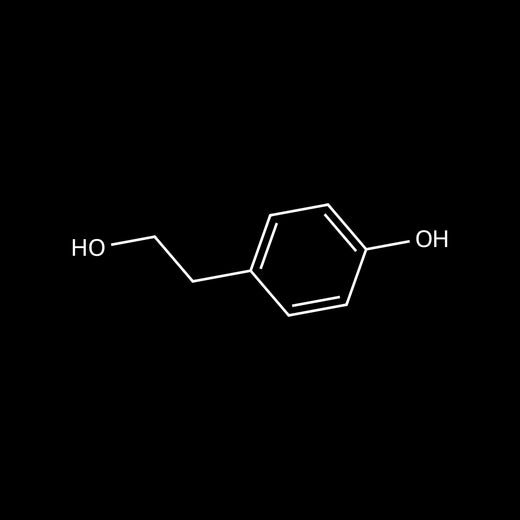
Tyrosol is a solid phenol with a hydroxyethyl side chain and a mild, sweet, fruity-floral odour that leans towards rose.
- Olfactive family
- Florals · 785 entries of the glossary in this family Subfamily: Classic florals · 314 entries in this subfamily
- Pyramid
- Top-Heart Note
- Strength
- Low Step 2 of 5 · shared by 117 of 2,161 graded entries Graded entries at each step, from 1 to 5: 4, 117, 1,469, 507, 40. 24 more sit between two steps.
Tyrosol · Facets
Entries of the glossary that carry each facet, of 3,979:
- floral 1,551
- fruity 1,307
- rose 215
- sweet 1,990
Tyrosol · Scent
It smells floral, fruity and sweet, mild and faint, with a mainly rosy character.
Tyrosol · In Perfumery
It brings a faint, sweet, fruity-floral note that is mainly rosy.
Pyramid
Tyrosol: Top · Heart. Entries of the glossary stored at each place of the pyramid, of 4,000 (35 store no place):
- Top 718
- Top · Heart 501
- Heart 1,646
- Heart · Base 512
- Base 588
Tyrosol · In Depth
Identity
Its systematic name is 4-(2-hydroxyethyl)phenol, its CAS number is 501-94-0, its formula is C₈H₁₀O₂ and its molecular weight is 138.16 g/mol. It is a phenol substituted at position 4 by a 2-hydroxyethyl group, and it is also named 4-hydroxyphenethyl alcohol.
It is an antioxidant and a plant and fungal metabolite.
Odour
It smells floral, fruity and sweet, with a mainly rosy character. At 100 % the odour is mild and sweet, and the overall impression is faint. Its odour strength is low.
Occurrence in nature
It occurs in Olea europaea, Syringa oblata, Actinidia arguta, Arachis hypogaea, Aspalathus linearis and Azadirachta indica, as well as in Agaricus and Alternaria tagetica.
Use in flavours
It is used as a flavouring agent.
Properties
It is a solid that melts at 89 to 92 °C and boils at 308 to 311 °C at 760 mmHg. Its flash point is 142.78 °C and its logP is 0.69. It is soluble in alcohol and insoluble in water. Its estimated vapour pressure is 0.001 mmHg at 25 °C.
Safety and IFRA
No IFRA Standard covers this material itself in the 51st Amendment. Its INCI name is TYROSOL, its functions are antioxidant, oral care and skin conditioning, and its EC number is 207-930-8. It is registered under REACH. Its hazard statements are H315 for skin irritation, H319 for serious eye irritation and H335 for respiratory irritation, with the signal word Warning.
Tyrosol · Technical Sheet
Molecular weight
138.16 g/mol Heavier than 197 of the 410 other entries at the same place of the pyramid that store a weight; 8 weigh the same
2,572 entries store a molecular weight. By place in the pyramid: Top 547, Top · Heart 411, Heart 888, Heart · Base 454, Base 272.
Identity
- Type
- Ingredient
- Category
- Aroma chemicals
Classification
- Cluster
- Classic florals · 245 entries in this cluster
- Chemical class
- Alcohol
Chemical data
- Formula
- C8H10O2
- CAS
- 501-94-0
- PubChem CID
- 10393, compound record on PubChem
- InChIKey
- YCCILVSKPBXVIP-UHFFFAOYSA-N
Physical properties
- Boiling point
- 308 to 311 °C at 760 mmHg
- Melting point
- 89 to 92 °C at 760 mmHg
- Flash point
- 142.78 °C (289 °F)
- Vapour pressure
- 0.001 mmHg at 25 °C (estimated)
- Log P
- 0.851 (estimated)
Performance and rules
- IFRA status
- No IFRA Standard for the material itself (51st Amendment)
Tyrosol · See Also
Entries related to Tyrosol, by their place in the pyramid. « shared » marks a scent word Tyrosol has too.
Heart notes

Beer
fresh · rich · sweet (shared) Gourmand / Fantasy/Concept
Olive Leaf
fresh · green · woody Aromatic / Natural


Base notes

Argan
nutty · warm · rich Gourmand / Natural

Tyrosol · Sources
- PubChem Tyrosol
- ChEBI Tyrosol: chemical classification record
- The Good Scents Company Information System Tyrosol: data sheet
- Pyrfume Arctander, Perfume and Flavor Chemicals: odour descriptions (Pyrfume archive)
- Pyrfume Good Scents odour data (Pyrfume archive)
- Pyrfume Leffingwell odour data (Pyrfume archive)
- European Chemicals Agency Tyrosol: substance record
- Wikidata (LOTUS natural products data) Tyrosol: organisms it is reported in, with the papers
- IFRA Standards, 51st Amendment
- European Commission, CosIng Tyrosol: cosmetic ingredient record
Cite as PREMIEREPEAU Glossary, “Tyrosol”, https://premierepeau.com/pages/glossary-terms/tyrosol Updated 2026-11-20
