


Undecylenic Acid
Keywords: fatty · oily · woody
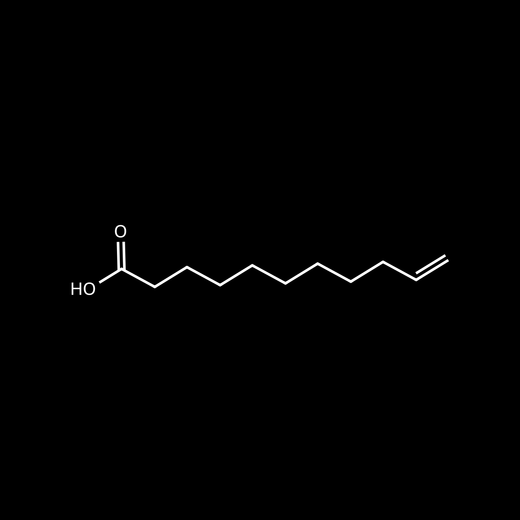
Undecylenic Acid is an undecenoic acid with its double bond in the 10-position and a sweet, woody, oily odour.
- Olfactive family
- Green · 370 entries of the glossary in this family Subfamily: Green notes · 218 entries in this subfamily Cluster: Green leafy notes · 420 entries in this cluster
- Material
- Synthetic
- Pyramid
- Heart · Volatility: Heart Note
- Also called
- 10-Undecenoic acid, Undec-10-enoic acid
Family, subfamily and cluster: PREMIEREPEAU house classification, version 2026‑11.
Undecylenic Acid · Facets
Entries of the glossary that carry each facet, of 3,979:
- fatty 265
- oily 237
- woody 792
- sweet 1,988
- acid 6
- fruity 1,301
Undecylenic Acid · Scent
It smells oily, sweet and woody, and the odour of the acid ranges from mildly acid and heavy-fruity to sour-fatty depending on the grade.
Undecylenic Acid · In Perfumery
It is used as a fragrance ingredient, and its function in cosmetics is fragrance.
Pyramid
Undecylenic Acid: Heart. Entries of the glossary stored at each place of the pyramid, of 4,006 (42 store no place):
- Top 718
- Top · Heart 497
- Heart 1,641
- Heart · Base 514
- Base 594
Undecylenic Acid · Extraction & Chemistry
It is derived from castor oil.
- Appearance
- Colourless to pale yellow liquid
Undecylenic Acid · In Depth
Identity
Undecylenic Acid has the formula C₁₁H₂₀O₂, the CAS number 112-38-9 and a molecular weight of 184.27 g/mol. Its IUPAC name is undec-10-enoic acid. It is an undecenoic acid having its double bond in the 10-position. It is a plant metabolite and an antifungal drug, and is used for the treatment of skin problems.
Odour
It smells oily, sweet and woody, with a fatty, acid and fruity side. The odour varies enormously between grades of the acid, from oily, mildly acid and heavy-fruity, overall pleasant, to acrid and repulsively sour-fatty. At 100 % it smells sweet and woody.
Occurrence in nature
It occurs in Salvia fruticosa, Salvia triloba, Anthrenus verbasci and Streptomyces.
Production
It is derived from castor oil.
Use in perfumery
It is a fragrance ingredient, and its function in cosmetics is fragrance. In cosmetics it also acts as a cleansing agent and a preservative.
Use in flavours
It is used as a flavouring agent for foods. Its flavour profile is floral.
Properties
It melts at 24.5 °C and decomposes at 275 °C. It boils at 137 °C at 2 mmHg. It is insoluble in water, where 73.7 mg/L dissolves at 30 °C, and soluble in alcohol and ether. Its density is 0.910 to 0.917, its refractive index is 1.446 to 1.453 and its logP is 3.86. Its flash point is 148.89 °C.
Safety and IFRA
No IFRA Standard covers this material itself in the 51st Amendment. Its INCI name is UNDECYLENIC ACID, and its functions are antimicrobial, emulsifying surfactant, fragrance, preservative and cleansing surfactant. It appears in Annex V of the EU Cosmetics Regulation (EC) No 1223/2009, entry 18. Its EC number is 203-965-8, and it is registered under REACH. Its hazard classification includes skin irritation category 2, eye irritation category 2, acute aquatic hazard category 1 and chronic aquatic hazard category 3.
Undecylenic Acid · Technical Sheet
Molecular weight
184.27 g/mol Heavier than 648 of the 860 other entries at the same place of the pyramid that store a weight; 25 weigh the same.
2,515 entries store a molecular weight. By place in the pyramid: Top 537, Top · Heart 403, Heart 861, Heart · Base 452, Base 262.
Identity
- Type
- Ingredient
- Category
- Aroma chemicals
Classification
- Chemical class
- Carboxylic acid
Chemical data
- Formula
- C11H20O2
- CAS
- 112-38-9
- Reported in plants
- Salvia fruticosa (1 paper; one: Fitoterapia 2001, Salvia fruticosa) · LOTUS
- PubChem CID
- 5634, compound record on PubChem
- InChIKey
- FRPZMMHWLSIFAZ-UHFFFAOYSA-N
- Wikidata · Wikipedia
- Undecylenic Acid: Q420346, item on Wikidata · Wikipedia, English article
Labelling
- EU cosmetics annexes
- CosIng, Annex V, entry 18 · preservative Maximum concentration:
“0.2% (as acid)”
Physical properties
- Boiling point
- 137 °C at 2 mmHg
- Melting point
- 24.5 °C
- Flash point
- 148.89 °C (300 °F)
- Density
- 0.910 – 0.917
- Refractive index
- 1.446–1.453
- Log P
- 3.86
Performance and rules
- Available as
- synthetic
- IFRA status
- No IFRA Standard for the material itself (51st Amendment)
Undecylenic Acid · See Also
Entries related to Undecylenic Acid, by their place in the pyramid. “shared” marks a scent word Undecylenic Acid has too.
Top notes

Aldehyde C-11 Undecylenic
aldehydic · citrus · floral Citrus / Top · Heart / Synthetic / 168.28 g/mol

Heart notes

2-Decenoic acid
fatty (shared) · waxy · fruity (shared) Green / Same cluster / 170.25 g/mol
Ethyl 10-undecenoate
fruity (shared) · waxy · winey Fruity / Heart · Base / 212.33 g/mol
9-Decenoic acid
fruity (shared) · waxy · cheesy Gourmand / 170.25 g/mol
Undecyl acetate
oily (shared) · fatty (shared) · rose Heart · Base / 214.34 g/mol
10-Undecen-1-ol
citrus · waxy · floral Florals / 170.29 g/mol
Allyl 10-undecenoate
pineapple · fatty (shared) · coconut Fruity / Heart · Base / 224.34 g/mol


Base notes
-
Orris Absolute
floral · powdery · sweet (shared) Florals / Natural 
Butyl 10-undecenoate
buttery · fatty (shared) · winey Fruity / 240.38 g/mol

Undecylenic Acid · Sources
- PubChem Undecylenic Acid
- ChEBI Undecylenic Acid: chemical classification record
- The Good Scents Company Information System Undecylenic Acid: data sheet
- Pyrfume Arctander, Perfume and Flavor Chemicals: odour descriptions (Pyrfume archive)
- Pyrfume Good Scents odour data (Pyrfume archive)
- Pyrfume Leffingwell odour data (Pyrfume archive)
- European Commission, CosIng Undecylenic Acid: cosmetic ingredient record
- Wikidata (LOTUS natural products data) Undecylenic Acid: organisms it is reported in, with the papers
- IFRA Standards, 51st Amendment
- European Chemicals Agency Undecylenic Acid: substance record
Cite as PREMIEREPEAU Glossary, “Undecylenic Acid”, https://premierepeau.com/
