


Wasabi
Keywords: fresh · green · spicy
Wasabi, or Japanese horseradish, is a plant of the family Brassicaceae. It is grown for its rhizomes, which are ground into a paste as a pungent condiment for sushi and other foods.

- Olfactive family
- Spicy · 155 entries of the glossary in this family Subfamily: Vegetable and culinary notes · 155 entries in this subfamily Cluster: Peppery spices · 28 entries in this cluster
- Material
- Natural Rhizome
- Pyramid
- Top · Volatility: Top Note
- Strength
- High Step 4 of 5 · shared by 500 of 2,148 graded entries Graded entries at each step, from 1 to 5: 4, 118, 1,462, 500, 40. 24 more sit between two steps.
- Also called
- Japanese horseradish, Wasabia japonica
Wasabi · Facets
Entries of the glossary that carry each facet, of 3,979:
- green 1,442
- spicy 474
- sweet 1,988
- herbal 757
- warm 1,108
- cool 79
- fresh 1,387
- peppery 46
- pungent 90
- sharp 44
Wasabi · Scent
Wasabi has a sharp smell, which allyl isothiocyanate gives it along with mustard, horseradish and radish.
Evolution over time
Wasabi: scent over time.
- Immediately
A sharp, pungent, lachrymatory opening, fresh and green with an aromatic edge.
Scent words: fresh · green · aromatic - After a few hours
The pungency settles into horseradish, garlic and onion-like tones, with a radish note and a vegetative green.
Scent words: green - After a few days
The last traces are peppery, sulphurous and musty, with mushroom-like and cooked, potato-like touches.
Wasabi · In Perfumery
Allyl isothiocyanate, the compound behind wasabi’s pungency, is also used as a flavouring agent in sauces and condiments.
Pyramid
Wasabi: Top. Entries of the glossary stored at each place of the pyramid, of 4,000 (36 store no place):
- Top 718
- Top · Heart 497
- Heart 1,641
- Heart · Base 514
- Base 594
Role in the formula
Wasabi: roles in the formula. Entries of the glossary that share each role, of 4,000:
- Modifier 1,167
- Signature note 897
- Lifting agent 567
- Volume builder 780
- Freshness 720
Wasabi · Terroir & Origins
- Producing countries
- Japan, Iceland, the Netherlands, Hungary, the UK, Western Canada, Oregon, North Carolina, Tennessee
Wasabi · Extraction & Chemistry
Allyl isothiocyanate is produced by hydrolysis of allyl glucosinolate, catalyzed by myrosinase, which is released on cell rupture caused by partial maceration, for example grating, of the plant.
Available as
Wasabi: available as.
- synthetic accord
- fantasy note
- rhizome
- paste
- Appearance
- Naturally green
Wasabi · Did You Know?
The chemosensory receptor TRPA1, the sensory neural target of mustard oil, is also known as the wasabi receptor. Synthetic allyl isothiocyanate is also used in fire alarms for the deaf.
Wasabi · In Depth
Wasabi (Eutrema japonicum, syn. Wasabia japonica) is a plant of the family Brassicaceae, which also includes horseradish and mustard in other genera. It is native to Japan, the Russian Far East including Sakhalin, and the Korean Peninsula. It grows naturally along stream beds in mountain river valleys in Japan.
Explore all seven extraits in the Discovery Set.
Botany
Eutrema is a genus of flowering plants of the family Brassicaceae, and its best known member is wasabi. Wasabi has large leaves produced from long, thin stalks. Its flowers appear in clusters from long stems that bloom from late winter to early spring. The main cultivars in the marketplace are E. japonicum ‘Daruma’ and ‘Mazuma’, but there are many others.
Chemistry
The chemical in wasabi that provides its initial pungency is the volatile compound allyl isothiocyanate. The same compound is responsible for the pungency of horseradish and mustard. Allyl isothiocyanate has the formula C₄H₅NS. It is a naturally occurring unsaturated isothiocyanate. Allyl isothiocyanate can also be released when the wasabi plants have been damaged, because it is used as a defense mechanism.
The unique flavour of wasabi is a result of complex chemical mixtures from the broken cells of the plant. They include the methylthioalkyl isothiocyanates 6-(methylsulfinyl)
Uses and cultivation
Wasabi is similar in taste to hot mustard or horseradish rather than chilli peppers, in that it stimulates the nose more than the tongue. Wasabizuke is made of wasabi leaves pickled in sake lees, and is considered a specialty of Shizuoka Prefecture. Wasabi is quite intolerant of direct sunlight, requires an air temperature between 8 and 20 °C, and prefers high humidity in summer. This makes fully satisfying commercial demand impossible for growers, which makes wasabi quite expensive.
A common substitute is a mixture of horseradish, mustard, starch, and green food coloring or spinach powder. In North America, wasabi is cultivated by a handful of small farmers and companies, including in the rain forests on the coast of Western Canada. In Europe, wasabi is grown commercially in Iceland, the Netherlands, Hungary, and the UK.
Wasabi · History
The oldest record of wasabi as a food dates to the 8th century. The wasabi plant was first described by Miquel in 1866. In 1930, Koidzumi transferred the wasabi plant to the genus Eutrema. The popularity of wasabi in English-speaking countries has coincided with that of sushi, growing steadily from about 1980.
Wasabi · Technical Sheet
Identity
- Botanical
- Eutrema japonicum (syn. Wasabia japonica)
- Taxonomy
- Brassicales order › Brassicaceae family › Eutrema genus · GBIF
- Botanical records
- Eutrema japonicum: POWO, Eutrema japonicum · IPNI, Eutrema japonicum · GBIF, Eutrema japonicum · Wikidata, Eutrema japonicum · Wikipedia, Eutrema japonicum
- IPNI
- Eutrema japonicum Koidz., Fl. Symb. Orient.-Asiat. 22 (1930) — Gen’ichi Koidzumi (1883–1953) · ≡ Lunaria japonica Miq. (1865)
- Type
- Ingredient
- Category
- Spices
- Note
- N/A – limited perfumery extraction data
In Nature
- Growth form
- Herb · POWO
- Native range
- Russian Far East · Eastern Asia · POWO
- Introduced to
- 1 region · Temperate Asia 1
- Recorded altitude
- 100–1,100 m · median 450 m · 285 records with an altitude · GBIF
- Wild or cultivated
- 13 introduced · 21 cultivated among 1,331 records (the rest carry no such mark) · GBIF
- Recorded in
- 14 of 512 squares of the world grid; a brighter dot holds more records · GBIF
- Also from this botanical family
- Brassicaceae: Cauliflower · Daikon Radish · Hoary Stock · Mustard Seed · Sweet Alyssum · Wallflower
In Print
- In English books
- most mentioned in the 2010s · Google Books Ngram
Classification
- Chemical class
- Isothiocyanates
Chemical data
- Formula
- Complex natural mixture (key constituents: allyl isothiocyanate C₄H₅NS; 6-(methylsulfinyl)
hexyl isothiocyanate; 7-methylthioheptyl isothiocyanate; 8-methylthiooctyl isothiocyanate) - Most reported compounds
- Allyl Isothiocyanate (3 papers; one: DOI) · 3-Butenyl isothiocyanate (2 papers; one: DOI) · 5-Hexenyl isothiocyanate (2 papers; one: DOI) · 1-Hexanol (1 paper; one: DOI) · LOTUS
- Structure
- Allyl Isothiocyanate:
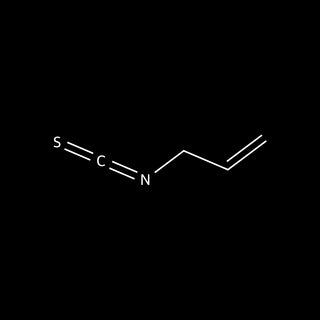
Allyl Isothiocyanate
PubChem, Allyl Isothiocyanate - INCI names (CosIng)
- WASABIA JAPONICA FLOWER EXTRACT (HUMECTANT, SKIN PROTECTING)WASABIA JAPONICA LEAF EXTRACT (ANTIMICROBIAL)WASABIA JAPONICA ROOT EXTRACT (SKIN CONDITIONING)WASABIA JAPONICA ROOT POWDER (SKIN CONDITIONING)
Performance and rules
- IFRA status
- No IFRA Standard for the material itself (51st Amendment)
Wasabi · See Also
Entries related to Wasabi, by their place in the pyramid. “shared” marks a scent word Wasabi has too.
Top notes

Serrano Pepper
spicy (shared) · fresh (shared) · warm (shared) Spicy / Same cluster / Natural
Peruvian Pepper
spicy (shared) · peppery (shared) · sweet (shared) Spicy / Top · Heart / Same cluster / Natural
Ginger
spicy (shared) · fresh (shared) · citrus Spicy / Natural
Allyl Isothiocyanate
pungent (shared) · mustard · sulfurous Natural & Synthetic
Hexyl isothiocyanate
green (shared) · horseradish · pungent (shared) Green / Top · Heart


Heart notes

Longoza
spicy (shared) · peppery (shared) Spicy / Same cluster / Natural
Alpinia
spicy (shared) · gingery · camphorous Spicy / Natural
Vinyl Guaiacol
warm (shared) · spicy (shared) · smoky Spicy / Natural & Synthetic
Daikon Radish
fresh (shared) · green (shared) · earthy Fruity / Fantasy/Concept
Caper
fresh (shared) · green (shared) · aromatic Aromatic / Natural


Wasabi · Sources
- Foods (2025) Health Benefits, Applications, and Analytical Methods of Freshly Produced Allyl Isothiocyanate
- Foods (2021) Important Odorants of Four Brassicaceae Species, and Discrepancies between Glucosinolate Profiles and Observed Hydrolysis Products
- PubChem Allyl Isothiocyanate
- IFRA Standards, 51st Amendment
- Wikipedia Wasabi
- Wikipedia Allyl isothiocyanate
- Wikipedia Eutrema
Cite as PREMIEREPEAU Glossary, “Wasabi”, https://premierepeau.com/
