


Serrano Pepper
Keywords: spicy · fresh · warm
Serrano pepper is a type of chili pepper (Capsicum annuum) that originated in the mountainous regions of the Mexican states of Puebla and Hidalgo.
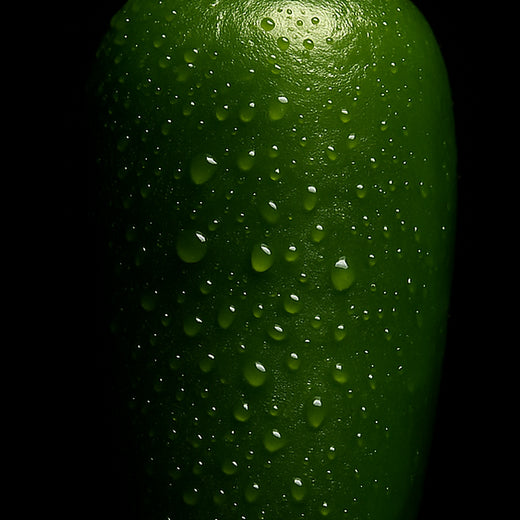
- Olfactive family
- Spicy · 154 entries of the glossary in this family Subfamily: Vegetable and culinary notes · 164 entries in this subfamily Cluster: Peppery spices · 28 entries in this cluster
- Material
- Natural Chili pepper (fruit of Capsicum annuum)
- Pyramid
- Top Note
- Strength
- High Step 4 of 5 · shared by 507 of 2,161 graded entries Graded entries at each step, from 1 to 5: 4, 117, 1,469, 507, 40. 24 more sit between two steps.
- Also called
- SERRANO CHILE · SERRANO CHILI PEPPER
Serrano Pepper · Facets
Entries of the glossary that carry each facet, of 3,979:
- green 1,444
- spicy 473
- sweet 1,990
- fruity 1,307
- warm 1,109
- fresh 1,392
Serrano Pepper · Scent
In green peppers of Capsicum annuum, the green odor could be representative of pepper fruit. 2-Isobutyl-3-methoxypyrazine contributes the most to the odor of 19 pepper varieties of Capsicum annuum, owing to its extremely low threshold concentration. 2-Isobutyl-3-methoxypyrazine is roughly described as having a green pea and green bell pepper odor. C6 and C9 aldehydes are the main sources of green aroma. 1-Octen-3-ol has a mushroom aroma, while 2-pentyl-furan contributes an earthy and beany odor, and 2-methoxy-phenol has a spicy, vanilla, and woody-like odor. 1-Hexanol, β-cyclocitral, and ethyl acetate provide a sweet, fruity smell. Pure capsaicin has a highly pungent odor.
Evolution over time
Serrano Pepper: scent over time.
- After a few hours
Mushroom and earthy, beany notes.
Scent words: earthy - After a few days
Spicy, vanilla and woody.
Scent words: spicy · woody
Serrano Pepper · In Perfumery
Pyramid
Serrano Pepper: Top. Entries of the glossary stored at each place of the pyramid, of 4,000 (35 store no place):
- Top 718
- Top · Heart 501
- Heart 1,646
- Heart · Base 512
- Base 588
Role in the formula
Serrano Pepper: roles in the formula. Entries of the glossary that share each role, of 4,000:
- Modifier 1,168
- Signature note 898
- Lifting agent 568
- Blender 1,041
- Volume builder 780
PREMIEREPEAU collection: Extrait de parfum
Serrano Pepper · Terroir & Origins
- Producing countries
- Mexico
Serrano Pepper · Extraction & Chemistry
Oleoresin capsicum is obtained by grinding capsicum finely and extracting capsaicin with an organic solvent such as ethanol. The solvent is then evaporated, and the waxlike resin that remains is the oleoresin. In another method, deseeded and destemmed capsicum powder is mixed with a low-boiling non-polar solvent such as pentane and brought to 64 °C or less, which keeps the natural ratio of capsaicinoids to terpenes in the essential oil extract.
Available as
Serrano Pepper: available as.
- synthetic accord
- fantasy note
- fresh fruit
- dried fruit
- Appearance
- Green when unripe; ripe fruit commonly green, red, brown, orange or yellow
Serrano Pepper · Did You Know?
Pure capsaicin is rated at 16,000,000 Scoville heat units, against 10,000 to 25,000 for the serrano. Birds are not affected by capsaicin and can eat chili fruits and seeds.
Serrano Pepper · In Depth
The name of the pepper is a reference to the mountains (sierras) of Puebla and Hidalgo. Serrano peppers are typically eaten raw and have a bright and biting flavor that is notably hotter than the jalapeño pepper. It is the second most used chili pepper in Mexican cuisine (after jalapeños).
The Plant and Fruit
Mature serrano pepper plants reach a height of 0.5-1.5 meters. Each plant can produce up to 50 pepper berries. Serrano peppers do better in soils with a pH between 7.0 and 8.5 in warm temperatures above 24 °C (75 °F) and have a low tolerance for frost. Raw serrano peppers provide 29 kilocalories per 100 grams. The fruit is picked either green or ripe.
Origin and Production
The Mexican states of Veracruz, Sinaloa, Nayarit, and Tamaulipas produce about 180,000 tonnes of serranos each year. The serrano belongs to Capsicum annuum, the most cultivated species in the genus Capsicum.
Culinary Use
Serrano peppers are made into hot sauces.
Heat and Capsaicin
The Scoville rating of the serrano pepper is 10,000 to 25,000. The Scoville scale is a measurement of spiciness of chili peppers and other substances, recorded in Scoville heat units (SHU). Capsaicin is the main active component of chili peppers and gives them their distinct pungent taste.
Capsaicin and several related amides (capsaicinoids) are produced as secondary metabolites by chili peppers. Capsaicin is present in large quantities in the placental tissue (which holds the seeds), the internal membranes and, to a lesser extent, the other fleshy parts of the fruits of plants in the genus Capsicum. Pure capsaicin is a hydrophobic, highly pungent crystalline solid.
Chemistry
Capsaicin, also known as 8-methyl-N-vanillyl-6-nonenamide, is a key compound found in peppers. Capsaicin synthase condenses vanillamine and 8-methyl-6-nonenoyl-CoA to produce capsaicin. Radiolabeling studies identified phenylalanine and valine as the precursors to capsaicin. A total of 199 volatile compounds were detected in 19 pepper varieties of Capsicum annuum at the green maturity stage. The main groups of volatile compounds present in the green peppers were alcohols, aldehydes, and alkenes.
Serrano Pepper · History
Capsicum annuum is one of the oldest cultivated crops, with domestication dating back to around 6,000 years ago in regions of Mexico. Remnants of wild peppers ancestral to modern Capsicum annuum varieties have been found in places such as the Oaxaca Valley in Mexico.
Serrano Pepper · Technical Sheet
Identity
- Botanical
- Capsicum annuum
- IPNI
- Capsicum annuum L., Sp. Pl. 1: 188 (1753) — Carl Linnaeus (1707-1778)
- Type
- Ingredient
- Category
- Fruits, vegetables and nuts
In Nature
- Native range
- Southwestern U.S.A. · South-Central U.S.A. · Southeastern U.S.A. · Mexico · Central America · Caribbean · Northern South America · Western South America · 1 more region · POWO
- Introduced to
- 106 regions · Africa 44 · Tropical Asia 21 · Pacific 12 · Temperate Asia 10 · Europe 9 · Northern America 6 · Australasia 3 · Southern America 1
- Flowering
- April–May · July–November · north of the equator · iNaturalist
- Recorded altitude
- 0–1,200 m · median 400 m · 9,432 records with an altitude · GBIF
- Wild or cultivated
- 4,484 native · 242 introduced · 13,585 cultivated among 75,921 records (the rest carry no such mark) · GBIF
- Recorded in
- 160 of 512 squares of the world grid; a brighter dot holds more records · GBIF
- Also from this genus
- Capsicum: Green Chilli · Shishito Pepper · Carolina Reaper · Ghost Pepper
- Also from this botanical family
- Solanaceae: Belladonna · Blonde Tobacco · Cuban Cigar · Goldenberry · Ground Cherry · Mandrake · 11 more entries
In Print
- Timeline
- first described 1753 · earliest aroma paper in Europe PMC, 1994
- In English books
- most mentioned in the 1980s · Google Books Ngram
Classification
- Chemical class
- Complex natural
Chemical data
- Formula
- C₁₈H₂₇NO₃ (capsaicin)
- CAS
- Capsaicin CAS: 404-86-4 (main pungent compound)
- INCI names (CosIng)
- CAPSICUM ANNUUM CALLUS CULTURE EXTRACT (SKIN CONDITIONING)CAPSICUM ANNUUM EXTRACT (FRAGRANCE, SKIN CONDITIONING, TONIC)CAPSICUM ANNUUM FRUIT EXTRACT (ANTI-SEBORRHEIC, ANTIMICROBIAL, ANTIOXIDANT, ASTRINGENT, HAIR CONDITIONING, SKIN PROTECTING)CAPSICUM ANNUUM LEAF EXTRACT (SKIN CONDITIONING)CAPSICUM ANNUUM FRUIT JUICE (SKIN CONDITIONING)CAPSICUM ANNUUM FRUIT MERISTEM CELL (ANTIOXIDANT, SKIN CONDITIONING, SKIN PROTECTING)CAPSICUM ANNUUM FRUIT POWDER (SKIN CONDITIONING)CAPSICUM ANNUUM RESIN (SKIN CONDITIONING)
Labelling
- EU allergens reported
- Linalool · Citronellol · Benzaldehyde · Methyl Salicylate
Physical properties
- Molecular weight
- 305.4 (capsaicin)
- Boiling point
- 210 to 220 °C at 0.01 Torr (capsaicin)
- Melting point
- 62 to 65 °C (capsaicin)
- Flash point
- 113 °C, closed cup (capsaicin)
- Log P
- 3.04 (capsaicin)
- Note
- Serrano pepper note in perfumery is a spicy fantasy accord. Capsaicin: MW 305.41, MP 62-65 °C, BP 210 °C @ 0.01 mmHg. Scoville: 10,000-25,000 SHU.
Performance and rules
- IFRA status
- No IFRA Standard for the material itself (51st Amendment)
Serrano Pepper · See Also
Entries related to Serrano Pepper, by their place in the pyramid. « shared » marks a scent word Serrano Pepper has too.
Top notes

Peruvian Pepper
spicy (shared) · peppery · sweet (shared) Spicy / Top · Heart / Same cluster / Natural
Japanese Pepper
spicy (shared) · citrus · fresh (shared) Spicy / Same cluster / Natural
Cardamom
spicy (shared) · aromatic · fresh (shared) Spicy / Top · Heart / Natural
Timur
spicy (shared) · fresh (shared) · citrus Spicy / Top · Heart / Natural
Green Chilli
green (shared) · spicy (shared) · fresh (shared) Aromatic / Fantasy/Concept


Heart notes

Ghost Pepper
spicy (shared) · fruity (shared) · earthy Spicy / Same cluster / Natural
Saffron
spicy (shared) · medicinal · honeyed Spicy / Natural
Cinnamon
spicy (shared) · warm (shared) · sweet (shared) Spicy / Natural
Nigella
spicy (shared) · earthy · aromatic Spicy / Natural
Poivrol
spicy (shared) · warm (shared) · woody Spicy / Fantasy/Concept
Carolina Reaper
spicy (shared) · fruity (shared) · sweet (shared) Spicy / Fantasy/Concept


Serrano Pepper · Sources
Read the science
- Front Nutr 2022 Comprehensive fruit quality assessment and identification of aroma-active compounds in green pepper (Capsicum annuum L.)
- RSC Adv 2020 Physicochemical, microbial, and aroma characteristics of Chinese pickled red peppers (Capsicum annuum) with and without biofilm
- Molecules 2021 Geographical Discrimination of Bell Pepper (Capsicum annuum) Spices by (HS)-SPME/GC-MS Aroma Profiling and Chemometrics
- Frontiers in nutrition (2022) Comprehensive fruit quality assessment and identification of aroma-active compounds in green pepper (Capsicum annuum L.)
- PubChem Capsaicin
- IFRA Standards, 51st Amendment
- Google Patents Patent US6465022
- Wikipedia Serrano pepper
- Wikipedia Capsaicin
- Wikipedia Capsicum annuum
- Wikipedia Scoville scale
- Wikipedia Oleoresin capsicum
- Wikipedia Capsicum
Cite as PREMIEREPEAU Glossary, “Serrano Pepper”, https://premierepeau.com/pages/glossary-terms/serrano-pepper Updated 2026-11-18
