White Currant

AccordFRUITS, VEGETABLES & NUTSfresh · fruity · sweet

Seven perfumesOne of them is looking at you

TopPyramid
—Strength
—Tenacity
—Origins

Editorial noteWe own no rights to this material, its name or its trademark. This entry is independent editorial journalism, published under freedom of expression.
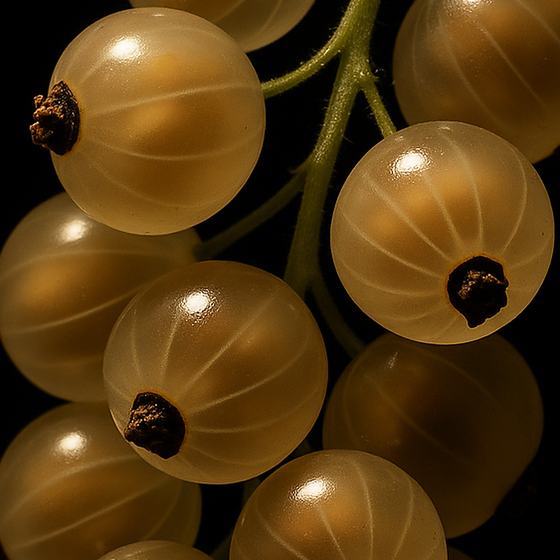
Specimen
White Currant perfume ingredient
Top
Ribes rubrum
Fantasy/Concept
Definition

White currant is a group of cultivars of the red currant (Ribes rubrum), a species of flowering plant in the family Grossulariaceae. Its berries are translucent white and sweeter than those of the red currant.

FLORAL GREEN SPICY SWEET FRUITY WARM FRESH
Whitecurrant
Type
Accord
Olfactive family
Fruity
Subfamily
Green fruits
Cluster
Mixed fruit notes
Source
fruit
Instruments
Pyramid
TTop
HHeart
BBase

Scent

It is an intense, dominant green and fruity aroma, tangy and somewhat minty or citrus-like, with deep, warm, wine-like earthy undertones. Some perceive a tomcat-urine-like note in it, attributed in part to minute amounts of a sulfur compound, 4-methoxy-2-methylbutan-2-thiol.

The Full Story

White currant is a group of cultivars of the red currant (Ribes rubrum), a species of flowering plant in the family Grossulariaceae, native to Europe. It is a sweeter and less pigmented variant of the redcurrant, not a separate botanical species; it is marketed as a different fruit. The shrub is deciduous, grows to 1 m tall and broad, and bears palmate leaves and masses of spherical, edible berries in summer. The berries are slightly smaller and sweeter than red currants.

Origin and Production

The group's origin is given as Central and Eastern Europe. Red and white currants are cultivated for their ornamental value as well as their berries, unlike their close relative the blackcurrant. Currant bushes grow best in partial to full sunlight and can be planted between November and March in well-drained, neutral to slightly acid soil. They are considered cool-climate plants and fruit better in northern areas. The firm and juicy fruit are usually harvested in summer. Whole trusses of fruits can be cut instead of individual fruit. Known forms include 'Blanka', 'White Pearl' and 'Versailles Blanche', and there are also cultivars with yellow and pink fruit, called yellow currants and pink currants. The cultivars 'White Grape' and 'Blanka' have gained the Royal Horticultural Society's Award of Garden Merit. The bushes can suffer from pests such as gooseberry sawfly and birds.

Flavour and Nutrition

The white-fruited variant of redcurrant has the same tart flavour as the redcurrant but with greater sweetness. The tart flavour of redcurrant fruit comes from a relatively high content of organic acids and mixed polyphenols. White currant berries are 84% water, 14% carbohydrates and 1% protein, with negligible fat. A 100 g reference amount supplies 56 calories and is a rich source of vitamin C, at 46% of the Daily Value.

Culinary Uses

White currants are often served raw and provide a sweetly tart flavor. White currant preserves, jellies, wines and syrups are also produced. Jams and jellies made from them are normally pink. White currants are rarely specified in savoury cooking recipes compared with their red counterparts.

Blackcurrant in Perfumery

The bud oil has a fruity, terpenic aroma with terpenic, nutmeg, neroli, basil and marjoram notes.

Did You Know?

In France, Bar-le-duc or Lorraine jelly is traditionally made from white currants or alternatively redcurrants. The pips are taken out by hand, originally by monks, with a goose feather, before cooking.

Extraction & Chemistry

Extraction method

In general, an absolute is made by extracting plant material with a hydrocarbon solvent such as hexane to give a concrete, then extracting the concrete with ethanol, cooling the ethanol extract to solidify waxes, and filtering it cold. When the ethanol evaporates, the absolute is left behind. About 300 kilos of buds yield only 1 kilo of absolute.

Botanical
Ribes rubrum
Synonyms
Whitecurrant
IFRA status
See note

No IFRA Standard for the material itself (51st Amendment)

In Perfumery

Blackcurrant absolute, from a close relative of the white currant, offers, at very low dosage, syrupy gourmand notes evoking the aromas of edible blackcurrant. Beyond that, it has an impact with very particular and powerful green touches. It is well adapted to floral accords and can also be a very good fixative or harmoniser in chypres. In food flavours, it heightens the fruity and green notes of sparkling beverages and is especially well suited to fruit flavors.

Role in the formula
01modifier
02signature note
03lifting agent
04blender
05freshness
Available as
synthetic accord fantasy note

See Also

7 notes