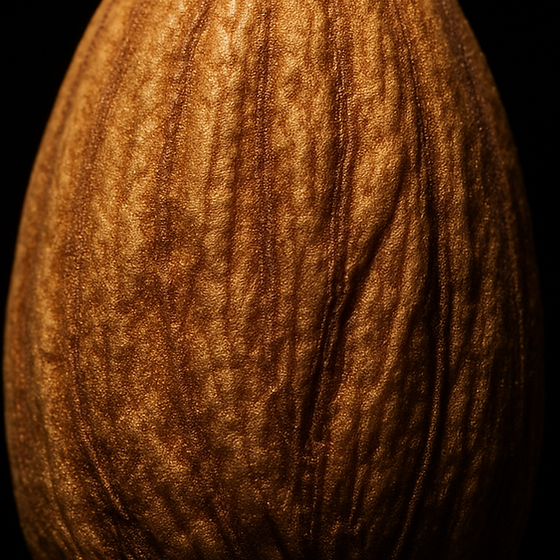
Badem

PrirodnaVOĆE, POVRĆE I ORAŠASTI PLODOVIorašast · sladak · kremast
Gornje notePiramida
—Jačina
—Trajnost
5Poreklo
Uzorak
Badem kao sirovina za parfeme
Gornje note
Prunus dulcis
Definicija

Almond as a perfumery material is bitter almond oil, an essential oil that is nearly pure benzaldehyde. Its odor is cherry pit, with a sweet fruity powdery background.

FRUITY SWEET POWDERY CHERRY-PIT ALMOND-LIKE
bitter almond oil
Type
Sirovina
Olfactive family
Voćni
Source
Bitter almond seed
Chemical class
Essential oil
Instrumenti
Piramida
GGornje note
SSrednje note
BBazne note
Zemlje proizvođači
Sjedinjene Američke Države Australija Španija Turska Maroko

Miris

Benzaldehyde has a characteristic odor similar to that of bitter almonds and cherry. The odor type of bitter almond oil is fruity. The odor of bitter almond oil is cherry pit, with a sweet fruity powdery background. The odor of benzaldehyde is also described as almond-like.

Detaljno

Benzaldehyde (C₆H₅CHO) is an organic compound consisting of a benzene ring with a formyl substituent. It is among the simplest aromatic aldehydes and one of the most industrially useful. Benzaldehyde has the formula C₇H₆O and the CAS number 100-52-7. It is a colorless liquid, strongly refractive, with a density of 1.044 g/mL and a boiling point of 178.1 °C. Benzaldehyde dissolves in water to 6.95 g/L at 25 °C.

The Chemistry of Bitter Almond

Amygdalin is a cyanogenic glycoside derived from the aromatic amino acid phenylalanine. It has the formula C₂₀H₂₇NO₁₁ and takes its name from the Ancient Greek word for almond. It is found in many plants, such as the seeds of apricots, bitter almonds, apples, peaches, cherries and plums. In one study, amygdalin concentrations in bitter almonds ranged from 33 to 54 g/kg depending on variety, while semibitter varieties averaged 1 g/kg and sweet varieties averaged 0.063 g/kg, with significant variability by variety and growing region. Other kernels and seeds contain amygdalin too, at about 14 g/kg in apricot, 6.8 g/kg in peach, 3.9 g/kg in red cherry, 2.7 g/kg in black cherry and 3 g/kg in apple seeds. Within these plants, amygdalin and the enzymes necessary to hydrolyze it are stored in separate locations and only mix as a result of tissue damage. Amygdalin breaks up under enzyme catalysis into benzaldehyde, hydrogen cyanide and two equivalents of glucose. Benzaldehyde released from amygdalin provides a bitter flavor. Bitter almonds may yield 4-9 milligrams of hydrogen cyanide per almond and contain 42 times higher amounts of cyanide than the trace levels found in sweet almonds.

Bitter and Sweet Almonds

The fruits from Prunus amygdalus var. amara are always bitter. Kernels of other Prunus species such as apricot, peach and cherry are bitter as well, although to a lesser extent. Bitterness in almonds rests on a single gene, and the bitter trait is recessive, which made it easier to domesticate. Because of a difference in a recessive gene called Sweet kernel, much less amygdalin is present in nonbitter (or sweet) almond than bitter almond. The bitter almond is slightly broader and shorter than the sweet almond and contains about 50% of the fixed oil that occurs in sweet almonds.

Almond Oil

Almonds are a rich source of oil, with 50% of kernel dry mass as fat. Almonds are 4% water, 22% carbohydrates, 21% protein and 50% fat. Oleum amygdalae, the fixed oil, is prepared from either sweet or bitter almonds and is a glyceryl oleate. The fixed oil has a slight odour and a nutty taste. In relation to total dry mass of the kernel, almond oil contains 32% oleic acid, 13% linoleic acid and 10% saturated fatty acid, mainly palmitic acid. Almond oil analysed separately provides, per 100 grams, 70 grams of oleic acid and 17 grams of linoleic acid. The fixed oil is almost insoluble in alcohol but readily soluble in chloroform or ether.

The Almond Tree

The almond tree bears fragrant white to pale pink flowers, 3-5 cm across, which appear before the leaves in early spring. Almond trees thrive in Mediterranean climates with warm, dry summers and mild, wet winters. Trees begin bearing an economic crop in the third year after planting and reach full bearing five to six years after planting. The fruit matures in the autumn, 7-8 months after flowering.

Production

In 2024 world production of almonds was 3.9 million tonnes, led by the United States with 51% of the total, followed by Australia and Spain.

Occurrence

The almond fruit is not a nut but a drupe. Iran is the world's most important gene pool for wild almonds. So far, 23 species and 7 of their interspecies hybrids have been reported in Iran. Most of the benzaldehyde that people eat is from natural plant foods, such as almond. Benzaldehyde, a component of bitter almond oil, can be extracted from a number of other natural sources.

This note in PREMIEREPEAU. Insuline Safrine. Sample all seven extraits in the Discovery Set.

Zanimljivosti

In 1832, Wöhler and Liebig published an investigation of the oil of bitter almonds. Their research showed that a group of elements with the chemical composition C₇H₅O can be thought of as a single functional group, which came to be known as a benzoyl radical. Their work established the concept of compound radicals, which had a profound influence on the development of organic chemistry. In the long run their identification of radicals can be seen as an early step along the path to structural chemistry.

Dobijanje i hemija

Način dobijanja

In the bitter almond, the enzyme emulsin acts in the presence of water on the glucosides amygdalin and prunasin, yielding glucose, cyanide and the essential oil of bitter almonds. Almond oil is obtained from the dried kernel of almonds. Benzaldehyde can be produced from both petroleum-based chemicals or plant-derived chemicals. Synthetic benzaldehyde is primarily produced using liquid phase chlorination and oxidation of toluene. Numerous other methods have been developed, such as the partial oxidation of benzyl alcohol, alkali hydrolysis of benzal chloride, and the carbonylation of benzene (the Gatterman-Koch reaction). Natural benzaldehyde is produced from cinnamaldehyde obtained from cassia oil by the retro-aldol reaction. The cinnamaldehyde is heated in an aqueous/alcoholic solution between 90 °C and 150 °C with a base, most commonly sodium carbonate or bicarbonate, for 5 to 80 hours.

Formula
Complex natural mixture (key constituents: benzaldehyde C₇H₆O)
CAS
8013-76-1
Botanički naziv
Prunus dulcis
Izgled
Pale yellow to yellow clear liquid
Sinonimi
bitter almond oil
Status prema standardima IFRA
Pogledajte napomenu

No IFRA Standard for the material itself (51st Amendment)

Fizička svojstva
Relativna gustina
1.04000 to 1.05000 @ 25.00 °C
Indeks prelamanja
1.54100 to 1.54600 @ 20.00 °C

U parfemima

Bitter almond oil, containing benzaldehyde, is used as a food flavouring and in perfume. Synthetic benzaldehyde is the flavoring agent in imitation almond extract, which is used to flavor cakes and other baked goods. Benzaldehyde is also commonly used in cherry-flavored sodas.

Uloga u formuli
01modifikator
02nota potpisa
03sirovina za stapanje
04graditelj volumena
05svežina
Oblici na tržištu
sintetički (benzaldehid) prirodno eterično ulje (FFPA) akord

Pogledajte i

6 nota