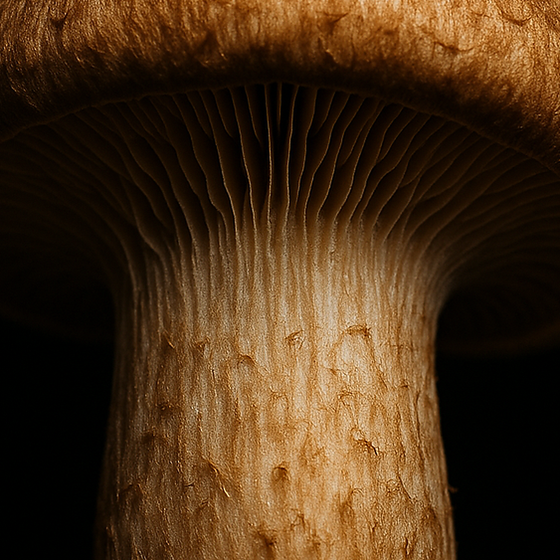
Pečurka

Prirodna i sintetičkaVOĆE, POVRĆE I ORAŠASTI PLODOVIearthy · green · mushroom
Gornje note·Srednje notePiramida
—Jačina
—Trajnost
—Poreklo
Uzorak
Pečurka kao sirovina za parfeme
Gornje i srednje note
Agaricus bisporus
Definicija

A mushroom is the fleshy, spore-bearing fruiting body of a fungus, and 1-octen-3-ol, also called mushroom alcohol, is responsible for much of the odour associated with fungi. The odour of 1-octen-3-ol is fresh-cut mushroom, earthy and green.

PEČURKAST ZEMLJAN ZELEN METALAN
common mushroom, button mushroom, white mushroom, cultivated mushroom
Type
Sirovina
Olfactive family
Zemljani
Source
fungus
Chemical class
Chiral secondary alcohol (C8)
Instrumenti
Piramida
GGornje note
SSrednje note
BBazne note
—Jačina
Very intense
Very intense
Trajnost na mirisnoj traci
Moderate

Miris

1-Octen-3-ol has a fresh-cut mushroom, earthy and green odour, with metallic and slightly fatty facets. Its main descriptors are mushroom, earthy, metallic-green, wet soil and slightly animalic. The odour evokes damp forest floors, fresh mushrooms and crushed greenery. The (R)-(-) isomer has a mushroom smell, while the (S)-(+) isomer has a mouldy, grassy smell. An Agaricus bisporus extract in oil has a rich, creamy, multi-layered mushroom aroma with earthy, woody-mossy, salty, fatty and subtly animalic nuances.

Detaljno

1-Octen-3-ol, also called mushroom alcohol, is a colorless liquid that occurs widely in nature. It is found in many mushrooms, where it may play a role as an antifeedant.

The Mushroom Itself

Agaricus bisporus, the cultivated mushroom, is a basidiomycete mushroom native to grasslands in Eurasia and North America. It is cultivated in more than 70 countries.

Where the Odour Comes From

Enzymes in the mushroom break down linoleic acid, and 1-octen-3-ol is one of the products. Mushrooms produce only the (R)-(-) isomer, and it is largely synthesised in the cap and gills. The enzymatic pathway that forms it is activated when mushroom tissue is wounded. 1-Octen-3-ol is generated by a wide range of both macroscopic and microscopic fungi and is nearly ubiquitous in both mushrooms and moulds. Among the volatiles of truffles are fatty acid-derived C8 alcohols and aldehydes with a characteristic fungal odor, such as 1-octen-3-ol and 2-octenal; the alcohol is derived from linoleic acid and produced by the mature white truffle T. borchii. Beyond mushrooms and truffles, it occurs in many other foodstuffs, notably giving the odour of Camembert cheese a mushroom note.

Chemistry

1-Octen-3-ol is a chiral secondary alcohol with the formula CH₂=CHCH(OH)(CH₂)₄CH₃. Because the molecule has a chiral carbon, it can exist as two optical isomers. Recent studies have indicated that the major volatile constituents of fresh button mushroom are eight-carbon volatiles, such as 1-octen-3-ol, 3-octanol, 2-octen-1-ol, 1-octanol and 3-octanone. 1-Octen-3-one, a related molecule, has an even lower odour threshold and a very strong smell of mushrooms. 1-Octen-3-one was identified as the main aroma component of cooked button mushroom. In a study of the aroma compounds of the porcini, Boletus edulis, 1-octen-3-one was the most prevalent chemical detected in raw mushrooms.

Mushroom Extract

White mushroom extract is produced from the stems and caps of Agaricus bisporus mushrooms. The finished product is a concentrated mushroom extract in a base of 98% MCT oil.

Other Occurrences and Uses

Octenol is responsible for the moldy odor of damp indoor environments. Octenol is used, sometimes in combination with carbon dioxide, to attract insects in order to kill them with certain electrical devices. In the United States, octenol is approved by the Food and Drug Administration as a food additive.

Zanimljivosti

1-Octen-3-ol attracts mosquitoes, especially together with carbon dioxide, and has been used in mosquito traps. A smell of mushrooms near a Canadian car painting plant was traced to 1-octen-3-one, formed by the reaction of methanal in paint resins with heptan-2-one used as a solvent.

Dobijanje i hemija

Način dobijanja

Natural 1-octen-3-ol can be produced with a crude enzyme homogenate from mushrooms in a bioreactor, and this process is used industrially to make 1-octen-3-ol. In the laboratory, it can be made by the selective reduction of 1-octen-3-one. It can also be made by a Grignard-type reaction involving acrolein and amyl iodide. Another laboratory route starts with the teleomerisation of butadiene with acetic acid, using a palladium complex as catalyst, and the acetate of 1,7-octadien-3-ol that forms is converted to the alcohol. Hydrodistillation of the flowering aerial parts of the mint-family plant Melittis melissophyllum gives an essential oil with 43.6-54.2% 1-octen-3-ol, and the plant has been suggested as a future commercial source.

Formula
Complex natural mixture (key constituents: 1-octen-3-ol C₈H₁₆O; 3-octanol)
CAS
3391-86-4 (1-octen-3-ol)
Botanički naziv
Agaricus bisporus
Izgled
Colorless to pale yellow liquid (1-octen-3-ol); colorless, transparent, mobile liquid (extract)
Jačina mirisa
Very intense
Trajnost
Moderate
Sinonimi
common mushroom, button mushroom, white mushroom, cultivated mushroom
Status prema standardima IFRA
Pogledajte napomenu

No IFRA Standard for the material itself (51st Amendment)

Fizička svojstva
Tačka ključanja
174 °C at 1 atm
Tačka paljenja
68 °C

U parfemima

The right-handed isomer of 1-octen-3-ol, known as mushroom alcohol or matsutake alcohol, is used in perfumery because it is the main flavor and odor component of matsutake. 1-Octen-3-ol has a very low odour threshold, around 1 ppb. In flavour work, 1-octen-3-ol is a principal natural flavouring compound. In a recombination test of button mushroom aroma, omitting 1-octen-3-ol caused a significant difference in the electronic-nose response, so it ranks among the most crucial aroma substances for roasted button mushroom.

Uloga u formuli
01modifikator
02sirovina za stapanje
03naturalizator
Oblici na tržištu
synthetic aroma chemical extract in oil

Pogledajte i

6 nota