Tartuf

Prirodna i sintetičkaKORENJE I MAHOVINEzemljan · sumporast
Bazne notePiramida
4/5Jačina
—Trajnost
4Poreklo
Uzorak
Tartuf kao sirovina za parfeme
Bazne note
Tuber melanosporum (black truffle) / Tuber magnatum (white truffle)
Definicija

Truffles are subterranean fungi that grow on tree roots, usually with oak or hazelnut trees.

Terreux
97
Musqué
82
Animalique
70
Doux
35
Chaleureux
60
Soufré
88
black truffle, Périgord truffle, French black truffle, white truffle, tartufo bianco d'Alba
Type
Sirovina
Olfactive family
Zemljani
Source
fungus
Chemical class
complex natural
Instrumenti
Piramida
GGornje note
SSrednje note
BBazne note
4/5Jačina
Visoka
jačina mirisa
Zemlje proizvođači
Francuska Španija Italija Australija

Miris

The fruiting bodies of the black truffle exude a scent reminiscent of undergrowth, strawberries, wet earth, or dried fruit with a hint of cocoa. Some very aromatic white truffles are notably pungent, even irritating the eye when cut or sliced. The C8 alcohols and aldehydes of truffles, such as 1-octen-3-ol and 2-octenal, have a characteristic fungal odor. Pure 2,4-dithiapentane has a strong odor, reminiscent of freshly prepared mustard. Dimethyl sulfide has a characteristic odor commonly described as cabbage-like. The Tuber melanosporum extract at 1.00 % in propylene glycol has a fungal odor of truffle.

Propisi i izmene formule

Detaljno

Truffles are subterranean fungi that grow on tree roots. They are found underground, usually with oak or hazelnut trees. The black Périgord truffle (Tuber melanosporum) is named after the Périgord region in France and is harvested in late autumn and winter. The white truffle (Tuber magnatum) is mainly found in Italy, but also in other parts of Southern Europe, as well as Thailand.

This note in PREMIEREPEAU. Albâtre Sépia. Sample all seven extraits in the Discovery Set.

Habitat and growth

Black truffles associate with oaks, hazelnut, cherry, and other deciduous trees. Black truffles grow at a depth of 5 cm to 50 cm as ectomycorrhizae, preferably in loose calcareous soil. The white truffle grows symbiotically with oak, hazel, poplar and beech. The soils of the white truffle have an average pH of about 7.7 and range from neutral to alkaline. The Périgord truffle is restricted to alkaline environments.

The symbiosis of holm oak saplings and black truffles has been shown to improve photosynthesis and root growth in the plant. Black truffles suppress the growth of plants around their symbiont, creating the impression of a burnt area. Truffles draw carbohydrates from the tree and use them to construct filaments that push through the soil in search of other rootlets. The mycorrhiza with their filaments are far better than an uncloaked rootlet at collecting nutrients for the tree.

No one has ever managed to grow a truffle in the laboratory without a tree. A truffle farmer does not plant truffles but oak trees, since truffles grow only near the roots of certain trees. In cultivation, the first fruiting bodies can be harvested about 4-10 years after the trees are planted. Black truffles are now also cultivated in Australia and New Zealand. In 1937, France produced about 1,000 metric tonnes of black truffles.

Aroma and chemistry

Without smell, a truffle would rot in place and not fulfill its function of spreading seed. Truffles possess significant variability in their aroma profiles from species to species. Among the hundreds of aroma active compounds in truffles, 2-methylbutanal, 3-methylbutanal, dimethyl disulphide (DMDS) and dimethyl sulphide (DMS) are the most common natural aroma compounds. Dimethyl sulfide is the main volatile product of various truffles.

The volatile compounds that contribute to the aroma of the black truffle include 2-methyl-1-butanol, isoamyl alcohol, 2-methylbutyraldehyde and 3-methylbutyraldehyde, as well as traces of sulfur compounds. 1-Octen-3-ol was detected in high amounts in raw T. melanosporum. Several species of yeast, which produce part of the aromatic compounds, have been isolated from Tuber melanosporum and Tuber magnatum. If black truffles are stored at room temperature, the aromatic compounds dissipate, while storage around the freezing point leads to an increased synthesis of these compounds.

2,4-Dithiapentane is an organosulfur compound and the simplest alkyl dithioether. It is also named bis(methylthio)methane. 2,4-Dithiapentane is found as an aromatic component in some truffle varieties. It is the key odorant of Tuber magnatum. Thiophene derivatives appear to be produced by bacterial symbionts living in the truffle body. In Tuber borchii, thiophene derivatives, in particular 3-methyl-4,5-dihydrothiophene, were the main contributors to the human-sensed aroma.

Authenticity

Cheaper Tuber borchii are sold for T. magnatum. In some cases, scent is enhanced with petroleum-based essence such as bis(methylthio)methane. Isotopic analysis is the most reliable detection of fraud or of mislabelling. The carbon isotope ratio (δ13C) of bis(methylthio)methane in genuine truffles lies between -43 and -34‰, and synthetic aroma gives more negative values.

In a fragrance

Truffle is a base-note signature in PREMIEREPEAU's Albâtre Sépia — paired with white truffle ink, tonka bean, iso E super and frankincense. The accord uses both the dithiomethane sulphur signal and a fatty-earthy mushroom alcohol backbone (oct-1-en-3-ol) to recreate the truffle's full register without the literal extract.

Zanimljivosti

Androstenol, or a derivative, is found in black truffles, and this was offered as an explanation for how pigs locate them deep in the ground. Experiments in France showed that pigs responded to truffles and truffle scent extract but ignored purified androstenol. Dimethyl sulfide is the molecule that creates the pigs' interest. In experiments, pigs grubbed for the synthetic truffle scent with the same enthusiasm as for real truffles. The record price for a single white truffle was set in December 2007, when a 1.5 kg specimen sold for $330,000. In November 1999 the then-largest truffle in the world, weighing 1.31 kg, was found near Buje, Croatia.

Dobijanje i hemija

Način dobijanja

2,4-Dithiapentane is industrially prepared by the acid-catalyzed condensation of methyl mercaptan with formaldehyde. After the chemical components of truffle aroma were identified, the nine most important ones were synthesized and mixed into a chemical cocktail that would fool most human noses. The exact composition of the synthetic aroma used to imitate truffle flavor is unknown. Cultivation involves planting trees, such as hazel, whose roots are inoculated with truffle mycelium. Saplings were first inoculated with truffle spores in the early 1970s, which raised the chance that the trees would produce truffles. Truffles are traditionally located with pigs, though dogs are now preferred. Some truffle oils are made with the residue of truffles collected or prepared for sale.

CAS
85085-76-3
Botanički naziv
Tuber melanosporum (black truffle) / Tuber magnatum (white truffle)
Izgled
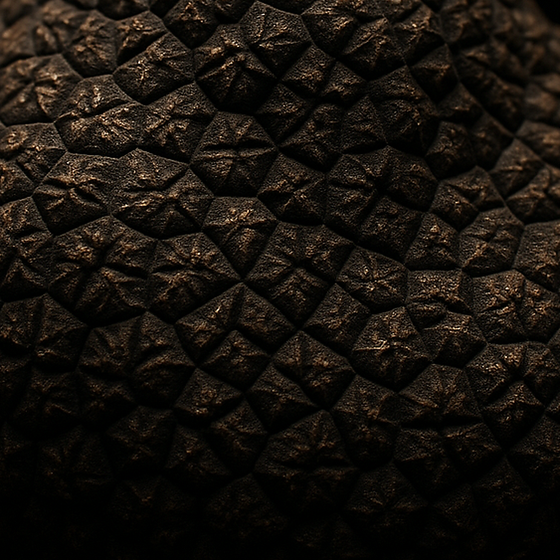
Black truffle: round, dark brown fruiting bodies with a black-brown skin and small pyramidal cusps
Jačina mirisa
Jak
Sinonimi
black truffle, Périgord truffle, French black truffle, white truffle, tartufo bianco d'Alba
Raspon cena
1,000-2,000 per kg (black truffle, 2013)
Status prema standardima IFRA
Pogledajte napomenu

No IFRA Standard for the material itself (51st Amendment)

U parfemima

Truffle-derived products have a short shelf-life and are available only during the truffle season, and the food industry has been developing synthetic flavors. The mixture of DMS and 2-methylbutanal has been used for a long time by the food industry to reproduce T. melanosporum aroma. A synthetic version of 2,4-dithiapentane is the primary aromatic additive in commercial truffle products, such as truffle oil, truffle butter, truffle salt and truffle pastes. Many of these products contain no truffle content at all. Truffle oil is used as a lower-cost and convenient substitute for truffles, to provide flavouring, or to enhance the flavour and aroma of truffles in cooking. The vast majority of truffle oil is oil artificially flavoured with a synthetic agent such as 2,4-dithiapentane. Truffle-flavoured oils contain more than 60 volatiles, of which 2,4-dithiapentane is the most common. Truffle vodka can carry a more complex and accurate truffle flavour than oil without synthetic flavourings, because more aromatic molecules in truffles are soluble in alcohol. Black truffles refine the taste of meat, fish, soups, cheeses and risotto in cooking. Unlike white truffles, the aroma of black truffles does not diminish when they are heated but becomes more intense. The Tuber melanosporum extract has the cosmetic ingredient functions humectant, perfuming and skin conditioning. PREMIEREPEAU's Albatre Sépia (/products/albatre-sepia-white-truffle-ink-perfume) uses white truffle as a structural anchor alongside ink and gourmand elements, exploring the material's most inky and lithographic qualities.

Uloga u formuli
01fiksativ
02modifikator
03okosnica
04nota potpisa
05sirovina za stapanje
06naturalizator
Oblici na tržištu
ekstrakt sintetički akord

Pogledajte i

6 nota