Tonka

Prirodna
—Piramida
4/5Jačina
—Trajnost
2Poreklo
Uzorak
Tonka kao sirovina za parfeme
Dipteryx odorata
Definicija

Tonka bean is the seed of Dipteryx odorata, a tree of the pea family native to northern South America. The seeds have a strong fragrance similar to that of sweet woodruff, due to their high content of coumarin.

SLADAK KAO SENO VANILAST
Cumaru, tonkin bean, tonquin bean, sarrapia
Type
Sirovina
Source
seeds (beans) of Dipteryx odorata
Instrumenti
4/5Jačina
Visoka
jačina mirisa
Zemlje proizvođači
Venecuela Nigerija

Miris

Tonka bean absolute has a strong fragrance with powdery, almond and vanilla notes, nuanced by dry, woody and tobacco facets. The aroma of the bean is often described as a sweet blend of cinnamon, clove, almond, vanilla and caramel, sometimes with hints of cherry or freshly cut hay.

The resinoid is described as rich, sweet and herbaceous-coumarinic, with prune, caramel and soft spicy undertones. The resinoid has a herbal-almond coumarinic backbone similar to new-mown hay. The resinoid's drydown is soft-spicy, subtly vanillic and long-lasting.

Detaljno

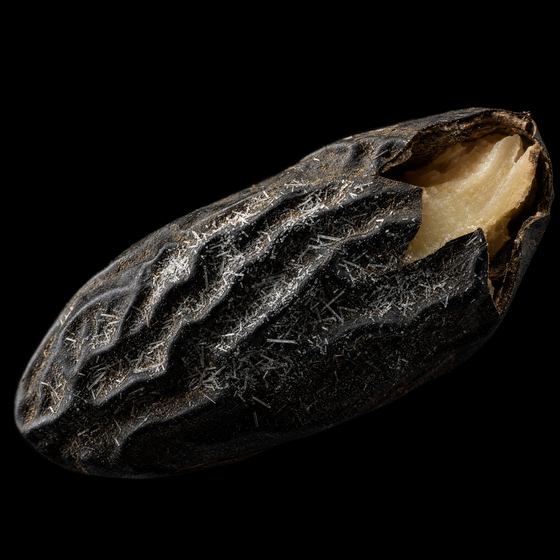
The tree, Dipteryx odorata, is semi-deciduous and is pollinated by insects. The tree belongs to the pea family, Fabaceae, and is also called cumaru. The seeds are black and wrinkled and have a smooth, brown interior. Each developed fruit contains one seed.

Tonka bean in PREMIEREPEAU

Tonka and coumarin are among the materials listed for Albâtre Sépia, composed by Florian Gallo. Albâtre Sépia is also part of the Discovery Set.

The tree and its fruit

Dipteryx odorata is found in present-day Venezuela, northern Brazil, Colombia, Suriname and the Guianas, as well as the nearby islands of Trinidad and Tobago. The tree grows to a height of up to 25-30 m (82-98 ft), with a trunk of up to 1 m (3 ft 3 in) in diameter. The bark is smooth and gray, whereas the wood is red. The leaves are alternate and pinnate, with three to six leathery, glossy, dark green leaflets, and the flowers are pink.

The fruit resembles a small mango, ripening from dark green into yellow and mahogany. Its fibrous yellow pulp encases a fuzzy, peach-like pit that holds a smooth, black seed. The name tonka bean is derived from the Tupi and Galibi languages of Indigenous South America. The tree also yields a durable hardwood known as cumaru, which is exported for flooring and furniture.

Where the smell comes from: coumarin

The scent of tonka comes from coumarin (C₉H₆O₂, molecular weight 146.14, CAS 91-64-5). The seeds normally contain about 1-3% of coumarin, but can rarely reach levels of up to 10%. Coumarin is also present in lavender, cinnamon, licorice, strawberries and cherries.

Coumarin belongs to the benzopyrone chemical class and is considered a lactone. Coumarin is a colorless crystalline solid with a bitter taste. Coumarin can be prepared by several name reactions; the Perkin reaction between salicylaldehyde and acetic anhydride is a popular example.

Many anticoagulant prescription drugs, such as warfarin, are based on 4-hydroxycoumarin, a chemical derivative of coumarin; coumarin itself has no anticoagulant properties.

Use in food and tobacco

In France, tonka beans are used in cuisine, particularly in desserts and stews. The flavour has been described as a complex mix of vanilla, almond, clove, cinnamon and amaretto. The beans are still used to flavor some pipe tobaccos.

Food rules and safety

In large infused doses, coumarin may cause hemorrhages, liver damage, or paralysis of the heart. It is therefore controlled as a food additive by many governments.

In the United States, 21 CFR 189.130 deems food containing any added coumarin, as such or as a constituent of tonka beans or tonka extract, to be adulterated, based on a Federal Register order of 5 March 1954 (19 FR 1239). European Regulation (EC) No 1334/2008 sets maximum limits for coumarin in food, among them 15 mg/kg in fine bakery ware (traditional and seasonal bakery ware citing cinnamon excepted) and 5 mg/kg in desserts.

Cultivation

The cumaru tree is a light-demanding calcifuge tree which grows on poor, well-drained soils. The best growth is reached on fertile soils rich in humus. A tree yields about 1.0-3.5 kg (2.2-7.7 lb) of beans per year, but produces a large volume of seeds every four years.

Zanimljivosti

The name coumarin comes from coumarou, the French word for the tonka bean. Radio-carbon dating of stumps of the tree near Manaus showed that it is one of around 100 species that definitely live to over 1,000 years.

Dobijanje i hemija

Način dobijanja

In Brazil, the ripe fruits are harvested mainly between August and September, after they have fallen to the ground, and are picked by hand. The shell is broken with a stone or a hammer to extract the beans, a technique called 'pisado'. The beans are dried in the shade, then in the sun, and immersed in strong alcohol at 65° for 24 hours. The beans are then left to dry for five to six days, during which they develop a white glaze as small coumarin crystals form on the outer layer. The beans are transformed first into a concrete and then into an absolute through solvent extraction.

Botanički naziv
Dipteryx odorata
Izgled
Black, wrinkled seed with a smooth, brown interior
Jačina mirisa
Jak
Sinonimi
Cumaru, tonkin bean, tonquin bean, sarrapia
Status prema standardima IFRA
Pogledajte napomenu

No IFRA Standard for the material itself (51st Amendment)

U parfemima

Tonka bean is listed among the materials of Albâtre Sépia, composed by Florian Gallo, together with coumarin. In France, tonka beans are used in perfumes. Tonka bean absolute is an essential component of amber and oriental accords. Its distinctive facets make it suited to tobacco or fougère accords. Tonka beans have been used as a source of natural coumarin.

Pogledajte i

6 nota