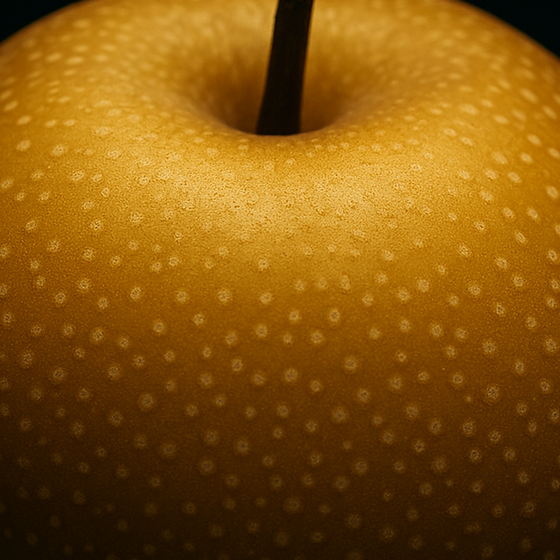
Nashi pear is the edible fruit of Pyrus pyrifolia, a species of pear tree native to southern China and northern Indochina that has been introduced to Korea, Japan and other parts of the world. In Japanese the fruit is called nashi. The fruits are not generally baked in pies or made into jams because they have a high water content and a crisp, grainy texture, very different from the European varieties. They are commonly served raw and peeled.
Origin and Cultivation
Cultivars are classified in two groups, the Akanashi ('Russet pears') and the Aonashi ('Green pears'). 'Kosui' is the most important cultivar in Japan. The name of the cultivar 'Nijisseiki' means "20th century". In Japan, over 1,200 names of cultivars have been recorded, and escaped and wild trees are still preserved. In Japan, almost all recent commercial cultivars are genetically derived from the cultivar Nijisseiki and from some local cultivars that originated in the Southern Kanto districts. In Japan, fruit is harvested in Chiba, Ibaraki, Tottori, Fukushima, Tochigi, Nagano, Niigata, Saitama and other prefectures, except Okinawa. In Nepal and the Himalayan states of India, they are cultivated as a cash crop in the Middle Hills between about 1,500 and 2,500 metres in elevation, where the climate is suitable. Three serious diseases are recorded in Japanese orchards: rust, black spot and scab. Scab is left as a difficult disease to control.
Aroma Chemistry
More than 300 volatile compounds have been identified in pear fruit (Pyrus pyrifolia Nak.). In six cultivars, three of Pyrus communis and three of Pyrus pyrifolia, a total of 510 volatile compounds were identified. Sixteen ester and alcohol compounds, including butyl acetate and hexyl acetate, are present at higher contents in the Pyrus communis cultivars than in the Pyrus pyrifolia cultivars. Of 47 volatile compounds shared by three P. pyrifolia cultivars, only ethyl caproate was significantly higher in concentration than in three P. communis cultivars. Methyl and hexyl esters of decadienoate are the character-imparting compounds of the European pear. A high concentration of 2,4-decadienoates in fruit flesh is accepted by consumers. Ethyl decadienoate, also known as pear ester, has the formula C₁₂H₂₀O₂ and a molar mass of 196.29 g/mol. It is found in apples, Bartlett pears, Concord grapes, beer, pear brandy and quince.
Culinary Use and Culture
In cooking, ground pears are used in vinegar- or soy sauce-based sauces as a sweetener, instead of sugar. They are also used when marinating meat, especially beef, as in the Korean dish bulgogi, because of enzymes that tenderize the proteins in the meat. Because of their relatively high price and the large size of the fruit of cultivars, the pears tend to be served to guests, given as gifts, or eaten together in a family setting. Traditionally in East Asia the tree's flowers are a popular symbol of early spring, and it is a common sight in gardens and the countryside. In Korea, the fruit is known as bae and is grown and consumed in great quantity. In the South Korean city of Naju, there is a museum called The Naju Pear Museum and Pear Orchard for Tourists.