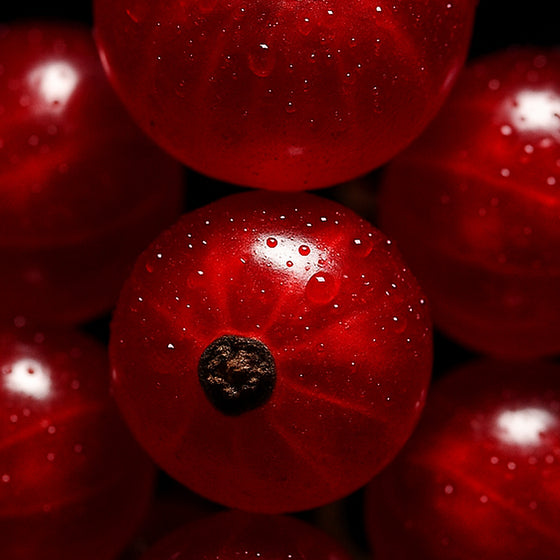
Red currant is native to western Europe. The species is widely cultivated and has escaped into the wild in many regions.
Botany
The shrub normally grows 1-1.5 metres tall, with five-lobed leaves arranged spirally on the stems. The flowers are inconspicuous and yellow-green, held in pendulous racemes 4-8 centimetres long, and they mature into bright red, translucent, edible berries. The berries are about 8-12 millimetres in diameter, and the wild plant has 3-10 berries on each raceme. The plant is self-pollinating but produces more fruit when pollinated by another plant of a different variety. The white currant is a cultivar of R. rubrum: a sweeter and less-pigmented variant of the redcurrant, not a separate botanical species.
Classification and names
Recent treatments place the red currant in Grossulariaceae because of wholly inferior ovaries, a totally syncarpous gynoecium and fleshy fruit. Prevalent monographs recognise a single genus, Ribes, for both currants and gooseberries. The centres of diversity for black currants and red currants include Northern Europe, Scandinavia and the Russian Federation. R. sativum and R. vulgare are synonyms of R. rubrum. The red currant is called aalbes or rode bes in Dutch, groseillier in French, johannisbeere in German, ribs in Danish, vinbar in Swedish and grosellero rojo in Spanish.
Cultivation
Currant bushes prefer a level of sunlight ranging from partial to full and can grow in most types of soil. They are relatively low-maintenance plants and can also be used as ornamentation. Red currant species grow wild in northern France, Germany and Austria, but their fruit does not attain the size and quality of the more northern species. Ribes triste, the North American red currant, has fruit quality similar to European red currants, but it is lower yielding and has not been domesticated. The cultivars 'Jonkheer van Tets', 'Red Lake' and 'Stanza' have gained the Royal Horticultural Society's Award of Garden Merit. Germany and the Slovak Republic are the leading producers of white currants.
Taste and chemistry
The tart flavour of redcurrant fruits comes from a relatively high content of organic acids and mixed polyphenols. As many as 65 different phenolic compounds may contribute to the astringent properties of redcurrants. Twenty-five individual polyphenols and other nitrogen-containing phytochemicals have been isolated from redcurrant juice specifically with the astringent flavour profile sensed on the human tongue. With maturity the tart flavour of redcurrant fruit is slightly greater than its blackcurrant relative but with the same approximate sweetness. The white-fruited variant has the same tart flavour but greater sweetness.
Nutrition
Raw red or white currants are 84% water, 14% carbohydrates and 1% protein, with negligible fat. A 100-gram portion supplies 234 kilojoules (56 kilocalories) of food energy and is a rich source of vitamin C, at 46% of the Daily Value.
Culinary uses
Red currants are valued for fresh markets and for the production of preserves. In the United Kingdom redcurrant jelly is a condiment often served with lamb. In France, Bar-le-duc is a spreadable preparation traditionally made from white currants or alternatively redcurrants. In Linz, Austria, redcurrant is the most commonly used filling for the Linzer torte. In Russia redcurrants are used in jams, preserves, compotes and desserts. In Scandinavia and Schleswig-Holstein the fruit is often used in fruit soups and summer puddings. The leaves have many uses in traditional medicine, such as making an infusion with black tea.