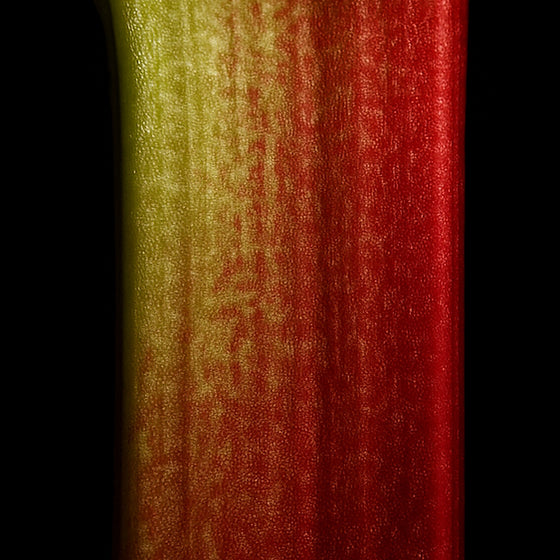
Rhubarb is the fleshy, edible stalks (petioles) of species and hybrids of Rheum in the family Polygonaceae, which are cooked and used for food. The plant is a herbaceous perennial that grows from short, thick rhizomes. The large, triangular leaves contain high levels of oxalic acid and anthrone glycosides, making them poisonous and therefore inedible.
Rheum is a genus of about 60 herbaceous perennial plants. The precise origin of culinary rhubarb is unknown. Modern rhubarb cultivars are tetraploids with 2n = 44, in contrast to 2n = 22 for the wild species. The small flowers are greenish-white to rose-red and grouped in large compound leafy inflorescences.
Species and Cultivation
Species of Rheum are native to eastern Europe and to southern and eastern temperate Asia, with a few reaching into northern tropical Asia, and they are cultivated in Europe, Asia and North America. The genus was described in 1753 by Carl Linnaeus, initially for three species: R. rhaponticum, R. rhabarbarum and R. ribes. Rheum rhabarbarum is native to a region stretching from southern Siberia to north and central China, and is considered one of the species involved in the development of culinary rhubarb. Its roots were harvested from the wild for centuries as a popular medicine in Europe and Asia.
The early cultivated species and the hybrid readily hybridize, and culinary rhubarb was developed by selecting open-pollinated seed, so its precise origin is almost impossible to determine. In appearance, samples of culinary rhubarb vary on a continuum between R. rhaponticum and R. rhabarbarum. Many cultivars have been developed for human consumption, most of which are recognised as Rheum × hybridum by the Royal Horticultural Society.
Chemistry of the Stalk
Analysis of the volatiles of uncooked rhubarb (Rheum rhabarbarum) stalks found a preponderance, approximately 65%, of compounds with C6 skeletons. Fifty-nine components were reported for the first time in rhubarb. Besides unsaturated C6 aldehydes and alcohols, substantial amounts of the less common (E)-2- and (E)-3-hexenoic acid were detected. Volatiles of rhubarb (Rheum rhabarbarum) stalks were isolated by a vacuum headspace method and analysed by capillary gas chromatography-mass spectrometry. Gas chromatography-olfactometry and odor activity values showed the C6 compounds to be of sensory importance to the aroma of rhubarb.
The initial spectrum of C6 components is changed by subsequent isomerization and reductions.
The acidic flavour of the stalks is caused by nontoxic malic acid. In the stalks, oxalic acid makes up about 10% of a total acidity of 2-2.5%, which derives mainly from malic acid. The plants also produce citric acid and anthraquinone glycosides.
Toxicity of the Leaves
The oxalic acid content of rhubarb leaves varies, but a typical value is about 0.5%. A 65 kg adult would need to eat 4 to 8 kg of leaves to obtain a lethal dose, depending on which lethal dose is assumed. The leaves are believed to also contain an additional, unidentified toxin, which might be an anthraquinone glycoside.
All parts of the plant contain slightly poisonous oxalic acid, but its concentration in the stalks used in food preparation is very low. The raw or cooked leaf blades are poisonous to humans and livestock if eaten in large enough amounts.
Uses of the Stalks
The leaf stalks can be used raw while they have a crisp texture, but are most commonly cooked with sugar and used in pies, crumbles and other desserts. Rhubarb can also be put into savoury dishes or pickled.
Medicinal Rhubarb
Rhubarb has long been used in China as an antibacterial, anti-inflammatory, anti-fibrotic and anticancer medicine. The drug rheum is prepared from the rhizomes and roots of R. officinale, or medicinal rhubarb. The roots of R. macrocarpum are used in the Tian-Shan to make a dye.