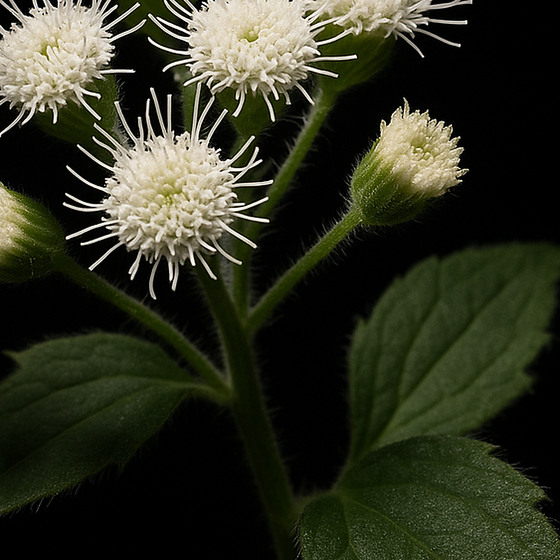
Snakeroot is the name of several different plants, among them Virginia snakeroot (Aristolochia serpentaria), Canadian snakeroot (Asarum canadense), Seneca snakeroot (Polygala senega) and Indian snakeroot (Rauvolfia serpentina). Black snakeroot is a name of black cohosh (Actaea racemosa), a flowering plant of the family Ranunculaceae. White snakeroot (Ageratina altissima) is a poisonous perennial herb in the family Asteraceae, native to eastern and central North America.
Origin and Habitat
White snakeroot is native to the central and eastern United States, from Texas in the west to Maine in the east and north, and Florida in the south. The species is also native in Canada in Quebec, Ontario, and the Northwest Territories. It is found in woods and brush thickets and also in shady areas with open bare ground. Plants are upright or sometimes ascending and grow to 1.5 metres (4.9 ft) tall. Flat-topped panicles or compound corymbs of white flower heads appear at the end of the upper branches. The plant can spread either by the wind dispersal of its seeds or by rhizomes.
The genus name Ageratina is derived from Greek meaning 'un-aging', in reference to the flowers keeping their color for a long time. A cultivar, sold under the name Eupatorium rugosum 'Chocolate', is grown in gardens for its dark-tinted foliage.
Virginia snakeroot is native to eastern North America, from Connecticut to southern Michigan and south to Texas and Florida. They have pipe-shaped flowers and heart-shaped leaves. Virginia snakeroot is considered an endangered species in New York.
Chemistry
White snakeroot contains the toxin tremetol. Tremetol is a fat soluble, high molecular weight alcohol. Crude tremetol was later shown to be separable into a toxic ketone fraction (61%) and a sterol fraction (39%) which is nontoxic. The ketone fraction was later separated into tremetone, dihydrotremetone and hydroxytremetone.
The chief constituents of Virginia snakeroot are a bitter principle, aristolochine, a volatile oil, a resin and tannic acid in small quantity. The volatile oil, 1/2 per cent, contains a terpene and mainly borneol ether.
Toxicity
When the plants are consumed by cattle, the meat and milk become contaminated with the toxin. When milk or meat containing the toxin is consumed, the poison is passed on to humans. The poisoning is also called milk sickness, as humans often ingested the toxin by drinking the milk of cows that had eaten snakeroot.
Milk sickness is characterized by trembling, vomiting, and severe intestinal pain. The toxins are not inactivated by pasteurization. Human milk sickness is uncommon today in the United States. The plant is highly toxic and may be fatal if eaten.
The leaves and stems are the most toxic parts of the plant, and the underground parts are thought to be less toxic. In addition to cattle, the plants are also poisonous to horses, goats, and sheep. Tremetol is likely not the singular cause of milk sickness, and other chemicals likely cause it in combination with tremetol.
Dr. Thomas Barbee of Bourbon County, Kentucky, wrote the first description of milk sickness in 1809 and set down its symptoms. The losses from the illness led the Kentucky General Assembly to offer a $600 reward in 1830 to anyone who discovered its cause. Medical science in America did not formally name white snakeroot as the cause until 1928, when biochemistry had advanced enough to analyse the plant's toxin. Dr. Anna Pierce Hobbs is credited as the first person to learn the specific cause, back in the 1830s.
Virginia Snakeroot in Medicine
In the small doses in which serpentaria is given in medicine it is a bitter stomachic. In large doses it produces vomiting and purging.
Explore all seven extraits in the Discovery Set.