Censer: The Vessel That Swings Incense, From Han China to Santiago

A censer is a vessel for burning incense. The church censer, or thurible, is a covered bowl of charcoal on four chains, swung so that the air keeps the fire alive, with three swings for the priest and people under the Roman Missal. Santiago's botafumeiro weighs 53 kilograms and is pulled by eight men.
What is a censer?
A censer is a vessel for burning incense: in church, a covered bowl of burning charcoal hung on chains and swung, so that the moving air keeps the fire alive. The Catholic Encyclopedia of 1908 adds that it is "now commonly called a thurible." Older censers include the long-handled burners of Egypt and the bronze hill censers of Han China.
In the cathedral of Santiago de Compostela, eight men called tiraboleiros pull on a rope until a censer of 53 kilograms flies across the transept. The cathedral gives its measurements: it "measures 1.50 metres; it hangs from a height of 20 metres and can pick up great speed." A physicist calculated the swing in 1984: about 82 degrees, reached in about 17 cycles and about 80 seconds.
Tourist pages add a reason. "The Botafumeiro cleansed the halls of the acrid smell from the masses of unwashed pilgrims," writes one; it was used "to purify the air of the cathedral made disagreeable by stinking, sweaty pilgrims," writes another. The cathedral gives a different one: "The Botafumeiro is used for liturgical reasons, in the same way as a priest would use a censer at the altar." No text read for this article supports the pilgrims' smell, and every church text read gives the smoke one meaning: prayer.
The vessel
The Catholic Encyclopedia describes the church censer piece by piece: "a cup, or bowl, which rests" on a base, with "a hollow movable pan for holding ignited charcoal, a lid or covering, and four chains about three feet in length." Three chains join the bowl to a disc held in the hand; the fourth raises the lid. The server carries it low and swings it "gently to and fro in order that the current of air thus created may cause the fire to burn the fragrant gums or incense which is placed on it."
The chains came late. "Its primitive form, however, was quite different from what it is now, being something like a vase with a perforated cover to emit the perfumed odours. Later on chains were added for greater convenience in manipulation." In the Middle Ages censers "were often made of gold and silver," and the inventories of cathedrals such as St John Lateran, Trier, Louvain, Lincoln and York Minster describe them in detail.
Censer and thurible: the two words
They are one object with two names from two roads. Walter Skeat's etymological dictionary of 1888 derives censer from the French encensoir, "a censer, or perfuming-pan," and the Low Latin incensorium, from incensum, "incense, lit. 'that which is burnt.'" Chaucer already "has censer," in the Canterbury Tales.
Thurible comes straight from Latin: thuribulum, "a vessel for holding frankincense," built on thus or tus, frankincense. Skeat adds that the Latin noun "is not a true Lat. word, but borrowed from Gk.," and gives an English use by Bishop Jeremy Taylor: "A pot of manna, or thurible." The server who carries it is the thurifer. The Roman Missal uses thurible throughout and never censer.
The censer in the Bible
In the King James Bible the censer carries fire and incense at the moments of atonement. "And Moses said unto Aaron, Take a censer, and put fire therein from off the altar, and put on incense, and go quickly unto the congregation, and make an atonement for them." On the Day of Atonement the high priest takes "a censer full of burning coals of fire from off the altar before the LORD, and his hands full of sweet incense beaten small, and bring it within the vail."
The meaning the churches kept comes from the Psalm and the Apocalypse. "Let my prayer be set forth before thee as incense," says Psalm 141. In Revelation, "another angel came and stood at the altar, having a golden censer," and "the smoke of the incense, which came with the prayers of the saints, ascended up before God out of the angel's hand." The 1910 encyclopedia makes the smoke "typical of the good Christian's prayer."
How the thurible is swung at Mass
The rules are written. The General Instruction of the Roman Missal, in its English text on the Vatican's site, defines the gesture: "Thurification or incensation is an expression of reverence and of prayer." Incense "may be used if desired in any form of Mass," at five moments: the entrance procession, the incensing of the cross and the altar, the Gospel, the offerings, and the showing of the host and the chalice after the consecration. The priest puts the incense in the thurible "and blesses it with the Sign of the Cross without saying anything." In the procession, the thurifer walks first, "carrying a thurible with burning incense."
| Swings of the thurible | For whom or what, by the Roman Missal, no. 277 |
|---|---|
| Three | The Blessed Sacrament, a relic of the Holy Cross and images of the Lord, the offerings, the altar cross, the Book of the Gospels, the Paschal Candle, the priest and the people |
| Two | Relics and images of the Saints exposed for public veneration |
| Single swings | The altar, the priest walking around it |
The 1910 encyclopedia described the swing itself, as it was then: the censer is raised "to the height of the eyes, given an outward motion and slightly ascending towards the object to be incensed, and at once brought back to the starting point. This constitutes a single swing."
When the Church began to use incense
Later than the vessel's Biblical past suggests. "During the first four centuries there is no evidence for its use," writes the 1910 encyclopedia, and "The earliest authentic reference to its use in the service of the Church is found in Pseudo-Dionysius." It then dates the steps of the Roman rite: incensation "at the Gospel of the Mass appears very early, at the Offertory in the eleventh, and at the Introit in the twelfth century," at the canonical Hours about the thirteenth, and at the Elevation about the fourteenth.
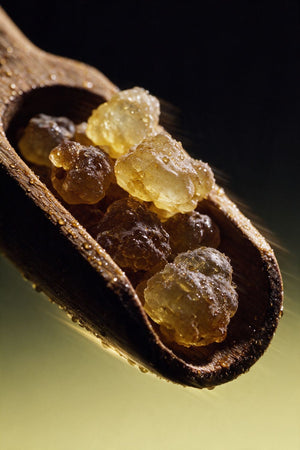
The resin of the thurible, then as now, is chiefly the incense of the frankincense trees, joined in churches by others such as benzoin. The story of frankincense and myrrh is told in frankincense and myrrh.
The botafumeiro of Santiago
The largest censer in use has a written past. "The first documented reference to the Botafumeiro is an annotation in a page from the Codex Calixtinus, where it is referred to as 'Turibulum Magnum.'" Today there are two. The one usually swung is of brass, made in 1851 by José Losada to replace one "stolen during the French occupation." The other, a silver replica, was given in 1971 and is kept in the Chapter Library.
| The botafumeiro | Figure | Source |
|---|---|---|
| Weight | 53 kg | The cathedral |
| Height of the censer | 1.50 m | The cathedral |
| Hung from | 20 m | The cathedral |
| Men at the rope | 8 tiraboleiros | The cathedral |
| Widest swing | About 82 degrees | J. R. Sanmartín, 1984 |
| Cycles to reach it | About 17 | J. R. Sanmartín, 1984 |
| Time to reach it | About 80 seconds | J. R. Sanmartín, 1984 |
| Speed often quoted | Up to 70 km/h | A Santiago travel agency |
The physics is the men's. Sanmartín's paper in the American Journal of Physics treats it as a pendulum "cyclically pumped by men who pull at the supporting rope." It adds a refinement the cathedral may not have needed: "If the pumping cycle is inverted once the maximum amplitude has been attained, the Censer could be swiftly brought to rest, avoiding the usual violent stop." It also discusses "Historically recorded accidents."
The cathedral swings it at its main feasts, among them the Epiphany, Pentecost and 25 July, the feast of Saint James. When this article was written its page carried a notice: "the Botafumeiro is temporarily not operating due to restoration work." A Santiago travel agency gives the price of a swing outside the feast days at 400 to 450 euros.
Censers before the Church
The vessel is far older than the thurible. The 1910 encyclopedia notes that "on Egyptian monumental tablets kings are represented swinging censers," and museums hold the objects themselves.
| Censer | Date | Material | Size | Museum |
|---|---|---|---|---|
| Egyptian censer | 525 to 343 BCE | Leaded bronze | 45 cm long, 4.5 cm high | Metropolitan Museum of Art |
| Hill censer (boshanlu), Western Han | 3rd to 2nd century BCE | Earthenware, after a bronze model | 22.2 cm high | Harvard Art Museums |
| Hill censer, Han dynasty | 25 to 220 | Cast bronze | 18.4 cm high | Victoria and Albert Museum |
| Byzantine censer | 6th century | Cast copper alloy | 77.5 cm with its chain | Metropolitan Museum of Art |
| Swiss censer | Before 1477 | Silver | 81 cm with its chain | Metropolitan Museum of Art |
The Chinese hill censer had its own meaning. The Victoria and Albert Museum explains the shape: "This type of incense burner is sometimes called a 'hill censer', because of its shape. Daoist faithfuls believed immortals and mythical beasts lived in the Bo Mountain." The smoke rose through the openings of a bronze mountain, as it rises through the pierced lid of a thurible. How to burn incense at home, on charcoal or on ash, is told in how to burn incense.
Frequently Asked Questions
What does censer mean?
A censer is a vessel for burning incense. Walter Skeat's dictionary of 1888 traces the word to the French encensoir and the Low Latin incensorium, from incensum, that which is burnt, and finds it already in Chaucer's Canterbury Tales. In churches the same vessel is called a thurible, from the Latin thus, frankincense.
What is the purpose of a censer?
In worship its purpose is symbolic: the rising smoke stands for prayer. The Roman Missal calls incensation an expression of reverence and of prayer, and the cathedral of Santiago says its great censer is used for liturgical reasons. Swinging the vessel also sends air over the charcoal, which keeps the fire burning the incense.
What does censer represent in the Bible?
In the King James Bible the censer carries fire and incense at moments of atonement: Aaron takes one to stop a plague in Numbers 16, and the high priest carries one behind the veil in Leviticus 16. In Revelation 8 an angel holds a golden censer, and the smoke rises with the prayers of the saints.
What is the swinging smoke thing in the Catholic Church?
It is the thurible, a censer on chains carried by a server called the thurifer. Under the Roman Missal incense may be used at the entrance, at the Gospel, at the offerings and after the consecration, with three swings for the Blessed Sacrament, the altar cross, the Gospel book, the priest and the people.
What is the difference between a censer and a thurible?
A thurible is a censer on chains, the form swung in Latin churches; censer is the wider word and covers fixed bowls, long-handled burners and the Chinese hill censers. The Catholic Encyclopedia of 1908 says the church censer is now commonly called a thurible, and the Roman Missal uses only thurible.
How heavy is the botafumeiro?
The cathedral of Santiago de Compostela gives 53 kilograms and 1.50 metres, hung from a height of 20 metres and moved by eight men called tiraboleiros. A travel agency's page gives a little over 60 kilograms and 1.60 metres. The brass censer in use was made in 1851 by José Losada.
Why does the botafumeiro swing so high?
Because the men pump it. A 1984 paper in the American Journal of Physics treats it as a pendulum cyclically pumped by men pulling at the rope, and calculates a widest swing of about 82 degrees, reached in about 17 cycles and about 80 seconds, in agreement with what is observed.
Did the botafumeiro cover the smell of pilgrims?
Tourist pages say so, but no text read for this article supports it. The cathedral states that the botafumeiro is used for liturgical reasons and that its rising smoke stands for the prayers of the pilgrims, and the church texts read give prayer, not hygiene, as the meaning of the smoke.
Sources
- P. Morrisroe, "Censer", The Catholic Encyclopedia, volume 3, New York, 1908, and "Incense", volume 7, 1910. Read at New Advent.
- Walter W. Skeat, An Etymological Dictionary of the English Language, second edition, Oxford, 1888, entries censer, thurible and incense. Read in full text at the Internet Archive.
- The Bible, King James Version: Numbers 16:46, Leviticus 16:12 to 13, Psalm 141:2, Revelation 8:3 to 4. Read through bible-api.com.
- General Instruction of the Roman Missal, nos. 120 and 276 to 277, English text on the website of the Holy See.
- Cathedral of Santiago de Compostela, "Liturgy", section Botafumeiro. Read on 20 November 2026.
- J. R. Sanmartín, "O Botafumeiro: Parametric pumping in the Middle Ages", American Journal of Physics 52(10), 937 to 945, 1984. DOI 10.1119/1.13798.
- The Metropolitan Museum of Art, censers 1999.519.10, 17.190.360 and 41.2.2. Victoria and Albert Museum, incense burner M.375&A-1910. Harvard Art Museums, 2002.278.A-B. Records read through the museums' data services.
- Pilgrim Travel, "El Botafumeiro". The pages quoted on the pilgrims' smell: Aleteia, 27 November 2018, and America magazine, 6 November 2010. Read on 20 November 2026.
Insuline Safrine
Extrait de parfum at 20%. 8 notes, including bitter almond and clove.
Read also
3
Backflow Incense Waterfall: Why the Smoke Falls, and What Nobody Has Measured
Every seller says the smoke falls because it cools. A patent says the particles, a student timed the fall, and a table of air shows the limit of the cooling story.
Sweetgrass Sweetgrass: Two Plants Share the Name, Burned and Woven
Sweetgrass is a northern grass that is braided and burned, and the word also names the basket grass of South Carolina. They are two plants, and only one has the coumarin scent.
Silk The Incense Road: The Silk Road Nobody Knows
A road older than silk, older than spice, older than any commodity route that textbooks care to remember.
Next
Perfumery Journal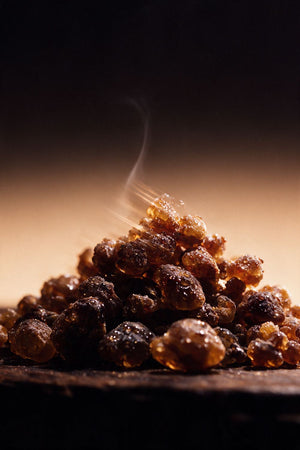
Church Benzoin: The Incense of Churches That Became a Base Note
24.01.26