Botafumeiro: The Giant Censer of Santiago and What the Record Says
The botafumeiro is the great censer of the cathedral of Santiago de Compostela. The cathedral gives 53 kilograms and 1.50 metres, hung from 20 metres and moved by eight men called tiraboleiros. A 1984 paper puts its widest swing at about 82 degrees. On 19 November 2026 the cathedral's page says it is temporarily not operating.
What is the botafumeiro?
The botafumeiro is the great censer of the cathedral of Santiago de Compostela, a brass vessel of 53 kilograms that burns incense and is swung through the transept by eight men. The cathedral gives its height as 1.50 metres and the height it hangs from as 20 metres. On 19 November 2026 the cathedral's page says it is not operating.
Four pages tell the same story about it: that it swung to clear the smell of unwashed pilgrims from the church. The cathedral gives another reason, which is prayer. A paper of 1984 calculated the swing and found that eight men can raise it to about 82 degrees in about 80 seconds. No text gives smell as the reason, and none denies it.
Where does the word botafumeiro come from?
The cathedral's own page says the name means censer in Galician. The dictionary of the Spanish Academy, in its 24th edition, derives it from that language and defines it as "gran incensario de la catedral de Compostela."
The same entry gives a second sense, marked colloquial: flattery. It lists the phrase "manejar el botafumeiro" for flattering someone. The Academy gives no date for either sense.
A Camino site splits it into "bota fume," which it translates as "blows smoke." That reading comes from a tourism page, not from the dictionary, which gives only the origin. A seafood restaurant in Barcelona, historic and open since 1975 by its own site, carries the same name. It is not the censer, and this article leaves it there.
How heavy is the botafumeiro?
The cathedral says: "It weighs 53 kg and measures 1.50 metres; it hangs from a height of 20 metres and can pick up great speed." It gives no speed. The Pilgrim's Reception Office repeats the 53 kilograms and the eight men.
Camino sites give heavier and larger figures, without saying where they come from. The table keeps each figure with the page that gives it.
| What | Figure | Who gives it |
|---|---|---|
| Weight | 53 kg | The cathedral |
| Weight, empty | 53 to 62 kg | Vivecamino |
| Weight, filled with incense and charcoal | Over 100 kg | Vivecamino |
| Weight, full | Up to 63 kg | Caminoways |
| Height of the censer | 1.50 m | The cathedral |
| Height of the censer | 1.5 to 1.6 m | Vivecamino |
| Hangs from | 20 m | The cathedral |
| Rope | 62 m long, 5 cm thick | Vivecamino |
| Men at the rope | Eight | The cathedral |
| Widest swing | About 82 degrees | J. R. Sanmartín, 1984 |
| Cycles to reach it | About 17 | J. R. Sanmartín, 1984 |
| Time to reach it | About 80 seconds | J. R. Sanmartín, 1984 |
| Speed | Up to 68 km/h | Vivecamino and Caminoways |
| Arc | 65 m | Vivecamino |
Two Camino sites disagree on the full weight, 63 kilograms against over 100. The cathedral confirms neither. Vivecamino adds that the censer is silver-plated and that the rope is now synthetic. Caminoways says the rope has been synthetic since 2004. The speed of 68 km/h is quoted on both pages and is not the cathedral's figure.
The eight men are called tiraboleiros. Vivecamino says they wear red tunics or mauve capes, that they prepare the censer with charcoal and incense, and that they stop it in full flight.
How does the botafumeiro swing so high?
By pumping. In 1984 J. R. Sanmartín published an analysis in the American Journal of Physics. He treats the censer as a pendulum that hangs in the transept and is "cyclically pumped by men who pull at the supporting rope." He calculated the largest angle it can reach, the number of cycles and the time needed to reach it. The results agree with observation: about 82 degrees, about 17 cycles, about 80 seconds, to within a few percent.
Vivecamino describes the movement as pushing the censer first and then pulling the rope. A paper of 2003 in Presence simulates the liturgy in virtual reality, so that users play the tiraboleiros. That paper says the men pull the rope in a pumping cycle, and that this turns the pendulum into one whose length varies.
Sanmartín's paper adds a refinement. "If the pumping cycle is inverted once the maximum amplitude has been attained, the Censer could be swiftly brought to rest, avoiding the usual violent stop." It also discusses "Historically recorded accidents."
What is burned in the botafumeiro?
Charcoal and incense, and nothing else is named. A marginal note in a manuscript describes a great censer "pleno carbonibus incensis cum ture," full of lit coals with incense. A later account, printed in a cathedral history, says the censer was "lleno de viuas brasas, y en el echado incienso y otros olores," which is full of live coals with incense and other scents thrown in.
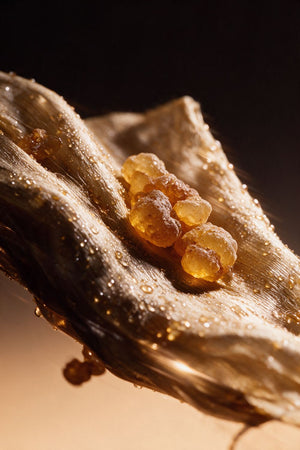
Caminoways says the tiraboleiros fill the censer with "about 40 kg of charcoal and incense." No page names the resin, the kind of charcoal or the supplier. The cathedral does not say that its incense is frankincense. The story of the resin that people have burned for five thousand years is told in frankincense, five thousand years of sacred commerce.
Our journal says of frankincense: "Burning it produces the church smell, which is smoky, sweet and solemn." In that account the church smell belongs to the burnt resin and its smoke, not to the raw lump. The longer account is in frankincense, trade and crisis.
Did the botafumeiro cover the smell of pilgrims?
Tourist pages say so. Vivecamino writes: "The function of the Botafumeiro was to spread incense through the temple to perfume it and eliminate unpleasant odors." Caminoways writes: "The swinging censer tradition likely began in the 11th century to freshen the air of weary, unwashed pilgrims." Aleteia, in 2018, says the censer "cleansed the halls of the acrid smell from the masses of unwashed pilgrims who gathered in the pews." America magazine, in 2010, says it was used "to purify the air of the cathedral made disagreeable by stinking, sweaty pilgrims."
None of the four quotes a medieval document. The cathedral gives another reason: "The purpose of this great censer is to symbolise the true attitude of the believer." Its page then gives two images. The smoke rises through the naves, "so must the prayers of the pilgrims rise to reach the heart of God." The aroma fills the basilica, as Christians with their lives are to "impregnate with the good scent of Christ" the society around them. The page never mentions the smell of pilgrims, hygiene or odour.
The dated texts are silent on smell as well. The marginal note of the manuscript lists a procession with relics and the great censer. The chapter act of 1602 is about the dome, its light and its ornament. This is silence, and silence is not proof. A medieval text on smell may still exist. For now the pilgrims' odour story is unsourced. It is not disproved.
The same holds for the date. The cathedral gives no century for its oldest mention. The 11th century of the tourist pages has no document behind it. The next chapter gives the earliest dated text.
How old is the botafumeiro?
The cathedral says: "The first documented reference to the Botafumeiro is an annotation in a page from the Codex Calixtinus, where it is referred to as 'Turibulum Magnum.'" It gives no century. The Codex belongs to the 12th century, and America magazine calls it the world's first tourist guide book. Because the note stands in the margin, it was added later and need not carry the date of the volume.
Antonio López Ferreiro printed the note in the sixth volume of his history of the cathedral. He writes that the great censer "debió comenzar á usarse por este tiempo," that it must have begun to be used at this time. The preceding pages name goldsmiths of 1313 to 1388, and he credits the apparatus to the blacksmiths and armourers. By position, then, he places it in the 14th century. He gives no year, and this is an inference from the note's place in his chapter.
The cathedral gives two censers today. One is brass, made in 1851 by José Losada to replace one stolen during the French occupation. The cathedral gives no year for the theft. The other is a silver replica, given in 1971, which is only placed in the transept when it is in use and is otherwise kept in the Chapter Library.
| When | What | Source |
|---|---|---|
| 12th century | The Codex Calixtinus, whose margin carries the note | America magazine, 2010 |
| Around the 14th century | The marginal note on the great censer, dated only by its place in his chapter | López Ferreiro, volume 6 |
| 27 September 1447 | A bull of Pope Nicholas V protecting a gift of the Dauphin Louis, which López Ferreiro believes was a censer | López Ferreiro, volume 7 |
| 21 May 1602 | A chapter act on the works under the dome and the frame of the censer's pulley | López Ferreiro, volume 8 |
| 1851 | The brass censer in use, by José Losada | The cathedral |
| 1971 | The silver replica | The cathedral |
| 19 November 2026 | Notice: temporarily not operating, restoration work | The cathedral |
The 1602 act shows that the machine was old by then. The chapter decided to take out the great beams under the dome that carried the pulley, and to put in an iron frame in their place, so that this "antigualla del incensario" would not be lost. López Ferreiro's heading for the act spells the name "bota-fumeiro". The act's own text says censer throughout, so the heading may be the editor's gloss and does not prove the name was used in 1602.
Has the botafumeiro ever fallen?
Reports say yes, and they disagree. Vivecamino writes: "The Botafumeiro has flown off 3 times throughout history: in 1499, 1622, and 1937." Caminoways writes: "Once, the Botafumeiro detached and flew out a window in 1499 during Princess Catherine of Aragon's visit." It adds that "In 1622, 1925, and 1937, the ropes failed, causing the Botafumeiro to fall or spill hot coals." One page says 1925 and the other does not. Neither quotes a document.
The cathedral's page says nothing of accidents. Sanmartín writes only of "Historically recorded accidents."
The one old account is in López Ferreiro's seventh volume, in a note, quoted from an older writer. It describes an incensario "tan grande como vna gran caldera," as large as a great cauldron, hung from heavy iron chains and swinging almost from one door of the crossing to the other. The chains broke. The censer went out through the church door, where it "se hizo pedazos," broke to pieces, and spilled all its fire "sin hazer mal a ninguna persona," without hurting anyone.
The text gives neither the narrator nor the year. The passage comes among notes on a pilgrimage made, López Ferreiro writes, "A fines de este mismo siglo XV," at the end of the 15th century or the start of the next. The account fits the story of 1499 and does not date it. It is an old text, and it says what was told then.
Does the botafumeiro swing every day?
No. The cathedral says it operates during the main solemnities, during the entrance procession or at the end of the Eucharist. Groups on a pilgrimage can ask for it, and the Pilgrim's Reception Office says to write to the cathedral at botafumeiro@catedraldesantiago.es to reserve it. Neither page gives a price. The cathedral's list of solemnities is set against the dates that Vivecamino lists for 2026.
| Solemnity | Date on the cathedral's page | Date on Vivecamino's 2026 list |
|---|---|---|
| The Epiphany | 6 January | 6 January |
| Resurrection Sunday | No date given | 5 April |
| The Ascension of the Lord | Not on the cathedral's list, but on the Pilgrim's Office list | 17 May |
| The Apparition of the Apostle, Clavijo | 23 May | 22 May |
| Pentecost | No date given | 24 May |
| The Martyrdom of Saint James | 25 July | 25 July |
| The Assumption of Mary | 15 August | 15 August |
| All Saints | 1 November | 1 November |
| Christ the King | No date given | 22 November |
| The Immaculate Conception | 8 December | 8 December |
| Christmas | 25 December | 25 December |
| Transfer of the remains of the Apostle | 30 December | 30 December |
The two lists differ on the feast of Clavijo, 23 May or 22 May, and on the Ascension. The cathedral's list is the one to read first.
Is the botafumeiro working now?
On 19 November 2026 the cathedral's liturgy page carries this line: "the Botafumeiro is temporarily not operating due to restoration work." No end date is given. Vivecamino's list for 2026 includes 22 November, Christ the King, with no mention of it. The Pilgrim's Reception Office lists the feast days and is silent on it too.
Related reading: the incense road, bakhoor, the ancient scenting ritual and benzoin, the incense of churches.
Frequently Asked Questions
What does botafumeiro mean?
Botafumeiro is the Galician word for the great censer of the cathedral of Santiago de Compostela. The Spanish Academy's dictionary defines it as the great censer of the cathedral of Compostela. In colloquial Spanish it also means flattery, and manejar el botafumeiro means to flatter someone. A Barcelona seafood restaurant carries the same name.
Does the botafumeiro swing every day?
No. The cathedral says it operates during its main solemnities, at the entrance procession or at the end of the Eucharist, among them 6 January, Pentecost, 25 July, 15 August, 1 November, 8 December and 25 December. Pilgrimages that have requested it from the cathedral can also have it, by email.
Has the botafumeiro ever fallen?
Reports say so and disagree. One Camino page counts three falls, in 1499, 1622 and 1937. Another has it flying out of a window in 1499 and ropes failing in 1622, 1925 and 1937. Neither quotes a document, and the cathedral's page is silent on accidents.
How heavy is the botafumeiro and how many men swing it?
The cathedral gives 53 kilograms and 1.50 metres, hung from a height of 20 metres and moved by eight men called tiraboleiros. Camino sites give up to 63 kilograms when full, or over 100 filled with incense and charcoal. The cathedral confirms neither of those two figures.
How does the botafumeiro swing so high?
Eight men pump the rope in a cycle. A 1984 paper in the American Journal of Physics treats the censer as a pendulum cyclically pumped by men pulling at the supporting rope, and calculates a widest swing of about 82 degrees, reached in about 17 cycles and about 80 seconds, matching observation.
Was the botafumeiro swung to hide the smell of pilgrims?
Tourist pages say so, but none quotes a document, and no text gives smell as the reason. The cathedral gives a symbolic purpose, the smoke rising like the prayers of the pilgrims. That does not prove no medieval text on smell exists. The story is unsourced, not disproved.
What is burned in the botafumeiro?
Charcoal and incense. A marginal note in a manuscript describes the censer full of lit coals with incense, and an old account adds other scents. Caminoways gives about 40 kilograms of charcoal and incense. No page names the resin.
Is the botafumeiro working now?
On 19 November 2026 the cathedral's liturgy page carried a notice that the botafumeiro is temporarily not operating due to restoration work. It gives no end date. Camino sites that list 2026 dates, such as 22 November for Christ the King, do not mention the notice.
Sources
- Cathedral of Santiago de Compostela, "Liturgy", section Botafumeiro, English text. Read on 19 November 2026.
- Pilgrim's Reception Office, "When is the Botafumeiro used?". Read on 19 November 2026.
- Real Academia Española, Diccionario de la lengua española, 24th edition, entry botafumeiro. Read on 19 November 2026.
- J. R. Sanmartín, "O Botafumeiro: Parametric pumping in the Middle Ages", American Journal of Physics 52(10), 937 to 945, 1984. Crossref record (abstract). DOI 10.1119/1.13798.
- Flores, Ferro and Taboada, "The Botafumeiro VR: Virtual Reality in the Liturgy of the Middle Ages", Presence 12(2), 222 to 228, 2003. Crossref record (abstract).
- Antonio López Ferreiro, Historia de la Santa A. M. Iglesia de Santiago de Compostela, volumes 6, 7 and 8 (chapter X, the notes of the 15th century, and appendix 56). Read in full text at the Internet Archive.
- Vivecamino, "All about the Botafumeiro: What is it, when does it start?". Caminoways, "Botafumeiro: Santiago Cathedral's Giant Swinging Censer", updated 12 November 2026. Read on 19 November 2026.
- Aleteia, "The Botafumeiro: an incense burner so large it needs a whole church to swing", 27 November 2018. America magazine, "World's greatest incenser swings with Pope", 6 November 2010. Read on 19 November 2026.
- PREMIEREPEAU journal article "Frankincense: Sacred Smoke, Ancient Trade, Modern Crisis". Read on 19 November 2026.
Nuit Élastique
Extrait de parfum at 20%. 8 notes, including magnolia, black olive and green olive.
Read also
3
Incense Frankincense: Sacred Smoke to Modern Crisis
What frankincense smells like, measured in the laboratory, and the trees behind the smell. A halving in 20 years and a fall of 90 percent in 50 come from two different papers, set here against the IUCN categories as G...
Church Benzoin: The Incense of Churches That Became a Base Note
In the highland forests of Laos, along the slopes of mountains that receive enough rainfall to sustain dense tropical canopy but enough altitude to cool the air to near-temperate mildness, there grows a tree that has ...
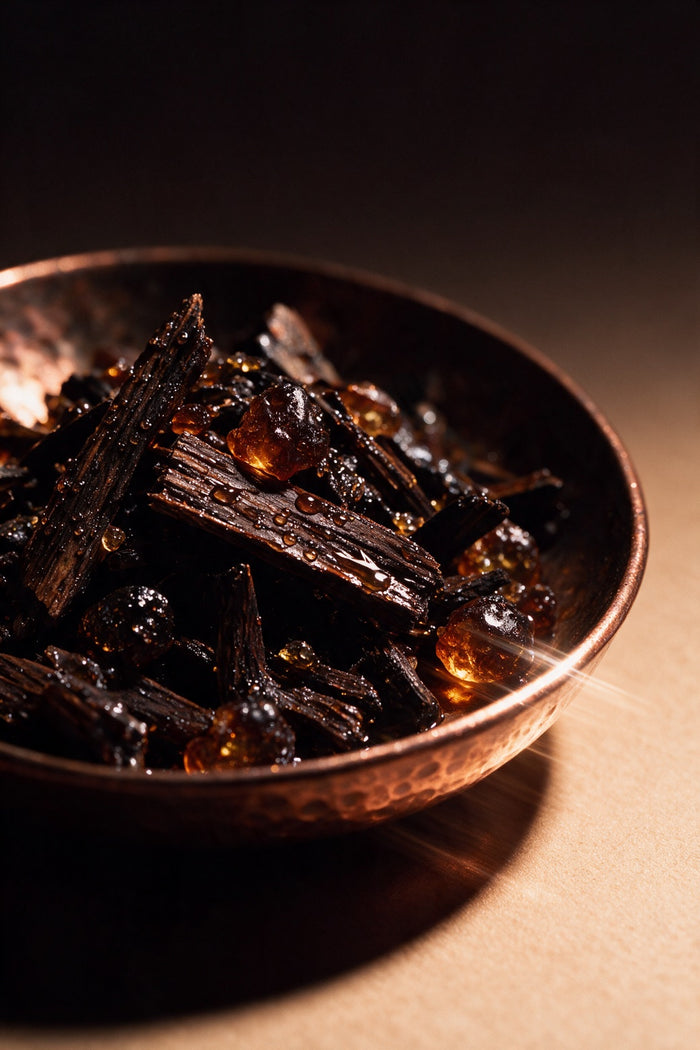
Bakhoor Bakhoor: The Ancient Scenting Ritual The West Forgot
The sources call it smouldering, and the oldest English eyewitness saw its smoke wafted to the face and beard. What bakhoor is made of, how it was used in Cairo and in Qatar, what the studies of its smoke report, and ...
Next
Perfumery Journal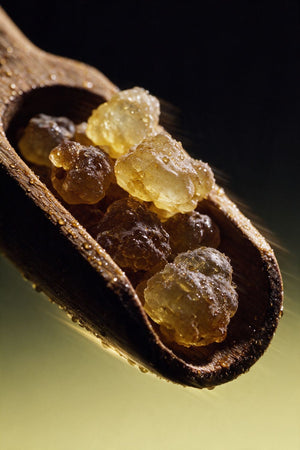
Incense Frankincense: 5,000 Years of Sacred Commerce
22.01.26