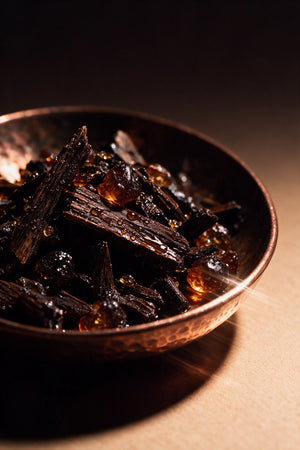
Florida Water: The Cologne, the 1808 Claim and the Ritual

Florida water is an alcohol-based toilet water of the cologne kind, built on lavender and bergamot with citrus and spice oils. A San Francisco newspaper advertised it in 1858 as made by a New York firm. Printed recipes of 1878 to 1888 differ, and the Fountain of Youth and 1808 stories have no early document behind them.
What is Florida water?
Florida water is an alcohol-based toilet water of the cologne kind, scented with lavender, bergamot and other citrus and spice oils. A San Francisco newspaper advertised it in 1858 as the work of a New York firm. A maker still sells it today, and it is also sold for rituals.
Two claims recur on almost every page that sells Florida water: that it is named for the Fountain of Youth, and that the bottle holds the formula of 1808. The printed record holds neither. The earliest advertisement quoted here, of 1858, speaks only of the "odor of crushed flowers." Three printed recipes of 1878, 1886 and 1888 are no two alike, and none carries a maker's name. For the ritual side the record is thinner still.
Why is it called Florida water? The Fountain of Youth story
The maker's own page says the label was "inspired by the enchanting properties of the famed Fountain of Youth" and that the formula "has remained unchanged for over 200 years." A wellness magazine of 2023 relays an author's account of the name along the same line: the Fountain of Youth is said to be somewhere in Florida. Neither text prints a document.
The older texts read differently. The advertisement of 1858 promises the "odor of crushed flowers" and a floral perfume. A London drug firm's formulary of 1881 prints an advertisement that explains the name by the plants themselves. The water, it says, is distilled from "freshly collected petals of the choicest blossoms of various fragrant plants of Florida," and "No crude irritating essential oils or artificial extracts enter into its composition."
| Source | Year | What it says of the name or the scent |
|---|---|---|
| San Francisco newspaper, advertisement | 1858 | The odor of crushed flowers, a floral perfume |
| London drug firm's formulary, advertisement | 1881 | Distilled from petals of fragrant plants of Florida |
| Wellness magazine page | 2023 | Named because the Fountain of Youth is said to be in Florida |
| The maker's about page | 2026 | Label inspired by the Fountain of Youth |
No dated text gives the Fountain of Youth reading before the modern pages. That does not prove that nobody told the story earlier. What the record does show is that the 1881 text and the recipes disagree. The recipes below are mixtures of essential oils, which is exactly what the 1881 advertisement says the water does not contain.
Who made Florida water first? The 1808 claim
The maker's collection page calls its product "The original formula since 1808" and lists no ingredient. The about page says only that the water was introduced in New York and sold in corner pharmacies. Neither page gives a recipe, a label or a document of 1808.
A history of the New York Quakers, printed in 1904, names the man behind the first firm. Robert I. Murray was born in 1786 and "embarked in the drug business with Benjamin S. Collins at the age of twenty-two." The business "subsequently became Murray & Lanman, and then Lanman & Kemp." The passage does not mention Florida water. By arithmetic, a man born in 1786 who starts in drugs at twenty-two starts in 1808. That match with the maker's year is an inference, and it may point to the drug firm rather than to the water.
| Year | Event | Source |
|---|---|---|
| 1786 | Robert I. Murray is born | Friends of the City of New York, 1904 |
| 1858 | A San Francisco advertisement calls it "the celebrated Florida Water" and names David T. Lanman & Co. of New York as maker of the genuine article | The Wide West, 16 May 1858 |
| 1881 | An advertisement says every genuine bottle bears the words "Lanman & Kemp, New York" | A London formulary, 1881 |
| 1909 | A court in Lima fines two men for imitating it | El Comercio of Lima, printed in a trade mark compendium of 1913 |
The 1858 advertisement is the earliest one on this page.
What is in Florida water? Three printed recipes
Three American books print a Florida Water recipe. They were made for druggists and housewives to follow, and they say what people mixed then, not what is wise to make now.
| Book | Year | Lavender | Bergamot | Other oils named | Spirit |
|---|---|---|---|---|---|
| Fenner's Complete Formulary, no. 4347 | 1888 | 6 fl. drachms, English | 2 fl. drachms | Lemon, cloves 20 minims, cassia 10 minims, orange 30 minims, rose essence 60 minims, neroli essence 10 minims | 15 fl. ounces cologne spirit |
| American Druggist | 1886 | 4 fl. oz | 4 fl. oz | Neroli 2 drachms, orange, clove 1 drachm, pure musk 4 grains, tincture of tonka to colour | 1 gallon cologne spirit, 96% |
| The American Housewife | 1878 | 2 drachms | 2 drachms | Neroli 1 drachm, melissa 30 drops, rose 10 drops, curcuma tincture 1 drachm, and one more oil of 2 drachms whose name is lost in the scan | 2 pints deodorized alcohol |
The oils are the ones perfumery knows as lavender, bergamot, clove and neroli, with orange and rose in two of the three. The 1886 recipe adds four grains of musk and colours the spirit with tonka, then asks for fifteen days of maceration and a filter through paper. The 1888 book says only "Mix them." Lavender leads or ties in all three, and no two agree on the rest. There was no single printed formula in the 1880s, and none of these books claims to give the maker's.
One more fact comes from the table. A modern wellness page calls lavender, lemon, bergamot and ylang-ylang the "Traditional oils for Florida water." Ylang-ylang is in none of the three old recipes.
What does Florida water smell like?
The maker describes "a light floral scent with lemon overtones." The wellness magazine calls it citrusy and floral. The advertisement of 1858 praised its floral perfume. Our glossary gives the parts of that picture. It records lavender as "fresh and floral," bergamot as "fresh, zesty and lavender-like," and clove bud oil as "intensely sweet-spicy." For neroli it gives "sweet and flowery notes." These are the smells of the oils named in the recipes, not of a bottle of any given year.
Is Florida water the same as eau de Cologne?
No, in the two American books that print both. The Housewife of 1878 puts an eau de Cologne on the same page as its Florida water. That Cologne is lavender, lemon, rosemary and cinnamon in six pints of cologne spirit, with no bergamot and no neroli. Fenner's formulary of 1888 prints a German cologne at number 4346, just before its Florida water. Its oils are bergamot, lemon, neroli and sandalwood, and it has no lavender.
The two kinds share a base of spirit and citrus, and the Housewife's pair shares lavender. That is as far as these books go, and they print single formulas, not definitions. The story of the original is in our article on the eau de Cologne, linked above, and the plain difference between a cologne and a perfume is in cologne against perfume. Rosemary, which that Cologne has and none of the three Florida recipes does, has its own glossary entry.
The Lima case of 1909: a name worth copying
A compendium of trade mark law printed in 1913 reprints a decision from El Comercio of Lima, dated 29 June 1909. Merchants of Lima complained of the imitation of "the Florida water of Murray and Lanman," a trade mark that had been registered in the name of Lanman and Kemp of New York. The court found that the accused had used genuine wrappers and labels, imitated them and forged the firm name. It fined each of the two men "one hundred pounds Peruvian gold."
The decision also says the mark "was registered in July 1894, and the registration renewed in August of 1904." The case shows that by 1909 the name sold well enough in Peru to be forged, and that the firm treated it as a mark to defend. The maker's wholesale page today lists bottles labelled for Peru.
What is Florida water used for?
As a toilet water, for the skin, the handkerchief and the bath. Everything else is a claim made by a seller. The advertisement of 1858 said it "rapidly removes all blemishes, tan or freckles from the skin." The advertisement of 1881 quoted two medical journals for the sick room. One, it says, found that the water "destroys offensive germs, purifies the atmosphere" when sprayed.
The maker's about page today lists uses over the years, among them to "relieve headaches, reduce fevers, prevent infection," beside a light cologne, an aftershave, a bath addition and a room spray. These are advertisements and sellers' lists, so none of them is reported here as a fact about health.
Florida water spiritual uses: what the record holds
Two sources speak of ritual. The maker's about text lists "ceremonial rituals for cleansing, good luck, and protection," and its collection page says the water is known for "its magical effect on the mind, body and soul." The wellness magazine page of 2023 relays two authors who say it is popular among people who practise hoodoo, rootwork and American folk magic, and it lists twenty ways to use it.
Among them is a bowl of the water on an altar as an offering to ancestors or guides. It also gives "spraying it around you or putting a bit on your wrists" to cleanse oneself, a bowl by the front door, and a little in the laundry. For money it says to spray diluted water and patchouli oil "on your cash for extra abundance." Those are its instructions, quoted as such. No study or text of the period shows that any of it does what it is meant to do.
The same page notes that the water is flammable and asks readers to take care near candles. The recipes above are mostly spirit, which would explain it, but that is an inference. For a related ritual scent with a documented history, see bakhoor.
How to make Florida water
The old books are in the table above. The 1888 recipe is a list of oils and "Mix them." The 1886 recipe macerates for fifteen days and filters.
The modern wellness page gives a home version. Combine one cup of vodka, an orange or lemon peel and a lemon peel, eight to ten drops of an essential oil, a handful or two of fresh herbs and an optional cinnamon stick in a sealed glass container. Leave it "for a full lunar cycle (29 days)." It names lavender, lemon, bergamot and ylang-ylang as the oils. That recipe is sold by the page as a do it yourself version, and it resembles no recipe printed in the 1880s.
For the wider family of citrus waters, see how to apply cologne and, for the history of scent itself, who invented perfume.
Frequently Asked Questions
What is Florida water?
It is an alcohol-based toilet water of the cologne kind. Printed recipes of 1878 to 1888 build it on lavender and bergamot, with oils such as neroli, orange, clove and rose, in cologne spirit. A San Francisco newspaper advertised it in 1858, and a maker still sells it today for the body, the home and rituals.
Why is it called Florida water?
Modern pages say the name comes from the Fountain of Youth, said to be somewhere in Florida, but they print no document. An advertisement of 1881 ties the name to petals of fragrant plants of Florida, and one of 1858 speaks of crushed flowers. No dated text prints the Fountain of Youth reading earlier.
Is Florida water the same as eau de Cologne?
Not in two American books, of 1878 and 1888. The Housewife of 1878 prints a Cologne of lavender, lemon, rosemary and cinnamon beside a Florida water with bergamot, neroli, melissa and rose. Fenner's formulary of 1888 lists a German cologne without lavender and a Florida water with it. They are separate formulas in both books.
What is in Florida water?
Three printed recipes name lavender and bergamot, with neroli in all and orange, clove, cassia, rose, melissa or musk in some, in cologne spirit or deodorized alcohol. The 1888 formulary and the 1886 American Druggist differ in quantities and kinds. No ingredient list of a bottle sold today was found on the maker's pages.
Who invented Florida water?
No document names an inventor. A 1904 history records Robert I. Murray, born in 1786, entering the drug trade at twenty-two, in a firm that became Murray & Lanman and then Lanman & Kemp. An advertisement of 1858 names David T. Lanman & Co. of New York as maker. No recipe of 1808 or signed by a maker was found.
How do you make Florida water?
The 1888 formulary mixes oils of lavender, bergamot, lemon, clove, cassia, orange, rose and neroli into cologne spirit. A modern wellness page steeps vodka, citrus peels, a few drops of essential oil, herbs and a cinnamon stick in a sealed glass container for 29 days. The two recipes are not alike.
How do you cleanse yourself with Florida water?
A wellness magazine page of 2023 says to spray it around you or put a bit on your wrists, and lists other uses on an altar, at the door and in the laundry. It cites no study or early text. No study shows that any of these practices does what it is meant to do.
Is Florida water flammable?
One wellness page says it is flammable and asks for care near candles. The old recipes are made mostly of spirit, such as 15 fluid ounces of cologne spirit in the 1888 formulary, which would explain the warning, though that is an inference. No safety data sheet for a bottle sold today was found.
Sources
- B. Fenner, Fenner's Complete Formulary, 1888, formulas 4346 and 4347. Read in full text at the Internet Archive.
- American Druggist, vol. 15, 1886, the Florida Water recipe. Read in full text at the Internet Archive.
- The American Housewife: Cook Book, 1878, p. 326, the Eau de Cologne and Florida Water recipes. Read in full text at the Internet Archive.
- The Wide West (San Francisco), 16 May 1858, advertisement column. Read in full text at the Internet Archive, volume of 7 June 1857 to 4 July 1858.
- Burroughs, Wellcome & Co., Medical Formulae of New and Improved Chemical and Pharmaceutical Preparations, 2nd edition, London, 1881, advertisement of Murray & Lanman's Florida Water. Read in full text at the Internet Archive.
- Friends of the City of New York in the Nineteenth Century, 1904, p. 81, on Robert I. Murray. Read at the Internet Archive.
- B. Singer, Trade Mark Laws of the World, and Unfair Trade, Chicago, 1913, the Peruvian decision reprinted from El Comercio, Lima, 29 June 1909. Read at the Internet Archive.
- The maker's collection page and about page, read on 19 November 2026. Mindbodygreen, "Florida Water: What It Is, Spiritual Uses + How To Make It", last updated 19 May 2023, read on 19 November 2026.
- PREMIEREPEAU glossary, entries lavender, bergamot, clove and neroli, read on 19 November 2026. Google's first page for "florida water" in the United States, read on 19 November 2026.
Doppel Dancers
Extrait de parfum at 20%. 8 notes, including pink pepper and skin.
Read also
3
Cologne vs Perfume: Two Questions, One Query
Cologne is a perfumed liquid, not a strength and not a sex. The date 1709 belongs to a firm, the men's meaning grows in American books after 1920, and the old dictionaries say neither.
Who Invented Perfume? A 4,000-Year History
Who invented perfume? The honest answer is: no single person, no single civilization, no single century. The history of perfume is not a straight line from cave fire to glass bottle. It is a braid of smoke and resin a...

Where to Spray Cologne and How to Apply It
The two-spray rule is in no paper, standard or perfumer's text we read. What is measured: the neck is the warmest of 15 skin regions, and the wrist was not tested. What is only claimed: the rest.
Next
Perfumery Journal
The Eau de Cologne: How an Italian Merchant Invented Modern Luxury
06.02.26