


Clove
Clove is the dried flower bud of the tree Syzygium aromaticum, of the Myrtaceae family. The oil of the buds is intensely sweet-spicy, with characteristic clove warmth.
- Olfactive family
- Spicy · 153 entries of the glossary in this family Subfamily: Warm spices · 143 entries in this subfamily Cluster: Clove-nutmeg spices · 14 entries in this cluster
- Material
- Natural Dried flower buds of Syzygium aromaticum
- Pyramid
- Heart · Base · Volatility: Heart · Base
- Strength
- Very strong Step 5 of 5 · shared by 39 of 2,156 graded entries Graded entries at each step, from 1 to 5: 4, 119, 1,473, 498, 39. 23 more sit between two steps.
- Also called
- Eugenia caryophyllata, Eugenia caryophyllus, Caryophyllus aromaticus, Eugenia aromatica, Jambosa caryophyllus
Family, subfamily and cluster: PREMIEREPEAU house classification, version 2026‑11.
Clove · Did You Know?
A clove tree named Afo on Ternate, which experts believe is the oldest in the world, may be 350–400 years old.
Clove · Scent
Clove bud oil is intensely sweet-spicy, with characteristic clove warmth, fruity-fresh top notes and subtle acetic undertones. Its heart is a rich, full-bodied aromatic spiciness, and its base has warm, slightly woody-balsamic undertones. It has a comforting, warm spicy scent, both powerful and delicate, with whiffs of floral and woody facets. Its odour is also described as aromatic, balsamic, fruity, medicinal, minty, phenolic, powdery, spicy, sweet and woody. The eugenol character appears subdued and sweetened compared to isolated eugenol or lower-quality clove oils. The oil has a refined complexity that clove leaf and stem oils lack.
Evolution over time
Clove: scent over time.
- Immediately
Fruity-fresh nuances with subtle acetic brightness.
Scent words: fresh · fruity - After a few hours
Rich, full-bodied aromatic spiciness with sweet-spicy clove warmth.
Scent words: aromatic · sweet · spicy - After a few days
Warm, slightly woody-balsamic undertones.
Scent words: balsamic · warm · woody
- Tenacity
- Excellent
Clove · In Perfumery
Clove bud oil is often at the heart of spicy notes, for its eugenol and leathery notes. It is also used in carnation reconstitutions to add a touch of naturalness to the accord. Clove buds are used commercially in the perfume industry.
Pyramid
Clove: Heart · Base. Entries of the glossary stored at each place of the pyramid, of 4,006 (42 store no place):
- Top 718
- Top · Heart 497
- Heart 1,641
- Heart · Base 514
- Base 594
In PREMIEREPEAU

Insuline Safrine
Intense Gourmand, Spicy Oriental
Greek saffron wound into Moroccan bitter almond and Madagascar clove. Vanilla and Australian sandalwood do not soften it. They hold it down.
- Clove:
- Top note: Clove.
- Duality
- Abundance / Excess
- Dominant
- Saffron Liqueur · Saint-Honoré Pastry · Praline Sandalwood
- Signature
- Imaginary Saffron Infusion · Saint-Honoré Pastry Accord · Praline Sandalwood
- Top
- Bitter Almond · Clove · Saffron Liqueur Accord
- Heart
- Orange Blossom · Spun Sugar · Butter Notes · Saint-Honoré Pastry Accord
- Base
- Vanilla · Cinnamon · Roasted Hazelnut · Sandalwood · Praline Sandalwood Accord
PREMIEREPEAU collection: Extrait de parfum
Clove · Terroir & Origins
- Producing countries
- Indonesia, Madagascar, Tanzania, Sri Lanka, Comoros
Clove · Extraction & Chemistry
Clove bud oil is obtained by steam distillation of the dried flower buds of Syzygium aromaticum. When the cloves are completely dry, they are sorted and cleaned. The buds are steam distilled and at the end of the process the essential oil is extracted by decantation.
- Appearance
- Yellow to brown, occasionally slightly viscous liquid; clear and mobile when fresh; darkens with age
Clove · In Depth
Clove — eugenol-led, sharp, medicinal — opens against Madagascar bud in PREMIEREPEAU’s Insuline Safrine, paired with saffron and bitter almond.
This note in PREMIEREPEAU. Insuline Safrine. Sample all seven extraits in the Discovery Set.
What clove is
Cloves are the aromatic flower buds of a tree in the family Myrtaceae, Syzygium aromaticum. They are native to the Maluku Islands, or Moluccas, in Indonesia. The clove tree is an evergreen with large leaves and crimson flowers grouped in terminal clusters. Cloves are commonly used as a spice, flavouring, or fragrance in consumer products, such as toothpaste, soaps, or cosmetics.
Harvest and drying
Cloves are harvested by hand when the flower buds are still closed but have reached their maximum growth. Several rounds of harvesting are needed as the flowers do not develop uniformly. The buds are spread out on mats and left to dry in the sun for several days. This produces the familiar dark brown colour.
Chemistry
The compound eugenol is responsible for most of the characteristic aroma of cloves. Eugenol comprises 72–90% of the essential oil extracted from cloves. Clove flower buds contain up to 18% of essential oil. Other constituents of clove oil include acetyl eugenol, beta-caryophyllene and vanillin. Eugenol is an allyl chain-substituted guaiacol, a member of the allylbenzene class of chemical compounds.
Sensitisation
Eugenol is subject to restrictions on its use in perfumery, as some people may become sensitised to it, although how far it can cause an allergic reaction in humans is disputed.
Production and other uses
Indonesia is the largest clove producer, but only about 10–15% of its cloves production is exported. The spice is used in a type of cigarette called kretek in Indonesia. It is often added to betel quids to enhance aroma while chewing. Clove essential oil may be used to inhibit mold growth on various types of foods. Eugenol or clove buds are used in certain dental treatments to relieve toothache.
Related: Allspice · Cinnamon · Nutmeg · West Indian Bay · Pimento Leaf · Eugenyl benzoate
Clove · History
Origins in the Moluccas
Until the colonial era, cloves only grew on a few islands in the Moluccas, historically called the Spice Islands. Cloves were first traded by the Austronesian peoples in the Austronesian maritime trade network. The word clove, first used in English in the 15th century, derives through Middle English and Old French from the Latin word clavus, meaning nail.
Dutch monopoly attempt
The Dutch East India Company consolidated its control of the spice trade in the 17th century and sought to gain a monopoly in cloves as it had in nutmeg. Clove trees grew all over the Moluccas, and the trade in cloves was beyond the limited policing powers of the corporation. In 1770, seedlings were stolen under the instruction of Pierre Poivre and brought to the Isle de France (Mauritius) and the Seychelles.
Clove · Technical Sheet
Identity
- Botanical
- Syzygium aromaticum
- Taxonomy
- Myrtales order › Myrtaceae family › Syzygium genus · GBIF
- Botanical records
- Syzygium aromaticum: POWO, Syzygium aromaticum · IPNI, Syzygium aromaticum · GBIF, Syzygium aromaticum · Wikidata, Syzygium aromaticum · Wikipedia, Syzygium aromaticum
- IPNI
- Syzygium aromaticum (L.) Merr. & L.M.Perry, Mem. Amer. Acad. Arts 18: 196 (1939) — Elmer Drew Merrill (1876–1956); Lily May Perry (1895–1992) · ≡ Caryophyllus aromaticus L. (1753)
- Type
- Ingredient
- Category
- Spices
In Nature
- Native range
- Malesia · POWO
- Introduced to
- 9 regions · Africa 5 · Tropical Asia 2 · Pacific 1 · Southern America 1
- Sample origins in GC-MS studies
- Morocco (1 paper; one: Plants (Basel) 2023, Morocco) · Cuba (1 paper; one: Journal of essential oil research 2001, Cuba)
- Recorded altitude
- 0–550 m · median 150 m · 111 records with an altitude · GBIF
- Wild or cultivated
- 6 native · 46 introduced · 6 cultivated among 1,333 records (the rest carry no such mark) · GBIF
- Recorded in
- 46 of 512 squares of the world grid; a brighter dot holds more records · GBIF
- Also from this genus
- Syzygium: Clove Leaf · Cloves · Anise Myrtle · Rose Apple
- Also from this botanical family
- Myrtaceae: Allspice · Blue Mallee · Cajeput · Eucalyptus · Flax-Leaved Paperbark · Fragonia · 23 more entries
In Print
- Timeline
- first described 1753 · earliest aroma paper in Europe PMC, 2001
- In English books
- most mentioned in the 2010s · Google Books Ngram
Classification
- Chemical class
- Essential oil; main constituent eugenol, an allylbenzene
Chemical data
- Formula
- Complex natural mixture (key constituents: eugenol C₁₀H₁₂O₂; eugenyl acetate; β-caryophyllene)
- Most reported compounds
- Eugenol (13 papers; one: J Agric Food Chem 2005, Eugenol) · Biflorin (5 papers; one: J Nat Prod 1996, Biflorin) · Eugenyl Acetate (4 papers; one: J Agric Food Chem 2005, Eugenyl Acetate) · Gallic Acid (4 papers; one: J Agric Food Chem 2005, Gallic Acid) · LOTUS
- Structure
- Eugenol, Eugenyl Acetate, Beta-Caryophyllene:
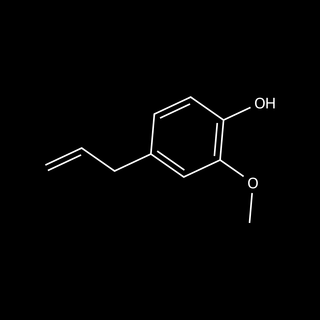
Eugenol
PubChem, Eugenol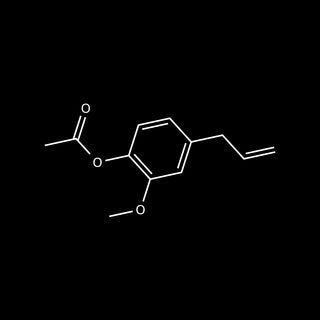
Eugenyl Acetate
PubChem, Eugenyl Acetate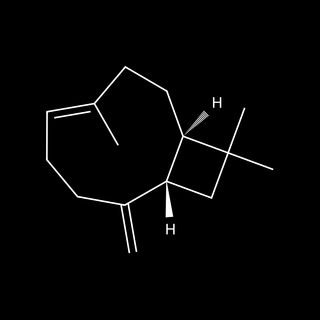
Beta-Caryophyllene
PubChem, Beta-Caryophyllene - CAS
- 8000-34-8
- Compound classes reported
- Monoterpenoids 8 % · Sesquiterpenoids 12 % · Phenolic acids (C6-C1) 27 % · Phenylpropanoids (C6-C3) 12 % · of 124 compounds reported, 27 % of them esters · LOTUS
Labelling
- EU cosmetics annexes
- Eugenia Caryophyllus Oil · CosIng, Annex III, entry 356, Eugenia Caryophyllus Oil · labelling
“The presence of the substance or substances shall be indicated as ‘Eugenia Caryophyllus Oil’ in the list of ingredients referred to in Article 19(1), point (g), when the concentration of the substance or substances exceeds: — 0,001 % in leave-on products — 0,01 % in rinse-off products.”
- Forms in the EU cosmetic inventory
- Clove: EUGENIA CARYOPHYLLUS BUD OIL · EUGENIA CARYOPHYLLUS FLOWER OIL · EUGENIA CARYOPHYLLUS BUD EXTRACT · EUGENIA CARYOPHYLLUS FLOWER EXTRACT · EUGENIA CARYOPHYLLUS BUD WATER · EUGENIA CARYOPHYLLUS FLOWER BUD POWDER · EUGENIA CARYOPHYLLUS FLOWER POWDER · EUGENIA CARYOPHYLLUS BARK EXTRACT · and 6 more
- EU allergens reported
- Citral · Eugenol · Isoeugenol · Benzyl Benzoate · Benzyl Salicylate · Cinnamal · Eugenyl Acetate · Pinene · Terpineol · Beta-Caryophyllene · Anethole · Benzaldehyde
Physical properties
- Boiling point
- 251 °C at 760 mm Hg
- Flash point
- 87.78 °C (190 °F) TCC
- Specific gravity
- 1.038 to 1.06 at 25 °C
- Refractive index
- 1.527 to 1.535 at 20 °C
Performance and rules
- IFRA status
- No IFRA Standard for the material itself (51st Amendment)
Clove · See Also
Entries related to Clove, by their place in the pyramid.
Top notes

Peruvian Pepper
spicy · peppery · sweet Spicy / Top · Heart / Same subfamily / Natural
Cardamom
spicy · aromatic · fresh Spicy / Top · Heart / Same subfamily / Natural
Ginger
spicy · fresh · citrus Spicy / Same subfamily / Natural


Heart notes

Saffron
spicy · medicinal · honeyed Spicy / Same subfamily / Natural
Longoza
spicy · peppery Spicy / Same subfamily / Natural
Pimento
spicy · warm · nutty Spicy / Same subfamily / Natural
Pimento Seeds
spicy · warm · sweet Spicy / Same subfamily / Natural


Clove · Sources
Read the science
- Food Chem (2025) Insights into the flavor endowment of aroma-active compounds in cloves (Syzygium aromaticum) to stewed beef
- International Plant Names Index (IPNI) Syzygium aromaticum (L.) Merr. & L.M.Perry
- Biomolecules (2020) Syzygium aromaticum L. (Myrtaceae): Traditional Uses, Bioactive Chemical Constituents, Pharmacological and Toxicological Activities
- IFRA Standards, 51st Amendment
- Wikipedia Clove
- Wikipedia Eugenol
Cite as PREMIEREPEAU Glossary, “Clove”, https://premierepeau.com/
