


Flax-Leaved Paperbark
Keywords: nutmeg · spicy · warm
Flax-leaved paperbark is a common name of Melaleuca linariifolia, a plant of the myrtle family Myrtaceae that is endemic to eastern Australia. It is a small tree with white or creamy white, papery bark.
- Olfactive family
- Spicy · 155 entries of the glossary in this family Subfamily: Warm spices · 145 entries in this subfamily Cluster: Clove-nutmeg spices · 14 entries in this cluster
- Material
- Natural Leaves and twigs of Melaleuca linariifolia
- Pyramid
- Heart · Volatility: Heart Note
- Also called
- Snow-in-summer, narrow-leaved paperbark, budjur
Flax-Leaved Paperbark · Facets
Entries of the glossary that carry each facet, of 3,979:
- spicy 474
- warm 1,108
- aromatic 102
- herbal 757
- camphoraceous 140
Flax-Leaved Paperbark · Scent
The leaf oil has a nutmeg scent.
Flax-Leaved Paperbark · In Perfumery
The essential oil is used in aromatherapy. The oil is also used in soaps.
Pyramid
Flax-Leaved Paperbark: Heart. Entries of the glossary stored at each place of the pyramid, of 4,000 (36 store no place):
- Top 718
- Top · Heart 497
- Heart 1,641
- Heart · Base 514
- Base 594
Role in the formula
Flax-Leaved Paperbark: roles in the formula. Entries of the glossary that share each role, of 4,000:
- Perfuming agent 43
- Fragrance ingredient 51
- Modifier 1,167
Flax-Leaved Paperbark · Terroir & Origins
- Producing countries
- Australia
Flax-Leaved Paperbark · Extraction & Chemistry
An essential oil is obtained from the fresh leaves and twigs. Oils similar to tea tree oil can be produced by water distillation from Melaleuca linariifolia.
Flax-Leaved Paperbark · Did You Know?
Smith recorded a report that the bark is very thick and spongy and serves as tinder.
Flax-Leaved Paperbark · In Depth
The plant
Melaleuca linariifolia is a small tree growing to a height of 6–10 m (20–30 ft) with distinctive and attractive white or creamy white, papery bark and a dense canopy. The flowers are white to creamy-white, perfumed and arranged in spikes on the ends of branches. Snow-in-summer occurs from the Maryborough district in Queensland to Bawley Point in the Ulladulla district in New South Wales. It is cultivated as an ornamental tree for parks and gardens and is also used as a screen or windbreak in Australia.
The oil
This species is rich in essential oils, especially terpinen-4-ol. Terpinen-4-ol is a monocyclic terpene alcohol with the formula C₁₀H₁₈O. Oils that meet the requirements of the tea tree oil standard have been distilled from Melaleuca species other than Melaleuca alternifolia, including Melaleuca linariifolia. In practice, commercial tea tree oil is produced from Melaleuca alternifolia.
Uses
An essential oil obtained from the leaves and twigs is strongly antiseptic, diaphoretic and expectorant.
Flax-Leaved Paperbark · History
Melaleuca linariifolia was first formally described in 1797 by James Edward Smith in Transactions of the Linnean Society of London.
Flax-Leaved Paperbark · Technical Sheet
Identity
- Botanical
- Melaleuca linariifolia
- Taxonomy
- Myrtales order › Myrtaceae family › Melaleuca genus · GBIF
- Botanical records
- Melaleuca linariifolia: POWO, Melaleuca linariifolia · IPNI, Melaleuca linariifolia · GBIF, Melaleuca linariifolia · Wikidata, Melaleuca linariifolia · Wikipedia, Melaleuca linariifolia · IUCN Least concern (LC), Melaleuca linariifolia
- IPNI
- Melaleuca linariifolia Sm., Trans. Linn. Soc. London 3: 278 (1797) — James Edward Smith (1759–1828)
- Type
- Ingredient
- Category
- Spices
In Nature
- Recorded altitude
- 0–750 m · median 50 m · 91 records with an altitude · GBIF
- Wild or cultivated
- 145 native · 109 introduced · 14 cultivated among 6,520 records (the rest carry no such mark) · GBIF
- Recorded in
- 29 of 512 squares of the world grid; a brighter dot holds more records · GBIF
- Also from this genus
- Melaleuca: Cajeput · Honey Myrtle · Paperbark · Rosalina · Tea Tree Oil
- Also from this botanical family
- Myrtaceae: Allspice · Anise Myrtle · Blue Mallee · Clove · Clove Leaf · Cloves · 22 more entries
In Print
- In English books
- most mentioned in the 1940s · Google Books Ngram
Chemical data
- Formula
- Complex natural mixture (key constituents: terpinen-4-ol C₁₀H₁₈O)
- Most reported compounds
- Myrcene (2 papers; one: Journal of essential oil research 1992) · Sabinene (2 papers; one: Journal of essential oil research 1992) · Beta-Pinene (2 papers; one: Journal of essential oil research 1992) · Para-Cymene (2 papers; one: Journal of essential oil research 1992) · Terpinolene (2 papers; one: Journal of essential oil research 1992) · LOTUS
- Structure
- Terpinen-4-ol:
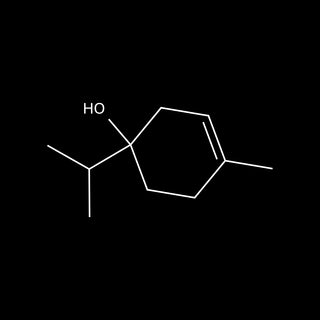
Terpinen-4-ol
PubChem, Terpinen-4-ol
Labelling
- EU allergens reported
- Limonene · Linalool · Pinene · Terpineol · Alpha-Terpinene · Terpinolene
Performance and rules
- Available as
- essential oil
- IFRA status
- No IFRA Standard for the material itself (51st Amendment)
Flax-Leaved Paperbark · See Also
Entries related to Flax-Leaved Paperbark, by their place in the pyramid. “shared” marks a scent word Flax-Leaved Paperbark has too.
Top notes

Paperbark
fresh · herbal (shared) · camphoraceous (shared) Aromatic / Natural-
Tea Tree Oil
fresh · citrus · green Aromatic / Natural 
Lemon Myrtle
citrus · fresh · green Citrus / Natural
Guava
fruity · sweet · tropical Fruity / Natural & Synthetic


Flax-Leaved Paperbark · Sources
- Clinical Microbiology Reviews Melaleuca alternifolia (Tea Tree) oil: a review of antimicrobial and other medicinal properties
- IFRA Standards, 51st Amendment
- Wikipedia Melaleuca linariifolia
- Wikipedia Tea tree oil
- PFAF Melaleuca linariifolia
- Practical Plants / Plants For A Future database Flax-Leaved Paper-Bark (Melaleuca linariifolia)
- PubChem Terpinen-4-ol
Cite as PREMIEREPEAU Glossary, “Flax-Leaved Paperbark”, https://premierepeau.com/
