Helichrysum: The Mediterranean Shrub Behind the Word Immortelle
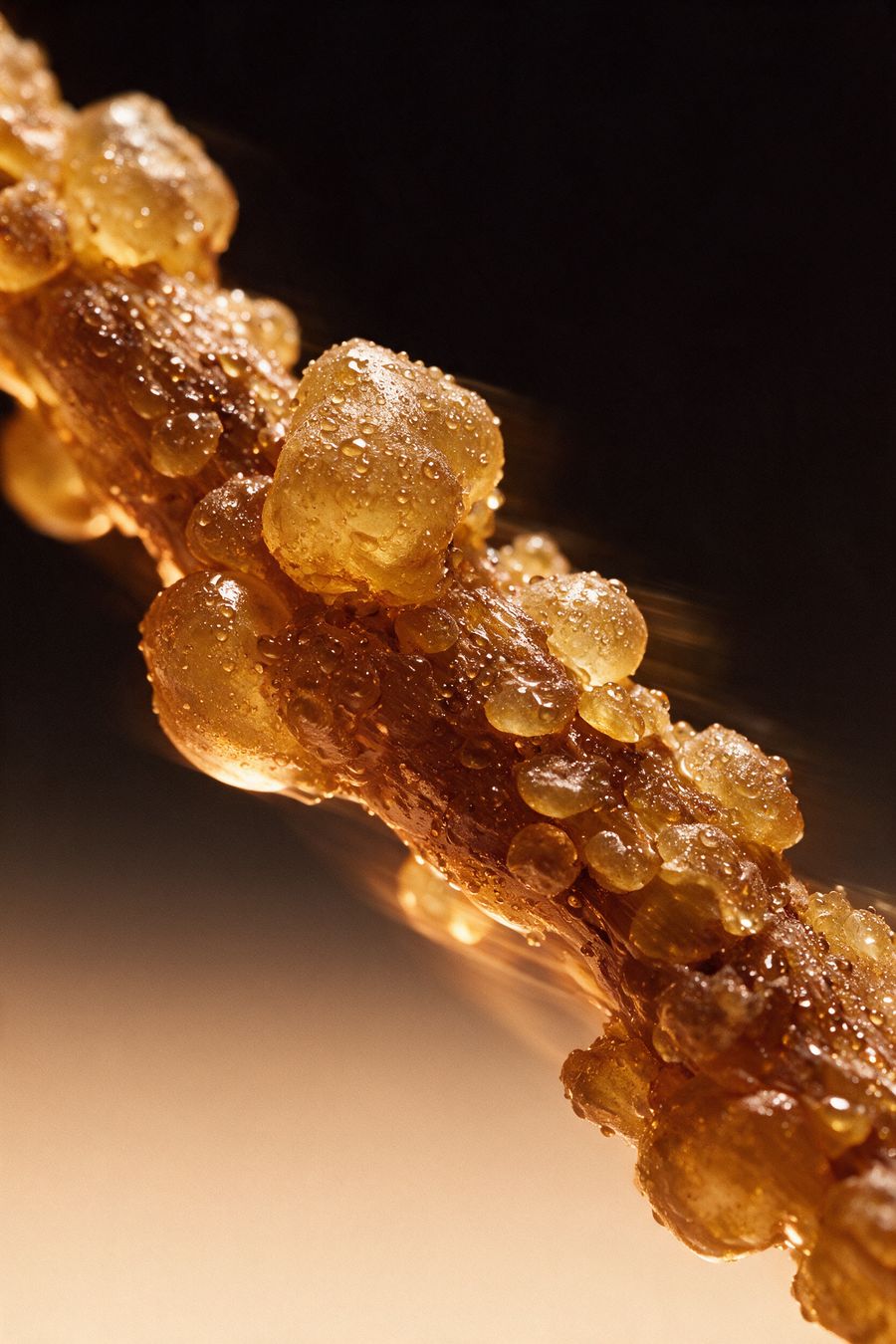
Helichrysum is a genus of daisies, and in perfumery the word names one species, Helichrysum italicum, a Mediterranean shrub also called immortelle or curry plant. The essential oil is distilled from early flowering tops, and a ton of tops gives about 900 g to 1.5 kg of it. The garden strawflower once sold as Helichrysum bracteatum is now Xerochrysum bracteatum, and the curry leaf tree belongs to the citrus family.
What is helichrysum?
Helichrysum is a large genus of daisies, and in perfumery the word means one species, Helichrysum italicum, the Mediterranean shrub also called immortelle. Its flowering tops give an essential oil and an absolute with a honeyed, hay-like smell, and its leaves smell of curry.
Three plants share two names. GBIF, the open biodiversity database, files the garden strawflower once sold as Helichrysum bracteatum under another genus, Xerochrysum. It gives that strawflower the French name "Immortelle à bractées," the same word the perfumer uses for Helichrysum italicum. And it lists "curry-plant" as an English name for both Helichrysum italicum and the curry leaf tree, which belongs to another family. A search for helichrysum meets all of them. This article keeps to the shrub perfumers use.
What is immortelle?
Immortelle is the French word for an everlasting flower. For the perfumer it names one species. A 2023 review in the journal Foods pairs them, "Helichrysum italicum, synonymously immortelle, or everlasting." GBIF adds Hélichryse d'Italie, Immortelle d'Italie and Éternelle jaune in French, and curry plant and Italian strawflower in English.
The genus name has its own root. The same review says it comes from the Greek words for sun and gold, a reference to the bright yellow flower heads.
Helichrysum italicum: the plant and its names
The review describes an aromatic shrub of 30 to 70 cm "with small yellow flowers that exhibit a strong and persistent smell similar to curry." It grows on dry, sandy and rocky ground across the Mediterranean. Kew's World Checklist of Vascular Plants treats Helichrysum italicum (Roth) G.Don as the accepted name. IPNI, the international plant names index, dates it to Loudon's Hortus Britannicus, page 342, in 1830.
Botanists do not agree on how many kinds the species holds. The 2023 review reports an older classification with six subspecies (italicum, microphyllum, picardii, pseudolitoreum, serotinum and siculum) and a revised one with four.
| Subspecies in the revised classification | Where, as the review reports it |
|---|---|
| italicum | Italy, Croatia, eastern Mediterranean coast of France and Corsica, Bosnia and Herzegovina, the Aegean islands of Greece and Cyprus |
| microphyllum | Crete |
| siculum | Sicily |
| tyrrhenicum | Corsica, Sardinia, Majorca, Dragonera Islet |
As for age, the only dated records are botanical names. IPNI dates the species name to 1830 and lists a variety named in 1904 and a subspecies named in 2006. Those are dates of names, not of use.
Helichrysum versus the strawflower
The garden plant sold for dried bouquets is not the perfumery shrub. GBIF accepts it as Xerochrysum bracteatum (Vent.) Tzvelev and lists Helichrysum bracteatum as one of its synonyms. Its English names there include golden everlasting and paper daisy. Both belong to the daisy family, and the link ends there.
The genus is wide. The reference list of Healthline's article on the oil cites studies of Helichrysum arenarium and Helichrysum plicatum next to Helichrysum italicum. The Pharmaceutics paper names Helichrysum stoechas as another well-known species of the genus, found throughout the Mediterranean (see Mediterranean immortelle). A label that says only helichrysum does not tell you which one it means.
Is the curry plant related to curry?
No. The curry leaf tree is Murraya koenigii, of the family Rutaceae and the order Sapindales. Helichrysum italicum is in the family Asteraceae, in the order Asterales. Healthline says the plant is called curry plant "because its leaves have a strong curry-like smell."
Where does helichrysum grow?
Kew's checklist lists Helichrysum italicum for sixteen places and as introduced in two. Cultivation for the oil is a shorter list.
| Source | What it lists |
|---|---|
| Kew's World Checklist | Algeria, Balearic Islands, Corsica, Cyprus, East Aegean Islands, France, Greece, Italy, Crete, Morocco, north-west Balkan Peninsula, Sardinia, Sicily, Spain, Tunisia, Türkiye. Introduced: Germany, Great Britain |
| 2023 review in Foods, cultivation | Corsica, Italy, Hungary, Bosnia and Herzegovina, Croatia |
Hungary is on the second list and not on the first. A 2025 paper in Frontiers in Plant Science adds a warning. Studies of the oil have been run on plant material from places where the shrub does not grow wild, and it names the USA and Serbia as examples.
What does helichrysum smell like?
Our glossary describes the absolute as "herbaceous, hay-like and honeyed, with a smoky tobacco and musk-like undertone." That is one house description of one absolute, not a measure of every immortelle. The curry smell belongs to the living leaves.
One molecule of the oil has a smell record of its own. For neryl acetate, the Leffingwell records list "floral," "fruity" and "sweet," and the Good Scents records add rose, grapefruit, pear, dewy, tropical, soapy and citrus.
What is in helichrysum oil?
The 2023 review says that oils of Helichrysum italicum made by hydrodistillation and steam distillation are dominated by the monoterpenes alpha-pinene, limonene, nerol, neryl acetate and neryl propanoate, and by the sesquiterpenes alpha-selinene, beta-selinene and gamma-curcumene. PubChem gives neryl acetate the formula C12H20O2 and a molar mass of 196.29, and ECHA lists it under the CAS number 141-12-8.
The share of each molecule is not fixed. In the 2025 Frontiers study, plants grown from the seed of 18 natural populations along the eastern Adriatic coast were raised in one field and their oils analysed. The paper reports that "the differences were attributed to genetic adaptation to the native environment."
| Compound, percent of the oil | Lowest | Highest | Average of 18 |
|---|---|---|---|
| Neryl acetate | 5.38 (Cavtat) | 29.22 (Lošinj) | 16.22 |
| ar-Curcumene | 4.85 (Lošinj) | 15.77 (Cavtat) | 9.73 |
| beta-Selinene | 6.05 (Rab) | 14.75 (Brač) | 9.07 |
The populations fell into three groups, a northern, a central and a southern Adriatic chemotype. The northern one, rich in that ester, was closest to Corsican oil, which the paper describes as "predominantly oxygenated compounds (neryl acetate, neryl propionate, aliphatic ketones and β-diketones)." The southern one, rich in ar-curcumene and poor in the ester, was closer to Italian oils. The paper also lists ten chemotypes from earlier work, among them a high alpha-pinene type and an italidiones type. Italidione I appears among the main compounds of the Adriatic oils.
Plant stage matters too. The review reports, from a study of Corsican oils of subspecies italicum, that neryl acetate rose from 15.8% in plants at the early shoot stage to 42.5% in full flowering.
How helichrysum oil is made, and why it costs so much
The review says the essential oil is made by hydrodistillation and steam distillation of early flowering tops, cut by hand from mid-June to mid-July. Steam distillation is told in steam distillation and how ingredients are born. The absolute is solvent extracted, a family of products explained in absolute, concrete and resinoid.
The review adds a third route. Supercritical CO2 extraction is used to obtain solvent-free extracts at low temperature, and a CO2 extract of Helichrysum italicum is dominated by sesquiterpenes, with a significant share of waxes. That method has its own article, the third way.
The review ties the price to the yield. It says that "a ton of flowering tops produces only about 900 g to 1.5 kg of essential oil," and that the low oil content of the plant "contributes to its extremely high price."
| Figure | Value | Source |
|---|---|---|
| Essential oil from a ton of flowering tops | about 900 g to 1.5 kg | Review in Foods, 2023 |
| Price of the essential oil | 30 to 120 euro per 5 mL | Review in Foods, 2023 |
The price is a retail range for the essential oil, given without a seller or a year of quotation. It is not a trade price for the absolute. The 2025 Frontiers paper makes a further point about the data behind the oil. Most studies of its composition were run on wild plants picked in the field or on commercial plantations "with more or less unknown origin of the plant material."
Is helichrysum allowed in perfume and cosmetics?
Three registers name it, and each does a different job. None of them is a safety verdict.
| Register | Entry | What it records |
|---|---|---|
| CosIng, European Commission | HELICHRYSUM ITALICUM FLOWER OIL, ID 87139, CAS 90045-56-0 | Functions fragrance and perfuming, status active |
| CosIng, European Commission | HELICHRYSUM ITALICUM EXTRACT, ID 34243 | Functions anti-sebum, fragrance and soothing |
| IFRA Transparency List | Helichrysum absolute and Helichrysum oil, CAS 8023-95-8 | Both listed |
| IFRA Transparency List | Neryl acetate, CAS 141-12-8 | Listed |
| ECHA, European Chemicals Agency | Neryl acetate, EC 205-459-2 | REACH registered |
CosIng lists ingredient names and their functions. The IFRA lines are rows of its Transparency List, not a Standard. ECHA's record says only that the molecule is registered. None of these records shows whether an IFRA Standard or a European annex limits helichrysum.
Does helichrysum heal scars?
The claim is old and the proof is thin. Four sources bear on it, and they point the same way.
The first is the 2023 review. It reports a study by Voinchet and colleagues in which 2 to 3 months of Helichrysum italicum subspecies serotinum oil, diluted to one tenth in Rosa rubiginosa oil, "reduced local inflammation, edema, bruises, and hematomas in the post-operative scars." The review gives this second hand.
The second is a 2024 paper in Pharmaceutics on rats with induced diabetes. A hydrogel carrying immortelle essential oil was put on excision wounds, and the authors report: "Superior re-epithelialization, scar maturation, and increased collagen fiber density were achieved after immortelle essential oil-based gel application." These were animal wounds, not human scars.
The third is a 2024 paper in the International Journal of Molecular Sciences. It used the hydrolate, the water left by distillation, on cultured skin cells after a scratch. Its authors write that the results "indicate a future translational application of this natural extract to support skin regeneration." That was cells in a dish, and not the oil.
The fourth is Healthline, updated in April 2026. It says: "Most studies have been small or involve animals or tissue in the laboratory, rather than humans." It lists acne scars under the heading "Claims unsubstantiated by research."
Taken together, they give one human report at second hand, one animal study and one cell study. None reports a trial on scars in people. None of them supports a claim about age spots.
No regulator or standard-setter opinion on helichrysum on skin is cited here, so there is no safety verdict and no advice. It reports what three sources say. Healthline writes: "One 2013 study with human subjects found one case of allergic contact dermatitis." It adds that the case was not seen in 10 other subjects of that study, and that animal and cell studies suggest the oil may stop some liver enzymes from working. The Pharmaceutics paper ran an acute dermal irritation test on rats and found its hydrogel had no potential to act as an irritant. The review describes the oil as used in aromatherapy and for skin conditions such as hematoma and sunburn.
Frequently Asked Questions
What is immortelle?
Immortelle is a common name of Helichrysum italicum, a Mediterranean shrub of the daisy family. A 2023 review in Foods writes the two names as synonyms. GBIF also lists Immortelle d'Italie in French and curry plant and Italian strawflower in English. The plant is not related to curry.
Is helichrysum the same as immortelle?
For the perfumery plant, yes: both words name Helichrysum italicum. The word helichrysum also covers many other species, and the strawflower once sold as Helichrysum bracteatum is now Xerochrysum bracteatum. A 2023 review in Foods writes Helichrysum italicum as synonymous with immortelle, or everlasting.
Is the curry plant related to curry?
No. The curry plant is Helichrysum italicum, in the daisy family Asteraceae. The curry leaf tree is Murraya koenigii, in the citrus family Rutaceae. GBIF lists curry-plant as an English name of both. Healthline says the plant is called curry plant because its leaves have a strong curry-like smell.
What does helichrysum smell like?
Our glossary describes the absolute as herbaceous, hay-like and honeyed, with a smoky tobacco undertone. The living leaves have a strong curry-like smell, says Healthline. For neryl acetate, a molecule of the oil, the Leffingwell records list floral, fruity and sweet.
What is in helichrysum oil?
A 2023 review lists alpha-pinene, limonene, nerol, neryl acetate and neryl propanoate, with the sesquiterpenes selinene and curcumene. Across 18 Adriatic populations grown in one field, the share of neryl acetate ranged from 5.38% to 29.22%. Corsican oil carries neryl propionate, ketones and beta-diketones too. The mix changes with origin.
Why is helichrysum oil expensive?
A 2023 review says a ton of flowering tops produces only about 900 g to 1.5 kg of essential oil, and calls the price extremely high, 30 to 120 euro per 5 mL. That is a retail range for the oil. A 2025 paper adds that most studies used wild or plantation material of uncertain origin.
Does helichrysum heal scars?
The sources do not show it in people. A review reports at second hand that the oil diluted to one tenth in Rosa rubiginosa oil reduced inflammation and bruising in post-operative scars. A rat study and a cell study point the same way, and Healthline says most studies are small or not in humans.
Is helichrysum allowed in perfume and cosmetics?
CosIng lists Helichrysum italicum flower oil with the functions fragrance and perfuming, status active. The IFRA Transparency List includes Helichrysum absolute and oil, and ECHA shows neryl acetate as REACH registered. These are listings, not safety verdicts, and none of them says whether a limit exists.
Sources
- V. Furlan and U. Bren, "Helichrysum italicum: From Extraction, Distillation, and Encapsulation Techniques to Beneficial Health Effects", Foods 12(4), 802, 2023. DOI 10.3390/foods12040802. Read in full text through Europe PMC.
- "Phenotypic plasticity vs. local genetic adaptation: essential oil diversity of natural immortelle (Helichrysum italicum (Roth.) G.Don) populations along eastern Adriatic coast", Frontiers in Plant Science, 2025. DOI 10.3389/fpls.2025.1467421. Read in full text through Europe PMC.
- "Immortelle Essential-Oil-Enriched Hydrogel for Diabetic Wound Repair", Pharmaceutics 16(10), 1309, 2024. DOI 10.3390/pharmaceutics16101309. Read in full text through Europe PMC.
- Study of the hydrolate of Helichrysum italicum on skin cells, International Journal of Molecular Sciences 25(9), 4736, 2024. DOI 10.3390/ijms25094736. Read in full text through Europe PMC.
- Healthline, "Helichrysum Essential Oil: Benefits, Uses, and Precautions", updated 20 April 2026. Read on 19 November 2026.
- GBIF backbone records for Helichrysum italicum, Xerochrysum bracteatum and Murraya koenigii (names, families, common names). IPNI record for Helichrysum italicum, Hortus Britannicus, 1830. Kew, World Checklist of Vascular Plants, distribution, read through GBIF. Read on 19 November 2026.
- PREMIEREPEAU glossary, entries immortelle, mediterranean immortelle, curry and curry tree. Read on 19 November 2026.
- PubChem, neryl acetate (CID 1549025). Good Scents and Leffingwell records for neryl acetate, through the Pyrfume data. European Commission CosIng, ingredients 87139, 34243 and 96848. IFRA Transparency List. ECHA, substance 100.004.964. Read on 19 November 2026.

Simili Mirage
Extrait de parfum at 20%. 8 notes, including olibanum, thyme and white thyme.
Read also
3
Steam Distillation: How Ingredients Are Born
Rose petals do not surrender their scent willingly. Steam distillation — the oldest industrial method for isolating volatile aromatic molecules from plant matter, requires between 3,500 and 5,000 kilograms of Rosa...
Sarsaparilla: Three Plants Share One Word, and the 1960 Ban Never Named the Vine
Sarsaparilla is three plants under one word, and the American order of 1960 that people blame for the old drink's decline never names the vine. It names safrole and oil of sassafras.
Supercritical CO2 Extraction: The Third Way
A moment, if you have ever crushed a leaf of blackcurrant between your fingers, when the smell that rises is so complete, so multilayered, so obviously alive, that you understand immediately why no blackcurrant fragra...
Next
Perfumery Journal
Steam Distillation: How Ingredients Are Born
21.10.25