


Beifuß
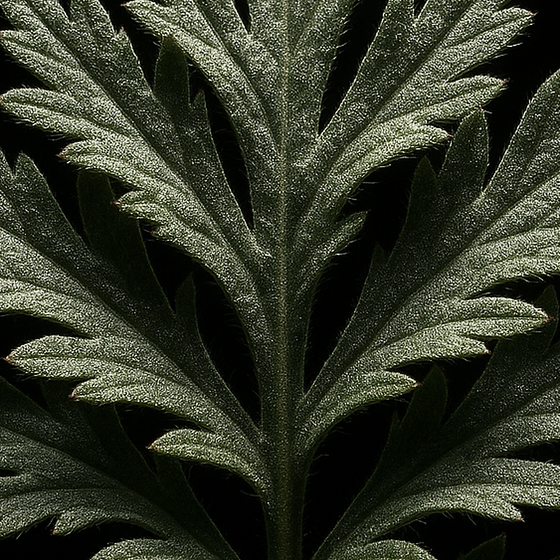
Beifuß ist Artemisia vulgaris, eine Pflanze, deren wasserdampfdestilliertes Öl krautig, kampferartig und salbeiähnlich duftet.
- Typ
- Zutat
- Duftfamilie
- Aromatisch
- Quelle
- Oberirdische Teile von Artemisia vulgaris; die Ölzusammensetzung variiert je nach Pflanzenteil und Population.
- Chemische Klasse
- komplex natürlich (ätherisches Öl)
Duft
Terroir & Verarbeitung
Die ganze Geschichte
Wussten Sie schon?
In einem Beleg von Gotland aus dem Jahr 1875, der im Uppsala landmålsarkiv liegt, bittet der Beifuß darum, Luna genannt zu werden, bevor er Heilkraft spendet. Der Vers besagt: Nennt man ihn Beifuß, heilt er weder Frau noch Kuh; nennt man ihn Luna, heilt er Kuh und Frau. Der ukrainische Name des Beifußes, chornóbyl', bedeutet „schwarzer Stängel“, und die ukrainische Stadt Tschernobyl hat ihren Namen von dieser Pflanze.
Extraktion & Chemie
Extraktionsmethode
Das ätherische Öl von Artemisia vulgaris wird durch Wasserdampfdestillation gewonnen.
- Formel
- Komplexes natürliches Gemisch; die berichteten Bestandteile variieren je nach Öl und umfassen 1,8-Cineol, Kampfer, Germacren D und Thujon (C₁₀H₁₆O).
- CAS
- 68991-20-8
- Botanische Bezeichnung
- Artemisia vulgaris
- Aussehen
- Gelbe Flüssigkeit (berichtet für Öle aus litauischen Wildbeständen)
- Geruchsintensität
- Mittel
- Synonyme
- Gemeiner Beifuß, Felon-Kraut, Chrysanthemenunkraut, Wilder Wermut, Old Uncle Henry, Seemannstabak, Naughty Man, Old Man
Der Thujongehalt unterliegt IFRA-Beschränkungen, einschließlich der Beiträge aus natürlichen Inhaltsstoffen (51. Änderung).
- Flammpunkt
- 131 °F (55 °C) TCC
- Dichte
- 0,91700 bis 0,93500 @ 25 °C
- Brechungsindex
- 1,46000 bis 1,47200 @ 20 °C
In der Parfümerie
Armoise-vulgaris-Öl verleiht einem Duft einen krautigen, frischen, kampferartigen Charakter. Die Einsatzmenge hängt von der Zusammensetzung des Öls und der Kategorie des Endprodukts ab, einschließlich der geltenden IFRA-Grenzwerte für Thujon. Eine Einsatzmenge im Duftbereich begründet keine Eignung für die Aromatisierung von Lebensmitteln.
Siehe auch
8 NotenQuellen
28- The Genus Artemisia: a 2012-2017 Literature Review on Chemical Composition, Antimicrobial, Insecticidal and Antioxidant Activities of Essential OilsMedicines (2017)
- Allelopathic Potential of Artemisia absinthium and Artemisia vulgaris from Serbia: Chemical Composition and Bioactivity on WeedsPlants (2025)
- ThujonePubChem
- IFRA Standards, 51st AmendmentIFRA
- armoise oilPerflavory
- Artemisia vulgarisGBIF
- Artemisia vulgarisWikipedia
- ThujoneWikipedia
- Nine Herbs CharmWikipedia
- Artemisia absinthiumWikipedia
- Artemisia vulgaris L. — species accountBotanical Society of Britain and Ireland, Fermanagh Flora
- Mugwort or Chrysanthemum Weed (Artemisia vulgaris)NC State Extension
- IFRA Standard: ThujoneInternational Fragrance Association — Amendment 49 (2020), retained in the 51st-Amendment framework
- Compositional Variability and Toxic Activity of Mugwort (Artemisia vulgaris) Essential OilsAsta Judzentiene and Rasa Garjonyte — Natural Product Communications (2016); State Research Institute, Center for Physical Sciences and Technology, Lithuania
- Artemisia vulgaris L.Plants of the World Online — Royal Botanic Gardens, Kew
- Artemisia vulgaris L. — taxonomic report, TSN 35505Integrated Taxonomic Information System
- Composition of the Essential Oil of Wild Growing Artemisia vulgaris from Erie, PennsylvaniaJack D. Williams, Ayman M. Saleh and Dom N. Acharya — Natural Product Communications (2012)
- Fragrance Ingredient Glossary — Armoise vulgaris oilInformation derived from the IFRA Fragrance Ingredient Glossary, developed by The International Fragrance Association (April 2020)
- Allergic contact dermatitis associated with mugwort (Artemisia vulgaris)Sik Haw, Hee-Ryung Cho and Mu-Hyoung Lee — Contact Dermatitis (2010)
- Harley MS 585, ff 130r–193r — LacnungaBritish Library Archives and Manuscripts Catalogue
- Old English Medical ProseIrene Tenchini — University of Oxford, Resources for Old English Prose
- Chemical Profile and Biological Activities of Essential Oil from Artemisia vulgaris L. Cultivated in BrazilSonia Malik et al. — Pharmaceuticals (2019)
- Mugwort: Usefulness and SafetyNational Center for Complementary and Integrative Health, US National Institutes of Health
- Oils, Artemisia vulgaris — CAS 68991-20-8US Environmental Protection Agency — CompTox Chemicals Dashboard
- Compendium — Artemisia vulgaris monographMonograph hosted by the Department of Biotechnology, Government of India
- Artemisia vulgaris — morphology and species profileNC State Extension Gardener Plant Toolbox
- Wormwood Forest: A Natural History of Chernobyl — Chapter 1Mary Mycio — Joseph Henry Press / National Academies (2005)
- Variations in Chemical Compositions and Biological Activities of Artemisia vulgaris L. (Common Mugwort) Essential Oils at Different Growth StagesIlker Demirbolat, Ebrar Inal, Seyma Ulusoy and Murat Kartal — Journal of Essential Oil Bearing Plants 25(2), 393–402 (2022); DOI 10.1080/0972060X.2022.2084348; Bezmialem Vakif University repository

