


ミドルピラミッド
3/5強さ
—持続性
7産地
標本
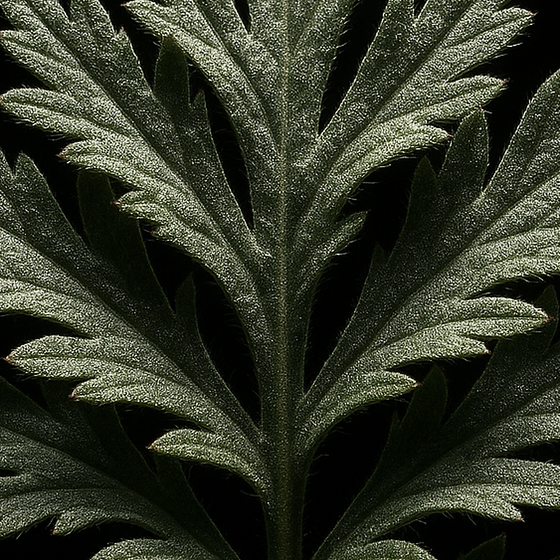
Artemisia vulgaris
ナチュラル
定義
ヨモギ(マグワート)はArtemisia vulgarisという植物で、その水蒸気蒸留オイルはハーブ調でカンフル様、セージを思わせる香りを持ちます。
ハーバル91
グリーン75
フレッシュ71
アロマティック47
ウッディ57
アーシー20
コモンマグワート、フェロンハーブ、クリサンセマムウィード、ワイルドウォームウッド、オールドアンクルヘンリー、セーラーズタバコ、ノーティーマン、オールドマン
- 種別
- 成分
- 香りの系統
- アロマティック
- 原料
- ヨモギ(Artemisia vulgaris)の地上部。精油の組成は、植物の部位や個体群によって異なります。
- 化学分類
- 天然複合物(エッセンシャルオイル)
計器
ピラミッド
Tトップ
Hミドル
Bベース
3/5強さ
中程度
香りの強さ
生産国
フランス モロッコ ドイツ ハンガリー インド 中国 日本
香り
PREMIEREPEAU にて
テロワールと加工
詳しい解説
豆知識
ウプサラの方言文書館(landmålsarkiv)に所蔵されている1875年のゴットランド島の資料では、ヨモギは癒やしの力を授ける前に「ルナ」と呼ぶよう求めます。詩によれば、「マグワート」と呼べば妻にも牛にも効きませんが、「ルナ」と呼べば牛にも妻にも効くとされています。ヨモギのウクライナ語名chornóbyl'は「黒い茎」を意味し、ウクライナの都市チェルノブイリの名はこの植物に由来します。
抽出と化学
抽出方法
Artemisia vulgarisの精油は水蒸気蒸留によって得られます。
- 分子式
- 複合的な天然混合物。報告される構成成分はオイルによって異なり、1,8-シネオール、カンファー、ゲルマクレンD、ツヨン(C₁₀H₁₆O)などが含まれる。
- CAS
- 68991-20-8
- 植物学名
- Artemisia vulgaris
- 外観
- 黄色の液体(リトアニアの野生個体群から得られたオイルについて報告されている)
- 香りの強さ
- 中程度
- 別名
- コモンマグワート、フェロンハーブ、クリサンセマムウィード、ワイルドウォームウッド、オールドアンクルヘンリー、セーラーズタバコ、ノーティーマン、オールドマン
IFRA規制状況
注記を参照ツヨン含有量は、天然原料由来分を含め、IFRAの規制対象です(第51次改訂)。
物理的性質
- 引火点
- 131 °F(55 °C)TCC
- 比重
- 0.91700〜0.93500 @ 25 °C
- 屈折率
- 1.46000〜1.47200 @ 20 °C
調香での役割
アルモワーズ・ブルガリス油は、フレグランスにハーバルでフレッシュ、樟脳のような個性をもたらします。その使用量は、油の組成と最終製品のカテゴリー、ならびにツヨンに関するIFRAの適用制限によって異なります。フレグランスとしての使用量は、食品用フレーバーとしての適合性を示すものではありません。
処方での役割
01モディファイア
02シグネチャーノート
03ブレンダー
04新鮮さ
提供形態
精油 アブソリュート
関連項目
8 ノート出典
28- The Genus Artemisia: a 2012-2017 Literature Review on Chemical Composition, Antimicrobial, Insecticidal and Antioxidant Activities of Essential OilsMedicines (2017)
- Allelopathic Potential of Artemisia absinthium and Artemisia vulgaris from Serbia: Chemical Composition and Bioactivity on WeedsPlants (2025)
- ThujonePubChem
- IFRA Standards, 51st AmendmentIFRA
- armoise oilPerflavory
- Artemisia vulgarisGBIF
- Artemisia vulgarisWikipedia
- ThujoneWikipedia
- Nine Herbs CharmWikipedia
- Artemisia absinthiumWikipedia
- Artemisia vulgaris L. — species accountBotanical Society of Britain and Ireland, Fermanagh Flora
- Mugwort or Chrysanthemum Weed (Artemisia vulgaris)NC State Extension
- IFRA Standard: ThujoneInternational Fragrance Association — Amendment 49 (2020), retained in the 51st-Amendment framework
- Compositional Variability and Toxic Activity of Mugwort (Artemisia vulgaris) Essential OilsAsta Judzentiene and Rasa Garjonyte — Natural Product Communications (2016); State Research Institute, Center for Physical Sciences and Technology, Lithuania
- Artemisia vulgaris L.Plants of the World Online — Royal Botanic Gardens, Kew
- Artemisia vulgaris L. — taxonomic report, TSN 35505Integrated Taxonomic Information System
- Composition of the Essential Oil of Wild Growing Artemisia vulgaris from Erie, PennsylvaniaJack D. Williams, Ayman M. Saleh and Dom N. Acharya — Natural Product Communications (2012)
- Fragrance Ingredient Glossary — Armoise vulgaris oilInformation derived from the IFRA Fragrance Ingredient Glossary, developed by The International Fragrance Association (April 2020)
- Allergic contact dermatitis associated with mugwort (Artemisia vulgaris)Sik Haw, Hee-Ryung Cho and Mu-Hyoung Lee — Contact Dermatitis (2010)
- Harley MS 585, ff 130r–193r — LacnungaBritish Library Archives and Manuscripts Catalogue
- Old English Medical ProseIrene Tenchini — University of Oxford, Resources for Old English Prose
- Chemical Profile and Biological Activities of Essential Oil from Artemisia vulgaris L. Cultivated in BrazilSonia Malik et al. — Pharmaceuticals (2019)
- Mugwort: Usefulness and SafetyNational Center for Complementary and Integrative Health, US National Institutes of Health
- Oils, Artemisia vulgaris — CAS 68991-20-8US Environmental Protection Agency — CompTox Chemicals Dashboard
- Compendium — Artemisia vulgaris monographMonograph hosted by the Department of Biotechnology, Government of India
- Artemisia vulgaris — morphology and species profileNC State Extension Gardener Plant Toolbox
- Wormwood Forest: A Natural History of Chernobyl — Chapter 1Mary Mycio — Joseph Henry Press / National Academies (2005)
- Variations in Chemical Compositions and Biological Activities of Artemisia vulgaris L. (Common Mugwort) Essential Oils at Different Growth StagesIlker Demirbolat, Ebrar Inal, Seyma Ulusoy and Murat Kartal — Journal of Essential Oil Bearing Plants 25(2), 393–402 (2022); DOI 10.1080/0972060X.2022.2084348; Bezmialem Vakif University repository

