


1-Phenylethanol
Keywords: floral · earthy · green
1-Phenylethanol is an aromatic alcohol with a floral, earthy, green odour of hyacinth, lilac and jasmin.
- Olfactive family
- Florals · 785 entries of the glossary in this family Subfamily: Fresh florals · 108 entries in this subfamily Cluster: Lily-like fresh florals · 67 entries in this cluster
- Material
- Natural & Synthetic
- Pyramid
- Top Note
- Strength
- Medium Step 3 of 5 · shared by 1,469 of 2,161 graded entries Graded entries at each step, from 1 to 5: 4, 117, 1,469, 507, 40. 24 more sit between two steps.
- Also called
- alpha-Methylbenzyl alcohol, Methylphenyl carbinol, Styralyl alcohol, 1-Phenethyl alcohol, (1-Hydroxyethyl)benzene, 1-Phenylethyl alcohol
1-Phenylethanol · Facets
Entries of the glossary that carry each facet, of 3,979:
- floral 1,551
- earthy 657
- green 1,444
- hyacinth 30
- jasmine 57
- lilac 21
1-Phenylethanol · Scent
Floral, earthy and green, with hyacinth, lilac, jasmin and mimosa facets.
1-Phenylethanol · In Perfumery
As a fragrance ingredient it brings a dry-floral, earthy-green odour of the lilac, jasmin and mimosa type.
Pyramid
1-Phenylethanol: Top. Entries of the glossary stored at each place of the pyramid, of 4,000 (35 store no place):
- Top 718
- Top · Heart 501
- Heart 1,646
- Heart · Base 512
- Base 588
1-Phenylethanol · Extraction & Chemistry
It is made by reduction of acetophenone, by reaction of methyl magnesium chloride and benzaldehyde, or by oxidation of ethylbenzene. In the hydroperoxide process, an organic hydroperoxide is used to epoxidize propylene, and an organic alcohol is a coproduct.
- Appearance
- Colourless to pale yellow liquid or white solid
1-Phenylethanol · In Depth
Identity
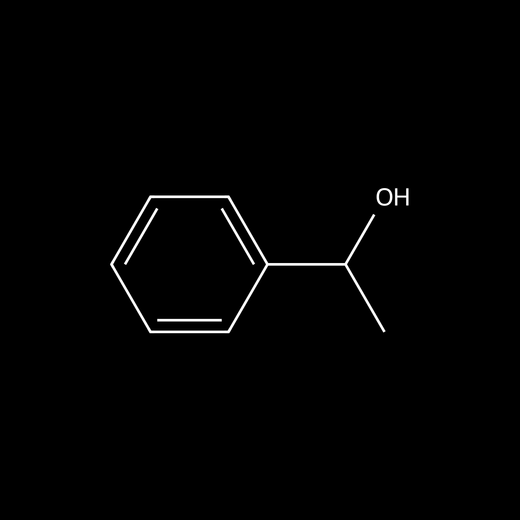
1-Phenylethanol has the IUPAC name 1-phenylethanol. Its CAS number is 98-85-1. Its molecular formula is C₈H₁₀O and its molecular weight is 122.16 g/mol. It is an aromatic alcohol, namely ethanol substituted by a phenyl group at position 1. Two optically active isomers exist, and the commercial product is the racemic form.
Odour
The odour is floral, earthy and green, with hyacinth, jasmin and lilac sides. It is dry-floral and earthy-green, of the lilac, jasmin and mimosa type, with moderate to poor tenacity. The odour is also mild and floral, with a hyacinth-gardenia character. At 100 % it is described as fresh, sweet, acetophenone, gardenia and hyacinth. Its odour strength is medium, and its substantivity is 8 hours at 100 %.
Occurrence in nature
It has been found in Achillea abrotanoides, Aspergillus niger, Castanopsis cuspidata, Cedronella canariensis, Cichorium endivia, Dicranopteris dichotoma and Hyssopus officinalis.
Production
It is made by reduction of acetophenone, by reaction of methyl magnesium chloride and benzaldehyde, or by oxidation of ethylbenzene. In the hydroperoxide process, an organic hydroperoxide is used to epoxidize propylene, and an organic alcohol is a coproduct.
Use in perfumery
It is used in perfumery as a fragrance ingredient. Cosmetic rules class it as a perfuming ingredient.
Use in flavours
It is used as a flavouring agent. Its flavour profile is floral, honey and rose. At 50 ppm the taste is chemical and medicinal, with a balsamic vanilla woody nuance. Reported use levels are 4.6 ppm in non-alcoholic beverages, 3.8 ppm in ice cream and ices, 6.8 ppm in candy, 9 ppm in baked goods, 4 ppm in gelatins and puddings and 0.3 ppm in chewing gum.
An acceptable daily intake of 0-0.1 mg/kg bw was set in 1993 and maintained in 2001, with no safety concern at current levels of intake when it is used as a flavouring agent.
Properties
It boils at 204 to 205 °C at 745 mmHg. It melts at 19 to 20 °C at 760 mmHg. Its flash point is 85 °C. Its estimated logP is 1.409. Its solubility in water is 1,950 mg/l at 25 °C. It is soluble in glycerol, mineral oil and alcohol.
Safety and IFRA
As of the 51st Amendment, no IFRA Standard covers this material itself. Its INCI name is STYRALYL ALCOHOL. Its EC number is 202-707-1, and it is registered under REACH. In 98.1% of reports it carries H302, harmful if swallowed, and in 77.2% H319, causes serious eye irritation.
1-Phenylethanol · Technical Sheet
Molecular weight
122.16 g/mol Heavier than 388 of the 546 other entries at the same place of the pyramid that store a weight; 13 weigh the same
2,572 entries store a molecular weight. By place in the pyramid: Top 547, Top · Heart 411, Heart 888, Heart · Base 454, Base 272.
Identity
- Type
- Ingredient
- Category
- Aroma chemicals
Classification
- Chemical class
- Alcohol
Chemical data
- Formula
- C8H10O
- CAS
- 98-85-1
- PubChem CID
- 7409, compound record on PubChem
- InChIKey
- WAPNOHKVXSQRPX-UHFFFAOYSA-N
Physical properties
- Boiling point
- 204 to 205 °C at 745 mmHg
- Melting point
- 19 to 20 °C at 760 mmHg
- Flash point
- 85 °C (185 °F)
- Vapour pressure
- 0.139 mmHg at 25 °C (estimated)
- Log P
- 1.409 (estimated)
- Tenacity
- 8 hour(s) at 100 %
Performance and rules
- Available as
- synthetic
- IFRA status
- No IFRA Standard for the material itself (51st Amendment)
1-Phenylethanol · See Also
Entries related to 1-Phenylethanol, by their place in the pyramid. « shared » marks a scent word 1-Phenylethanol has too.
Top notes

2-Phenyl-1-propanol
floral (shared) · hyacinth (shared) · lilac (shared) Florals / Top · Heart / Same cluster / 136.19 g/mol-
2-Phenylethanethiol
sulfurous · roasted · tropical Gourmand / Top · Heart / 138.23 g/mol -
4-Vinylphenol
medicinal · phenolic · spicy Aromatic / 120.15 g/mol

Heart notes

Phenylethyl Alcohol
floral (shared) · rosy · honeyed Florals / Synthetic / 122.16 g/mol
Rose
floral (shared) · honeyed · waxy Florals / Natural
Beer
fresh · rich · sweet Gourmand / Fantasy/Concept
Dimethyl benzyl carbinyl butyrate
fruity · plum · herbal Fruity / Heart · Base / 220.31 g/mol


1-Phenylethanol · Sources
- PubChem 1-Phenylethanol
- ChEBI 1-Phenylethanol: chemical classification record
- Pyrfume Arctander, Perfume and Flavor Chemicals: odour descriptions (Pyrfume archive)
- Pyrfume Good Scents odour data (Pyrfume archive)
- Pyrfume Leffingwell odour data (Pyrfume archive)
- The Good Scents Company Information System 1-Phenylethanol: data sheet
- Wikidata (LOTUS natural products data) 1-Phenylethanol: organisms it is reported in, with the papers
- European Commission, CosIng 1-Phenylethanol: cosmetic ingredient record
- IFRA Standards, 51st Amendment
- European Chemicals Agency 1-Phenylethanol: substance record
Cite as PREMIEREPEAU Glossary, “1-Phenylethanol”, https://premierepeau.com/pages/glossary-terms/1-phenylethanol Updated 2026-11-20
