


5-(Hydroxymethyl)furfural
Keywords: hay · herbal · caramellic
5-(Hydroxymethyl)
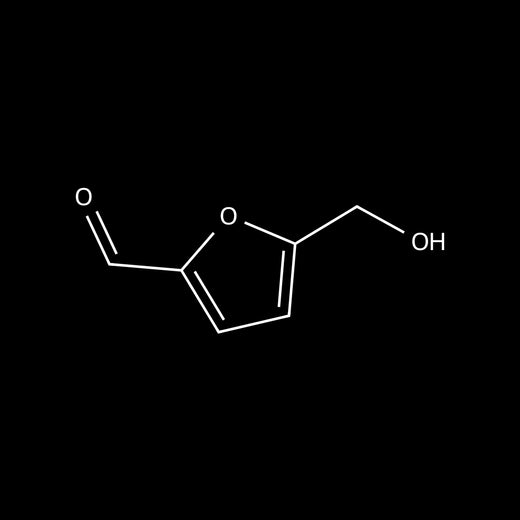
- Olfactive family
- Aromatic · 510 entries of the glossary in this family Subfamily: Herbal aromatics · 230 entries in this subfamily Cluster: Green-herbal notes · 155 entries in this cluster
- Material
- Synthetic
- Pyramid
- Top · Heart · Volatility: Top · Heart Note
Family, subfamily and cluster: PREMIEREPEAU house classification, version 2026‑11.
5-(Hydroxymethyl)
Entries of the glossary that carry each facet, of 3,979:
- hay 38
- herbal 757
- caramellic 95
- ethereal 184
- tobacco 67
- winey 129
5-(Hydroxymethyl)furfural · Scent
5-(Hydroxymethyl)furfural · In Perfumery
Its character is warm-herbaceous and ethereal, with a chamomile-like facet and a similarity to hay, caramellic and tobacco notes.
Pyramid
5-(Hydroxymethyl)
- Top 718
- Top · Heart 497
- Heart 1,641
- Heart · Base 514
- Base 594
5-(Hydroxymethyl)furfural · Extraction & Chemistry
It forms by the acid-catalysed dehydration of hexoses, and it is prepared from fructose or inulin hydrolysates by acid-induced elimination of three molecular equivalents of water. The yield from the fructose portion of the sugar molecule is 57 %. It can also be obtained from glucose, cornstarch, sucrose and molasses. It serves as a renewable building block for organic syntheses.
- Appearance
- Beige or yellow crystalline solid that forms needles
5-(Hydroxymethyl)furfural · Did You Know?
Its formation can be used as an index of excessive heat treatment and of deteriorative changes in food.
5-(Hydroxymethyl)furfural · In Depth
Identity
Its IUPAC name is 5-(hydroxymethyl)
Odour
Its odour is herbal, with hay, caramellic, ethereal, tobacco and winey facets. The odour is warm-herbaceous and winey-ethereal, remotely resembling Hungarian chamomile, with a similarity to hay, caramellic and tobacco often perceptible. Diluted to 0.1 % in dipropylene glycol, it smells fatty, buttery, musty, waxy and caramellic. The Merck Index also likens the odour to that of chamomile flowers.
Occurrence in nature
It is found in Allium cepa, Carica papaya, Cassia fistula, Acalypha spiciflora, Anemarrhena asphodeloides and Aralia bipinnata. It is virtually absent from fresh foods and forms in sugar-containing foods during storage, especially by drying or cooking.
Production
It forms by the acid-catalysed dehydration of hexoses, and it is prepared from fructose or inulin hydrolysates by acid-induced elimination of three molecular equivalents of water. The yield from the fructose portion of the sugar molecule is 57 %. It can also be obtained from glucose, cornstarch, sucrose and molasses. It serves as a renewable building block for organic syntheses.
Use in flavours
It is used as a flavouring agent, and its taste is herbal, hay and tobacco, or butter, caramel and musty.
Properties
It is a beige or yellow, hygroscopic solid that forms needles. It melts at 31.5 °C and boils at 114 to 116 °C at 1 mmHg. Its density is 1.2062 grams per cubic centimetre at 25 °C and its refractive index is 1.5627 at 18 °C. Its flash point is 79.44 °C, its vapour pressure is 0.00528 mmHg and its estimated logP is −0.778. It is freely soluble in methanol, ethanol, acetone, ethyl acetate and dimethylformamide, and soluble in ether, benzene and chloroform.
When heated to decomposition it emits acrid smoke and irritating fumes.
Safety and IFRA
No IFRA Standard covers this material itself. Its INCI name is HYDROXYMETHYLFURFURAL, and its cosmetic functions are antioxidant and skin conditioning, as an emollient, a humectant and a skin protectant. Its EC number is 200-654-9, and it is registered under REACH.
5-(Hydroxymethyl)furfural · Technical Sheet
Molecular weight
126.11 g/mol Heavier than 7 of the 402 other entries at the same place of the pyramid that store a weight; 2 weigh the same.
2,515 entries store a molecular weight. By place in the pyramid: Top 537, Top · Heart 403, Heart 861, Heart · Base 452, Base 262.
Identity
- Type
- Ingredient
- Category
- Aroma chemicals
Chemical data
- Formula
- C6H6O3
- CAS
- 67-47-0
- Reported in plants
- Prunus mume (2 papers; one: Chem Pharm Bull (Tokyo) 1989, Prunus mume) · Hippophae rhamnoides (1 paper; one: Nat Prod Res 2009, Hippophae rhamnoides) · LOTUS
- PubChem CID
- 237332, compound record on PubChem
- InChIKey
- NOEGNKMFWQHSLB-UHFFFAOYSA-N
- Wikidata · Wikipedia
- 5-(Hydroxymethyl)
furfural: Q414606, item on Wikidata · Wikipedia, English article
Physical properties
- Boiling point
- 291 to 292 °C at 760 mmHg
- Melting point
- 31.5 °C
- Flash point
- 79.44 °C (175 °F)
- Density
- 1.2062 g/cm³ at 25 °C
- Refractive index
- 1.5627 at 18 °C
- Vapour pressure
- 0.00528 mmHg
- Log P
- −0.778 (estimated)
Performance and rules
- Available as
- synthetic
- IFRA status
- No IFRA Standard for the material itself (51st Amendment)
5-(Hydroxymethyl)furfural · See Also
Entries related to 5-(Hydroxymethyl)
Top notes

Furfural
gourmand · bread · nutty Gourmand / Synthetic / 96.08 g/mol
2-Acetyl-5-Methylfuran
nutty · caramellic (shared) · coumarinic Gourmand / 124.14 g/mol
5-Methylfurfural
sweet · spicy · caramel Gourmand / 110.11 g/mol


5-(Hydroxymethyl)furfural · Sources
- PubChem 5-(Hydroxymethyl)
furfural - ChEBI 5-(Hydroxymethyl)
furfural: chemical classification record - Pyrfume Arctander, Perfume and Flavor Chemicals: odour descriptions (Pyrfume archive)
- Pyrfume Good Scents odour data (Pyrfume archive)
- Pyrfume Leffingwell odour data (Pyrfume archive)
- European Chemicals Agency 5-(Hydroxymethyl)
furfural: substance record - The Good Scents Company Information System 5-(Hydroxymethyl)
furfural: data sheet - Wikidata (LOTUS natural products data) 5-(Hydroxymethyl)
furfural: organisms it is reported in, with the papers - IFRA Standards, 51st Amendment
- European Commission, CosIng 5-(Hydroxymethyl)
furfural: cosmetic ingredient record
Cite as PREMIEREPEAU Glossary, “5-(Hydroxymethyl)
