


Alumroot
Keywords: floral · sweet
Alumroot is a common name of Heuchera, a genus of largely evergreen perennial plants in the family Saxifragaceae. All species are native to North America except for Heuchera sichotensis, native to the Russian Far East.
- Olfactive family
- Florals · 785 entries of the glossary in this family Subfamily: Classic florals · 314 entries in this subfamily
- Material
- Fantasy/Concept Flowers
- Pyramid
- Heart Note
- Strength
- N/A — no measured strength for a fantasy accord Not on the graded scale
- Producing countries
- North America
- Also called
- Coral bells
Alumroot · Facets
Entries of the glossary that carry each facet, of 3,979:
- floral 1,551
- green 1,444
- earthy 657
- sweet 1,990
- fresh 1,392
Alumroot · Scent
The flowers of Heuchera sanguinea, a species called coral bells, are sweetly fragrant. The stem of American alumroot is not aromatic.
Evolution over time
Alumroot: scent over time.
- Immediately
N/A — no documented evolution for a fantasy accord
N/A
Alumroot · In Perfumery
Pyramid
Alumroot: Heart. Entries of the glossary stored at each place of the pyramid, of 4,000 (35 store no place):
- Top 718
- Top · Heart 501
- Heart 1,646
- Heart · Base 512
- Base 588
Role in the formula
Alumroot: roles in the formula. Entries of the glossary that share each role, of 4,000:
- N/A — no documented formula role 360
PREMIEREPEAU collection: Extrait de parfum
Alumroot · Extraction & Chemistry
No process for extracting a fragrance material from alumroot is described.
Available as
Alumroot: available as.
- synthetic accord
- fantasy note
- Appearance
- N/A — no commercial essential oil; ornamental plant with earthy root character
Alumroot · Did You Know?
Heuchera sanguinea is called coral bells because of its cerise flowers. Its Latin epithet sanguinea means blood-red, in reference to the color of the flowers.
Alumroot · In Depth
Description
Heuchera have palmately lobed leaves on long petioles and a thick, woody rootstock. There are approximately 37 species. Their taxonomy is difficult because the species often intergrade with one another, hybridization is common, and the flowers change markedly in proportion as they develop.
Distribution and Habitat
Alumroot species grow in varied habitats, so some species look quite different from one another. H. maxima is found on the Channel Islands of California, where it grows on rocky, windy, saline-washed ocean shores. H. sanguinea can be found in the warm, dry canyons of Mexico and adjacent New Mexico and Arizona. Heuchera americana, American alumroot, is a small evergreen perennial native to eastern and central North America. It is found naturally in rock crevices and ledges of bluffs, and it prefers acidic soil.
Species Notes
Heuchera sanguinea is a perennial herb native to Arizona, New Mexico and northern Mexico. Its flowers are deep pink to red and bell-shaped, and the plant attracts bees and hummingbirds. The flowers of American alumroot are tiny, bell-shaped and greenish or creamy with a pinkish tint, and they open on leafless stalks above the foliage in spring.
Traditional Uses
Native American peoples used some Heuchera species medicinally. To the Navajo, H. novamexicana was a panacea and a pain reliever. The Cherokee used American alumroot to treat hemorrhoids, mouth soreness, irregular menstruation, and gastrointestinal problems. The Lumbee used the herb for conditions such as gastroenteritis, sore throats, ulcers, and dysentery.
Tannin and Astringency
American alumroot has a lot of tannin, which makes it very astringent and good for fixing dyes. Measured on the dried drug, tannin ranged from 9.33 to 19.66 percent, depending on the season when the alum-root was collected. The foliage is high in tannins, which gives it a bitter taste and makes it unappetizing to deer. The roots contain alum, a powerful astringent.
Cultivation
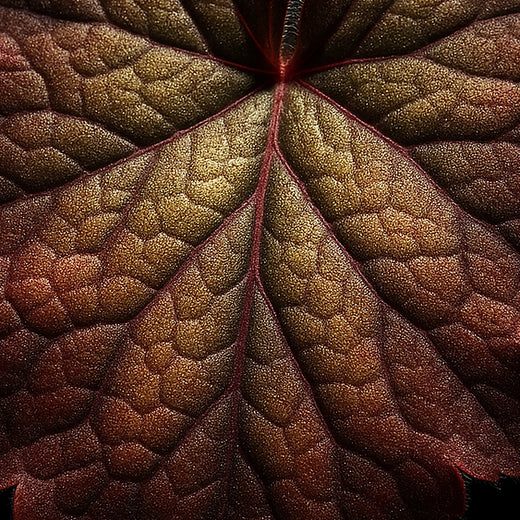
Several alumroots and their crosses are used as ornamental plants. They are valued as foliage plants, producing rosettes of leaves in shades of green, pink and bronze, often variegated or textured. The majority of Heuchera sold for gardens are hybrids of H. americana.
Alumroot · History
The genus was named after Johann Heinrich von Heucher, an 18th-century German physician and Professor at Wittenberg University.
Alumroot · Technical Sheet
Identity
- Botanical
- Heuchera
- IPNI
- Heuchera L., Sp. Pl. 1: 226 (1753) — Carl Linnaeus (1707-1778)
- Type
- Concept
- Category
- Accords and curiosities
Classification
- Cluster
- Classic florals · 245 entries in this cluster
- Chemical class
- Complex natural (essential oil)
Chemical data
- Formula
- N/A — no commercial essential oil
Physical properties
- Note
- No commercial essential oil. The name refers to Heuchera genus; the root was historically used as astringent (contains tannins). Perfumery note is a reconstruction.
Performance and rules
- IFRA status
- No IFRA Standard for the material itself (51st Amendment)
Alumroot · See Also
Entries related to Alumroot, by their place in the pyramid. « shared » marks a scent word Alumroot has too.
Heart notes

Jasmine
floral (shared) Florals / Natural
Orange Blossom
floral (shared) · honeyed · citrus Florals / Natural
Tuberose
floral (shared) · narcotic · creamy Florals / Natural
Violet
floral (shared) · violet Florals / Natural & Synthetic
Hellebore Flower
floral (shared) · earthy (shared) · fresh (shared) Florals / Fantasy/Concept
Solomon's Seal
herbaceous perennial · Polygonatum Florals / Natural


Other entries · Place in the pyramid not stored

Carnation
floral (shared) · spicy · clove Florals / Same cluster / Natural

Alumroot · Sources
- NC State Extension Alumroot
- IFRA Standards, 51st Amendment
- Henriette's Herbal Heuchera. Alum-root, American Sanicle. Heuchera americana
- Wikipedia Heuchera
- Wikipedia Heuchera sanguinea
- Wikipedia Heuchera americana
Cite as PREMIEREPEAU Glossary, “Alumroot”, https://premierepeau.com/pages/glossary-terms/alumroot Updated 2026-11-19
