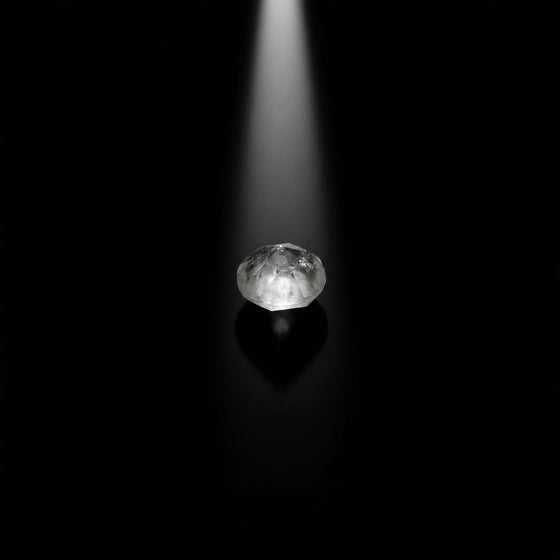
A dry, mineral brightness that smells like sunlight trapped in white stone. Ambroxan is the synthetic isolate of the key odorant in aged ambergris — a tricyclic ether (naphtho[2,1-b]furan) that does not so much smell as radiate. It projects outward from the skin in a transparent, crystalline haze that a significant fraction of the population cannot fully perceive.
Dry, mineral, crystalline. Not warm in the conventional amber sense — closer to the warmth of stone that has been sitting in sun. No sweetness, no resin, no obvious perfume character. Compared to Iso E Super’s soft, cedar-velvet murmur, ambroxan is louder, sharper, more transparent — light through glass versus light through gauze. Compared to natural ambergris’s marine-animalic depth, ambroxan is an abstraction: the mineral skeleton with the biological matter stripped away. At high concentration, a salty, almost metallic edge. At skin level, the impression of expensive cleanliness — not soap-clean, but the clean of cold marble and pressed linen.
Evolution over time
Immediately
Immediately
Mineral, sharp, almost salty. A crystalline brightness that projects outward immediately — spatial rather than olfactory. Not warm, not cold. Luminous. Like sunlight on white stone.
After a few hours
After a few hours
The mineral edge softens. A dry, transparent woody-amber glow settles closer to the skin. Radiance persists but turns intimate — less halo, more skin-warmth. The salty facet recedes; a faint muskiness emerges.
After a few days
After a few days
Extraordinary persistence on fabric. A clean, woody-mineral trace lingers — barely there, but structurally unmistakable. On skin, virtually undetectable after 24 hours. On cotton or wool, detectable for weeks.
The Full Story
Ambroxan is the synthetic isolate of ambergris — the crystalline base of Première Peau's Rose Monotone, anchoring rose oxide and lychee against modern vetiver.
Ambroxan (CAS 6790-58-5) is a tricyclic ether — formally, (3aR,5aS,9aS,9bR)-3a,6,6,9a-tetramethyldodecahydronaphtho[2,1-b]furan — that replicates the dry, mineral, woody-amber quality of aged ambergris. Molecular formula: C₁₆H₂₈O; molecular weight: 236.39 g/mol. Melting point: 74–75 °C. It is the synthetic counterpart of (−)-ambroxide, the principal odorous autoxidation product of ambrein, the triterpenoid alcohol constituting 25–45% of raw ambergris by mass. The first total synthesis from sclareol — a diterpene alcohol extracted from clary sage (Salvia sclarea) distillation residues — was achieved in the early 1950s. Subsequent chromatographic and GC-MS work in the 1970s and 1980s confirmed that (−)-ambroxide is the compound principally responsible for the characteristic odour of high-grade aged ambergris, rendering whale-derived material commercially obsolete.
What makes ambroxan singular is not its smell per se — descriptions range from woody-amber to mineral-clean to salty-crystalline — but its behaviour on skin. Industry literature reports a detection threshold of approximately 0.3 parts per billion, among the lowest in perfumery. At high concentrations, it reads almost aggressive: a dry, metallic, overexposed brightness. At trace levels, it creates a barely perceptible warm-skin effect that makes surrounding materials read as more clean. The molecule does not sit on the skin. It hovers.
The enantiomerically pure (−)-form (CAS 6790-58-5) is drier, sharper, and more projecting than the racemic mixture (dl-ambroxide, CAS 3738-00-9), which presents a rounder, muskier, closer-to-skin character. Today, ambroxan is a common aroma chemicals in fine fragrance, present in compositions across every olfactive family.
Modern production increasingly employs biotechnology. Engineered micro-organisms produce enantiomerically pure (−)-ambroxide from renewable feedstocks such as sugarcane, significantly reducing land use compared to the clary sage pathway. A 2025 study published in Communications Biology (Takase et al., DOI: 10.1038/s42003-025-08229-y) identified OR7A17 as the human olfactory receptor tuned to (−)-ambroxide. Non-functional alleles of OR7A17 are prevalent across populations — particularly in East Asia — meaning the same molecule that projects aggressively to one person may register as faint or flat to another.
Ambroxan provides the radiant, skin-scent finish of Rose Monotone, amplifying crystalline rose oxide and lychee with its diffusive mineral warmth.
What does ambroxan smell like
Warm, woody, and slightly mineral — like sun-heated driftwood with a faint salt edge. Ambroxan (CAS 6790-58-5, also known as Cetalox Laevo or Amberwood) is a synthetic analog of ambrein, the key odorant in ambergris. It does not smell animalic. It smells clean, diffusive, and enormous — a single molecule that fills a room with a warm, slightly metallic halo. The effect is more textural than aromatic: Ambroxan makes other notes project further, last longer, and feel more three-dimensional. It is the molecule behind the diffusive power of many modern niche fragrances.
A 2025 study published in Communications Biology (Takase et al., DOI: 10.1038/s42003-025-08229-y) identified OR7A17 as the specific human olfactory receptor that detects (−)-ambroxide. Non-functional alleles of OR7A17 are particularly prevalent in East Asian populations, meaning carriers can still detect the molecule but perceive it as significantly less pleasant. This receptor polymorphism explains why ambroxan-heavy fragrances provoke sharply divided reactions: what reads as aggressive mineral radiance to one person registers as flat or soapy to another.
Extraction & Chemistry
Extraction method: Synthetic — no natural extraction exists for pure ambroxan. The classical route begins with sclareol, a diterpene alcohol isolated from spent clary sage (Salvia sclarea) herb after steam distillation. The concrete contains approximately 50% sclareol by weight. Sclareol undergoes oxidative degradation to sclareolide (a bicyclic lactone), followed by reduction to a diol and acid-catalysed cyclisation to form the naphtho[2,1-b]furan ring system. Overall yield: approximately 75%. Since the mid-2010s, biotechnological routes using engineered micro-organisms produce enantiomerically pure (−)-ambroxide from renewable sugar-based feedstocks. These processes claim substantially reduced land use and carbon footprint versus the clary sage pathway, though independent LCA comparisons remain limited.
Ambroxan is a radiance engine. It does not contribute a conventional note — it generates an effect: projection, luminosity, a sense of the fragrance hovering above the skin rather than sitting on it. Functionally, it is a fixative, a diffusion amplifier, and a base-note backbone, often deployed at concentrations as low as 0.1–1% of the concentrate. Industry literature reports a detection threshold of approximately 0.3 ppb — among the lowest in perfumery. In fresh compositions, it contributes warmth without mass. In woody compositions, it extends the cedar-amber axis indefinitely. In ambers, it introduces a mineral dimension beneath balsamic sweetness. The enantiomerically pure (−)-form (CAS 6790-58-5) is drier, more radiant, and more projecting than the racemic dl-ambroxide (CAS 3738-00-9), which reads rounder, muskier, and closer to skin. In Première Peau’s compositions, ambroxan appears as the crystalline base of Rose Monotone (/products/rose-monotone-crystalline-lychee-perfume), where it hovers beneath rose oxide and Haitian vetiver. Ambrox Super — a captive variant from a major fragrance house — provides mineral depth in Albâtre Sépia (/products/albatre-sepia-white-truffle-ink-perfume) and the asphalt-vetiver base of Gravit as Capitale (/products/gravit as-capitale-neo-cologne-citron-asphalt-perfume).