


Australian Blue Cypress
Keywords: woody · warm · green
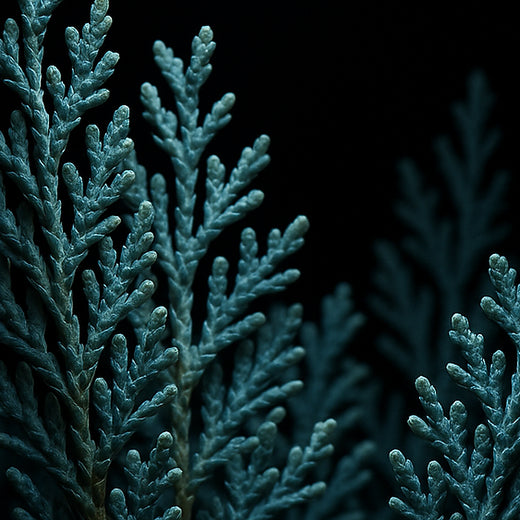
Australian Blue Cypress is a blue essential oil from Callitris intratropica, a conifer native to northern Australia. Its scent is generally smoky and sweet, with balsamic, woody, honey-like tones.
Not to be confused with Cypress (Cupressus sempervirens)
- Olfactive family
- Woods · 362 entries of the glossary in this family Subfamily: Classic woods · 124 entries in this subfamily Cluster: Smoky woods · 35 entries in this cluster
- Material
- Natural Bark and heartwood
- Pyramid
- Base · Volatility: Base Note
- Strength
- Medium Step 3 of 5 · shared by 1,473 of 2,156 graded entries Graded entries at each step, from 1 to 5: 4, 119, 1,473, 498, 39. 23 more sit between two steps.
- Also called
- Blue cypress, Callitris intratropica
Family, subfamily and cluster: PREMIEREPEAU house classification, version 2026‑11.
Australian Blue Cypress · Facets
Entries of the glossary that carry each facet, of 3,979:
- woody 792
- green 1,442
- sweet 1,988
- warm 1,108
- fresh 1,387
- honeyed 76
- resinous 199
- smoky 166
- balsamic 343
- herbal 757
Australian Blue Cypress · Scent
Its odour is characteristically woody, with herbal back notes. The oil has a fresh, foresty aroma. The woody scent is pleasant.
Evolution over time
Australian Blue Cypress: scent over time.
- Immediately
A fresh, foresty aroma.
Scent words: fresh - After a few hours
Woody, with herbal back notes.
Scent words: herbal · woody - After a few days
Smoky, sweet, balsamic and honey-like woody tones.
Scent words: sweet · honeyed · balsamic · woody · smoky
- Tenacity
- > 200 hours
Australian Blue Cypress · In Perfumery
The oil can be added directly to cosmetics, or its constituents can be extracted and added instead. In cosmetic products the wood oil has the function of fragrance.
Pyramid
Australian Blue Cypress: Base. Entries of the glossary stored at each place of the pyramid, of 4,006 (42 store no place):
- Top 718
- Top · Heart 497
- Heart 1,641
- Heart · Base 514
- Base 594
Role in the formula
Australian Blue Cypress: roles in the formula. Entries of the glossary that share each role, of 4,006:
- Fixative 340
- Modifier 1,167
- Backbone 196
- Signature note 897
- Volume builder 780
- Freshness 720
Australian Blue Cypress · Terroir & Origins
- Producing countries
- Australia
Northern Territory Blue Cypress
Darwin Plantations — Australia
Facet scores, out of 100
- Woody 89 (also a facet of the entry)
- Earthy 58
- Green 54 (also a facet of the entry)
- Smoky 48 (also a facet of the entry)
- Resinous 40 (also a facet of the entry)
- Sweet 38 (also a facet of the entry)
The Darwin plantations were planted by the Northern Territory government for timber production in the 1960s. They were left idle and written off until the oil was ‘discovered’ in 1995.
Harvesting large trees needs heavy machinery and a long distillation, which add significantly to the cost of the oil.
- Species
- Callitris intratropica
- Harvest
- Trees harvested on a 30-year plantation rotation
- Extraction
- Steam distillation of stem and branches, about 48 hours
Australian Blue Cypress · Extraction & Chemistry
The bark and heartwood are reduced to shavings or chips and steam distilled over 48 hours. The yield is about 1–2% of blue-green oil.
- Appearance
- Opaque, mobile cobalt blue liquid
Australian Blue Cypress · Did You Know?
A plantation of Callitris intratropica was established outside Darwin for use in house construction. After Cyclone Tracy it was realised that the timber did not resist strong winds, and the plantation was abandoned.
Australian Blue Cypress · In Depth
Callitris intratropica is a species of conifer in the family Cupressaceae. It is a tree native to northern Australia, in portions of Western Australia, the Northern Territory, and Queensland. Callitris is a genus of coniferous trees in the cypress family, with 22 recognized species, of which 19 are native to Australia. Alongside Eucalyptus and Acacia, Callitris is one of the dominant tree genera in Australia.
Description
Species of the genus Callitris are small to medium-sized trees or large shrubs, reaching 5–25 m in height. The leaves are scale-like, but young seedlings have needle-like leaves.
Names and Taxonomy
Cypress-pine is the usual traditional common name of the genus Callitris. Within the genus, Callitris intratropica is the species called blue cypress. Callitris intratropica is also treated as a synonym of Callitris columellaris. Other names under which it has been classified include Callitris robusta var. intratropica and Callitris columellaris subsp. intratropica.
Timber
The wood of cypress-pines is light, soft and aromatic. Cypress-pine is also termite resistant. It is used to make furniture, indoor and outdoor paneling, and fence posts. Cypress-pines are occasionally planted as ornamental trees, but their use is restricted by the very high risks of flammability in bushfires.
Chemistry
The oil is rich in guaiol and chamazulene, the blue compound. Guaiazulene is a bicyclic sesquiterpene. The oil’s listed constituents include guaiol at 13–15% and bulnesol at 8–10%, with guaiazulene present only in trace amounts. Dihydro columellarin is listed at 8–9%. Other constituents include a and b eudesmol together at 10–11%, g-eudesmol at 7–8%, b-salinene at 3–4%, g-guaiene at 2–3% and myrtenic acid at 2–3%.
Uses
The trees are now used for the production of a blue essential oil. A number of therapeutic effects are attributed to the essential oil, including antimicrobial and anti-inflammatory effects. Guaiazulene itself is an approved cosmetic color additive in the United States.
Explore all seven extraits in the Discovery Set.
Australian Blue Cypress · Technical Sheet
Identity
- Botanical
- Callitris columellaris F.Muell. (syn. Callitris intratropica)
- Taxonomy
- Pinales order › Cupressaceae family › Callitris genus · GBIF
- Botanical records
- Callitris columellaris: POWO, Callitris columellaris · IPNI, Callitris columellaris · GBIF, Callitris columellaris · Wikidata, Callitris columellaris · Wikipedia, Callitris columellaris · IUCN Least concern (LC), Callitris columellaris
- IPNI
- Callitris columellaris F.Muell., Fragm. (Mueller) 5(40): 198 (1866) — Ferdinand Jacob Heinrich von Mueller (1825–1896)
- Type
- Ingredient
- Category
- Woods and mosses
In Nature
- Growth form
- Tree · POWO
- Sample origins in GC-MS studies
- Nigeria (1 paper; one: Journal of essential oil research 2005, Nigeria)
- Recorded altitude
- 0–750 m · median 400 m · 653 records with an altitude · GBIF
- Wild or cultivated
- 1,694 native · 17 introduced · 71 cultivated among 34,197 records (the rest carry no such mark) · GBIF
- Recorded in
- 28 of 512 squares of the world grid; a brighter dot holds more records · GBIF
- Also from this botanical family
- Cupressaceae: Bagas de Zimbro · Cade Oil · Cedar · Cedar Leaves · Cedarwood · Chinese Cedarwood · 21 more entries
In Print
- Timeline
- first described 1866 · earliest aroma paper in Europe PMC, 2005
- In English books
- most mentioned in the 1970s · Google Books Ngram
Classification
- Chemical class
- Essential oil rich in guaiol and chamazulene
Chemical data
- Formula
- Complex natural mixture (key constituents: guaiazulene C₁₅H₁₈, the key blue pigment component)
- GC-MS study
- Journal of essential oil research 2005, Analyses of the volatile compounds of Callitris columellaris F. Muell. needles from two different regions of Nigeria
- CAS
- 187348-13-6
- INCI names (CosIng)
- CALLITRIS INTRATROPICA WOOD OIL (FRAGRANCE)
- Compound classes reported
- Sesquiterpenoids 68 % · Flavonoids 23 % · of 31 compounds reported · LOTUS
Labelling
- Forms in the EU cosmetic inventory
- Australian Blue Cypress: CALLITRIS COLUMELLARIS LEAF/WOOD EXTRACT · CALLITRIS COLUMELLARIS LEAF/TWIG OIL · CALLITRIS COLUMELLARIS SEED OIL
- EU allergens reported
- Cinnamyl Alcohol · Linalyl Acetate · Carvone · Menthol
Physical properties
- Flash point
- 110 °C [Closed Cup]
- Specific gravity
- 0.930 to 0.990 at 25 °C
- Refractive index
- 1.48 to 1.52 at 25 °C
Performance and rules
- Odour words (The Good Scents Company)
- woody · floral · earthy · fruity · balsamic · herbal · resinous · smoky (data sheet)
- Available as
- essential oil
- IFRA status
- No IFRA Standard for the material itself (51st Amendment)
Australian Blue Cypress · See Also
Entries related to Australian Blue Cypress, by their place in the pyramid. “shared” marks a scent word Australian Blue Cypress has too.
Top notes

Western redcedar
woody (shared) · fresh (shared) · herbal (shared) Woods / Top · Heart / Natural

Base notes

Vertofix Coeur
woody (shared) · amber · cedar Woods / Same subfamily / Synthetic
Cedrol
woody (shared) · dry · cedar Woods / Same subfamily / Natural
Hinoki Oil
woody (shared) · warm (shared) · spicy Woods / Same subfamily / Natural
Vetiver
earthy · woody (shared) · smoky (shared) Woods / Natural
Cedarwood
woody (shared) · dry · clean Woods / Natural
Patchouli
Woods / Natural
Sandalwood
woody (shared) · floral Woods / Natural


Australian Blue Cypress · Sources
Read the science
- Journal of essential oil research: JEOR. (2005) Analyses of the volatile compounds of Callitris columellaris F. Muell. needles from two different regions of Nigeria
- GBIF Callitris intratropica
- GBIF Callitris intratropica R.T.Baker & H.G.Sm., name record of the World Checklist of Vascular Plants (Kew)
- International Plant Names Index (IPNI) Callitris columellaris F.Muell.
- National Industrial Chemicals Notification and Assessment Scheme, Australia (1997) Callitris intratropica Oil, full public report NA/507
- IFRA Standards, 51st Amendment
- COSMILE Europe CALLITRIS INTRATROPICA WOOD OIL
- The Good Scents Company Callitris intratropica wood oil australia
- Wikipedia Callitris
- Wikipedia Callitris intratropica
- Wikipedia Guaiazulene
Cite as PREMIEREPEAU Glossary, “Australian Blue Cypress”, https://premierepeau.com/
