


Barley
Keywords: cereal · malty · roasted
Barley (Hordeum vulgare), a member of the grass family, is a major cereal grain grown in temperate climates globally.
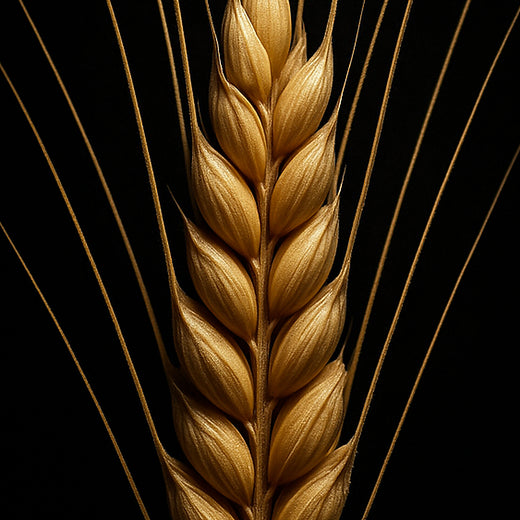
- Olfactive family
- Gourmand · 494 entries of the glossary in this family Subfamily: Cereal gourmand · 1 entry in this subfamily Cluster: Malty-cereal notes · 1 entry in this cluster
- Material
- Natural Cereal grain
- Pyramid
- Heart-to-Base
- Strength
- Medium Step 3 of 5 · shared by 1,469 of 2,161 graded entries Graded entries at each step, from 1 to 5: 4, 117, 1,469, 507, 40. 24 more sit between two steps.
- Also called
- barley grass, malting barley
Barley · Facets
Entries of the glossary that carry each facet, of 3,979:
- green 1,444
- earthy 657
- sweet 1,990
- warm 1,109
- fresh 1,392
- malty 15
- toasted 3
Barley · Scent
Roasted barley extract has a woody, gourmand smell that recalls caramel, gingerbread, mocha, cocoa beans and honey.
Evolution over time
Barley: scent over time.
- After a few hours
Gingerbread and mocha facets follow.
- After a few days
Cocoa bean and a woody gourmand base remain.
Scent words: gourmand · woody
Barley · In Perfumery
In fine fragrance and personal care, roasted barley extract supplies woody gourmand notes and combines with orange and woody accords, lending harmony and originality to a composition. The extract is also used in cosmetics.
Pyramid
Barley: Heart · Base. Entries of the glossary stored at each place of the pyramid, of 4,000 (35 store no place):
- Top 718
- Top · Heart 501
- Heart 1,646
- Heart · Base 512
- Base 588
Role in the formula
Barley: roles in the formula. Entries of the glossary that share each role, of 4,000:
- Modifier 1,168
- Signature note 898
- Blender 1,041
Barley · Terroir & Origins
- Producing countries
- Russia, Australia, Germany, France, Turkey, Canada
Barley · Extraction & Chemistry
Malting is the conversion of barley or other cereal grains into malt for use in brewing, distilling, or foods. The grain is immersed in water two or three times for two or three days to absorb moisture and start to sprout. The sprouted grain, called green malt, is then dried and toasted in an oven or kiln to the desired color and specification.
Available as
Barley: available as.
- synthetic accord
- fantasy note
- grain
- malt
- malt extract
- Appearance
- Golden to amber cereal grains; malt extract is dark amber syrupy liquid
Barley · Did You Know?
Wild barley was harvested in Southwest Asia as long as 50,000 years ago at Kebara Cave, and 23,000 years ago at Ohalo II. At Gilgal I, a site in Israel dated to about 11,700-10,550 years ago, archaeologists found a large granary containing thousands of wild barley grains.
Barley · In Depth
Growth and world production
Barley was domesticated in the Fertile Crescent around 9000 BC, which gave it nonshattering spikelets and made it much easier to harvest. Its use then spread throughout Eurasia by 2000 BC. Barley prefers relatively low temperatures and well-drained soil to grow. It is relatively tolerant of drought and soil salinity, but is less winter-hardy than wheat or rye.
In 2023, barley was fourth among grains in quantity produced, 146 million tonnes, behind maize, rice, and wheat. Globally, 70% of barley production is used as animal feed, while 30% is used as a source of fermentable material for beer, or further distilled into whisky, and as a component of various foods. In 2024, world production of barley was 142 million tonnes, led by Russia with 12% of the total. Australia, Germany and France were secondary producers.
Founder crop and cultivars
Barley is one of the three cereals among the founder crops, together with emmer wheat and einkorn wheat. Wild barley has two rows of spikelets, hulled grains and a brittle rachis, and domestication produced non-brittle, then naked, then six-rowed forms in succession. Brewers in Europe tend to use two-row cultivars, while breweries in North America use six-row barley or a mix.
Malting and browning
Barley grains are commonly made into malt using a traditional and ancient method of preparation. Malt is any cereal grain that has been made to germinate by soaking in water and then stopped from germinating further by drying with hot air. Barley is the most commonly malted grain, in part because of its high content of enzymes.
Malting develops the enzymes α-amylase and β-amylase, which convert the grain's starches into sugars such as glucose, maltose and maltotriose. Malts range in color from very pale through crystal and amber to chocolate or black malts.
The Maillard reaction is a chemical reaction between amino acids and reducing sugars that creates melanoidins, the compounds that give browned food its distinctive flavor. The Maillard reaction contributes to the browning of malted barley as found in malt whiskey and beer.
Maltol is produced during the roasting of malt, from which it gets its name, and in the baking of bread.
Barley · Technical Sheet
Identity
- Botanical
- Hordeum vulgare
- IPNI
- Hordeum vulgare L., Sp. Pl. 1: 84 (1753) — Carl Linnaeus (1707-1778)
- Type
- Ingredient
- Category
- Sweets and gourmand smells
In Nature
- Growth form
- Herb · POWO
- Native range
- Southeastern Europe · Northern Africa · Middle Asia · Caucasus · Western Asia · Arabian Peninsula · China · Indian Subcontinent · POWO
- Introduced to
- 174 regions · Northern America 64 · Europe 35 · Temperate Asia 21 · Southern America 18 · Africa 15 · Tropical Asia 9 · Australasia 8 · Pacific 3 · Antarctic 1
- Recorded altitude
- 50–1,400 m · median 350 m · 40,100 records with an altitude · GBIF
- Wild or cultivated
- 43,077 native · 4,832 introduced · 149,919 cultivated among 441,115 records (the rest carry no such mark) · GBIF
- Recorded in
- 141 of 512 squares of the world grid; a brighter dot holds more records · GBIF
- Also from this genus
- Hordeum: Whiskey
- Also from this botanical family
- Poaceae: Ammophila (Beach Grass) · Corn Silk · Flour · Flouve · Hay · Hay Absolute · 13 more entries
In Print
- Timeline
- first described 1753 · earliest aroma paper in Europe PMC, 2011
- In English books
- most mentioned in the 1980s · Google Books Ngram
Classification
- Chemical class
- Olfactory accord
Chemical data
- Formula
- N/A — complex natural material
- INCI names (CosIng)
- HORDEUM VULGARE EXTRACT (SKIN CONDITIONING - EMOLLIENT, SKIN CONDITIONING)HORDEUM VULGARE LEAF EXTRACT (SKIN CONDITIONING)HORDEUM VULGARE ROOT EXTRACT (SKIN CONDITIONING - EMOLLIENT, SKIN CONDITIONING)HORDEUM VULGARE SEED EXTRACT (SKIN CONDITIONING)HORDEUM VULGARE SPROUT EXTRACT (ANTIOXIDANT, HUMECTANT, SKIN CONDITIONING)HORDEUM VULGARE STEM WATER (SKIN CONDITIONING)HORDEUM VULGARE CERA (SKIN CONDITIONING - EMOLLIENT, SKIN CONDITIONING)
Labelling
- EU allergens reported
- Benzyl Alcohol
Physical properties
- Note
- Barley (Hordeum vulgare) — malted barley absolute exists but is rare; used primarily as gourmand olfactory concept
Performance and rules
- IFRA status
- No IFRA Standard for the material itself (51st Amendment)
Barley · See Also
Entries related to Barley, by their place in the pyramid. « shared » marks a scent word Barley has too.
Heart notes

Taro
nutty · roasted (shared) · popcorn-like Gourmand / Natural
Black Sesame
gourmand · nutty · roasted (shared) Gourmand / Natural & Synthetic
Rice Powder
cereal (shared) · popcorn-like Gourmand / Fantasy/Concept
Sorghum
sweet (shared) · fruity · green (shared) Gourmand / Fantasy/Concept


Barley · Sources
Read the science
- IFRA Standards, 51st Amendment
- Wikipedia Barley
- Wikipedia Malt
- Wikipedia Neolithic founder crops
- Wikipedia Maillard reaction
- Wikipedia Maltol
Cite as PREMIEREPEAU Glossary, “Barley”, https://premierepeau.com/pages/glossary-terms/barley Updated 2026-11-18
