


Black Sapote
Keywords: gourmand · fruity · sweet
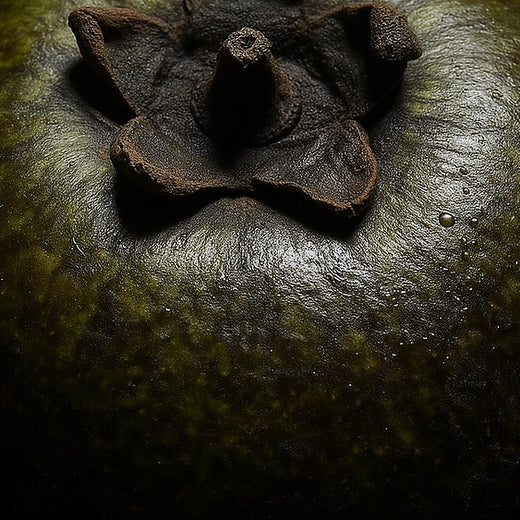
Black sapote (Diospyros digyna) is a tropical fruit tree closely related to the persimmon, in the family Ebenaceae. Its ripe pulp has a flavor, color and texture often likened to chocolate pudding.
- Olfactive family
- Fruity · 713 entries of the glossary in this family Subfamily: Tropical fruits · 123 entries in this subfamily Cluster: Mixed fruit notes · 353 entries in this cluster
- Material
- Natural Fruit
- Pyramid
- Heart Note
- Strength
- Medium Step 3 of 5 · shared by 1,462 of 2,149 graded entries Graded entries at each step, from 1 to 5: 4, 118, 1,462, 501, 40. 24 more sit between two steps.
- Also called
- chocolate pudding fruit, black soapapple, zapote prieto, black persimmon, zapote negro
Black Sapote · Facets
Entries of the glossary that carry each facet, of 3,979:
- sweet 1,987
- warm 1,109
- creamy 404
Black Sapote · Scent
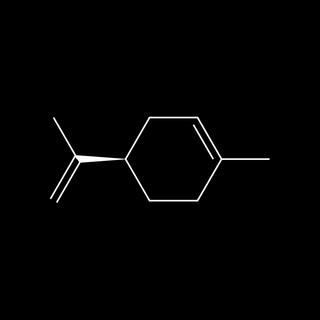
The most important of them, (E)-cinnamaldehyde, smells pungent and cinnamon-like, and its aroma is further described as sweet, spicy, aldehydic, balsamic, resinous and powdery. Limonene smells of citrus, orange and sweet freshness in its (+) form and is piny and turpentine-like in its (−) form; the form present in the fruit is not stated. Linalool is floral with a touch of spiciness, and is also described as citrus, sweet, woody and green. Methyl (E)-cinnamate is sweet and balsamic with a fruity note reminiscent of cinnamon and strawberry. (Z)-β-Ocimene belongs to a group of terpenes with a pleasant, sweet herbal scent.
Black Sapote · In Perfumery
Cinnamaldehyde, one of the aroma-active volatiles of the fruit, is used in some perfumes of natural, sweet or fruity scents.
Pyramid
Black Sapote: Heart. Entries of the glossary stored at each place of the pyramid, of 4,000 (35 store no place):
- Top 718
- Top · Heart 496
- Heart 1,644
- Heart · Base 513
- Base 594
Role in the formula
Black Sapote: roles in the formula. Entries of the glossary that share each role, of 4,000:
- Modifier 1,168
- Signature note 898
- Blender 1,041
- Volume builder 780
Black Sapote · Terroir & Origins
- Producing countries
- Mexico
Black Sapote · Extraction & Chemistry
The volatile compounds of the fruit were isolated for analysis by simultaneous distillation-solvent extraction.
Available as
Black Sapote: available as.
- synthetic accord
- fantasy note
- fresh fruit
- pulp
- Appearance
- Pulp glossy, brown to very dark brown, almost black, somewhat jelly-like
Black Sapote · Did You Know?
Unripe black sapotes are very astringent, irritant, caustic and bitter, and have been used as fish poison in the Philippines. In 1899, the annual crop in Mexico was valued at $27,000, a considerable sum at that time.
Black Sapote · In Depth
The tree and its fruit
Black sapote is a tropical fruit tree native to Mexico, Central America and Colombia. Black sapote is not related to white sapote and is only distantly related to mamey sapote. Mature trees can grow to over 25 m (82 ft) in height and are evergreen.
The fruit is 5 to 12.5 cm wide, and on ripening its skin becomes olive-green and then rather muddy-green. The pulp is white and inedible when unripe. The texture of the fruit has been likened to that of a papaya. There may be 1 to 10 flat, smooth, brown seeds in the center, but the fruits are often seedless. The ripe pulp is soft, sweet and mild in flavor.
Origin and Production
The black sapote is native along both coasts of Mexico, from Jalisco to Chiapas, Veracruz and Yucatan, and in the forested lowlands of Central America. It is frequently cultivated throughout this range. It was apparently carried by the Spaniards to Amboina before 1692, and to the Philippines long before 1776. Outside of its homeland, the fruit has not achieved any great popularity.
In Mexico, the fruits are common in the markets from August to January. The tree is usually grown from seeds, which remain viable for several months in dry storage and germinate in about 30 days after planting in flats. Most trees begin to bear in 5 to 6 years, but some may take somewhat longer. Fruits picked when full-grown but unripe have ripened in 10 days at room temperature.
Chemistry and Scent Profile
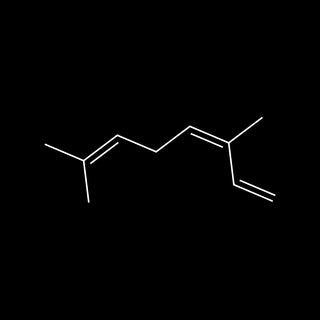
A total of 32 volatile constituents were detected in the fruit. They comprised 9 terpene compounds (49.1% of the total volatile composition), 11 ketones (9%), 5 aldehydes (29.2%), 4 alcohols (3.6%), 2 esters (8.2%) and a paraffin (0.8%). Major compounds were (Z)-β-ocimene (26.6% of the total volatile composition), (E)-cinnamaldehyde (25.5%) and limonene (17.0%).
Seven constituents were considered aroma-active by application of odour activity values, and the most important were (E)-cinnamaldehyde, 3-methylbutanal, limonene, (Z)-β-ocimene, linalool, methyl (E)-cinnamate and β-caryophyllene. Cinnamaldehyde, one of the major compounds of the fruit, gives cinnamon its flavor and odor.
Food Uses
In the Philippines, the seeded pulp of black sapote is served as dessert with a little milk or orange juice poured over it. The pulp is also made into ice cream. In Mexico, the pulp may be mashed, beaten or passed through a colander and mixed with orange juice or brandy. In Central America, the fermented fruits are made into a liqueur somewhat like brandy.
Other Uses
The wood is yellowish to deep-yellow with black markings near the heart of old trunks; it is compact and suitable for cabinetwork but little used. The crushed bark and leaves are applied as a blistering poultice in the Philippines. The ascorbic acid content of the fruit is said to be about twice that of the average orange.
Black Sapote · Technical Sheet
Identity
- Botanical
- Diospyros digyna
- Botanical records
- Diospyros digyna: POWO, Diospyros digyna · IPNI, Diospyros digyna · GBIF, Diospyros digyna · Wikidata, Diospyros digyna
- IPNI
- Diospyros digyna Jacq., Pl. Rar. Hort. Schoenbr. 3: 35, t. 813 (1798) — Nicolaus Joseph von Jacquin (1727–1817)
- Type
- Ingredient
- Category
- Fruits, vegetables and nuts
In Nature
- Recorded altitude
- 0–1,050 m · median 350 m · 645 records with an altitude · GBIF
- Wild or cultivated
- 1 introduced · 5 cultivated among 939 records (the rest carry no such mark) · GBIF
- Recorded in
- 17 of 512 squares of the world grid; a brighter dot holds more records · GBIF
- Also from this genus
- Diospyros: Ebony Tree · Persimmon
In Print
- In English books
- most mentioned in the 1990s · Google Books Ngram
Classification
- Chemical class
- Terpenes and aldehydes
Chemical data
- Formula
- Complex natural mixture (key constituents: (Z)-β-ocimene; (E)-cinnamaldehyde C₉H₈O; limonene)
Physical properties
- Note
- No commercial essential oil. The perfumery note evokes the chocolate-like, sweet tropical fruit character.
Performance and rules
- IFRA status
- No IFRA Standard for the material itself (51st Amendment)
Black Sapote · See Also
Entries related to Black Sapote, by their place in the pyramid. « shared » marks a scent word Black Sapote has too.
Top notes

Lychee
fruity (shared) · floral · rosy Fruity / Same cluster / Natural

Heart notes

Cupuaçu, Cupuassu, Copoasu
creamy (shared) · fruity (shared) · rich Fruity / Same cluster / Natural
Cherimoya
fruity (shared) · tropical · sweet (shared) Fruity / Same cluster / Natural
Coconut
gourmand (shared) · lactonic · tropical Fruity / Heart · Base / Same subfamily / Synthetic
SugarLoaf Pineapple
fruity (shared) · tropical · sweet (shared) Fruity / Same subfamily / Natural


Black Sapote · Sources
- FAO View crop
- IFRA Standards, 51st Amendment
- Wikipedia Diospyros nigra
- Wikipedia Cinnamaldehyde
- Wikipedia Limonene
- Wikipedia Linalool
- Wikipedia Methyl cinnamate
- Wikipedia Ocimene
Cite as PREMIEREPEAU Glossary, “Black Sapote”, https://premierepeau.com/
