


Calla Lily
Keywords: floral · sweet
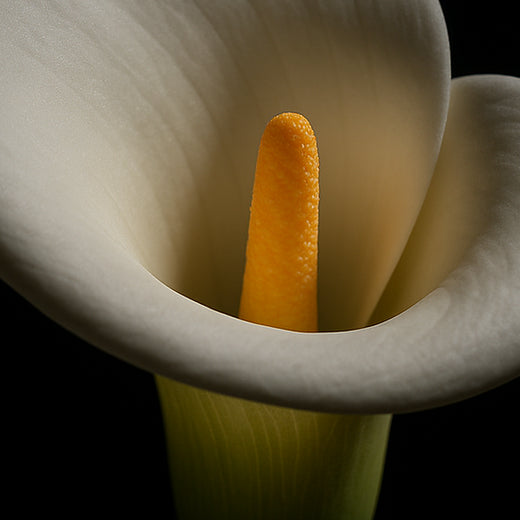
Calla lily (Zantedeschia aethiopica) is a flowering plant of the arum family and is not a true lily. Its spadix produces a faint, sweet fragrance.
- Olfactive family
- Florals · 779 entries of the glossary in this family Subfamily: Green florals · 143 entries in this subfamily Cluster: Lily-like fresh florals · 67 entries in this cluster
- Material
- Fantasy/Concept Flowering plant
- Pyramid
- Heart · Volatility: Heart Note
- Strength
- N/A — no measured strength for a fantasy accord Not on the graded scale
- Also called
- Arum lily, death lily
Family, subfamily and cluster: PREMIEREPEAU house classification, version 2026‑11.
Calla Lily · Facets
Entries of the glossary that carry each facet, of 3,979:
- floral 1,546
- green 1,442
- sweet 1,988
- fresh 1,387
- creamy 401
Editorial note We own no rights to this material, its name or its trademark. This entry is independent editorial journalism, published under freedom of expression.
Calla Lily · Scent
The spadix of Zantedeschia aethiopica produces a faint, sweet fragrance.
Evolution over time
Calla Lily: scent over time.
- Immediately
N/A — no documented evolution for a fantasy accord
- After a few hours
N/A
- After a few days
N/A
Calla Lily · In Perfumery
Once the data are analysed, a perfumer can recreate the scent.
Pyramid
Calla Lily: Heart. Entries of the glossary stored at each place of the pyramid, of 4,006 (42 store no place):
- Top 718
- Top · Heart 497
- Heart 1,641
- Heart · Base 514
- Base 594
Role in the formula
Calla Lily: roles in the formula. Entries of the glossary that share each role, of 4,006:
- N/A — no documented formula role 361
Calla Lily · Terroir & Origins
- Producing countries
- South Africa, New Zealand, Netherlands
Calla Lily · Extraction & Chemistry
The compounds are captured on cold surfaces, in solvent traps or on adsorbent materials, and are then analysed by gas chromatography, mass spectrometry or carbon-13 NMR.
Available as
Calla Lily: available as.
- synthetic accord
- fantasy note
- Appearance
- Colorless to pale yellow liquid
Calla Lily · Did You Know?
All parts of arum lilies are toxic because their cells contain needle-like crystals of calcium oxalate, called raphides. In the Amsterdam botanic garden, the seventeenth-century Dutch botanist Jan Commelin observed that overwatered Zantedeschia aethiopica loses excess water in drops from the leaf points, perfectly limpid and of an acrid taste.
Calla Lily · In Depth
The plant
Zantedeschia aethiopica, commonly known as calla lily, arum lily and death lily, is a flowering plant of the family Araceae, native to South Africa. The genus Zantedeschia has eight species. Z. aethiopica is a rhizomatous herbaceous perennial that grows 0.6 to 1 m tall, with large clumps of broad, arrow-shaped dark green leaves. Where water is sufficient the leaves are evergreen, and under dry conditions they are deciduous. Its preferred habitat is in or on the banks of streams and ponds.
The flower
The arum lily in a bouquet is a false flower. The true flowers are tiny and packed in tight groups around the central column, the spadix, which is surrounded by a petal-like bract, the spathe. A spathe is a large bract, and a bract is a modified or specialized leaf.
The inflorescence has a pure white spathe up to 25 cm and a yellow spadix up to 9 cm long. Female flowers, which are pollinated by insects such as beetles, mature before the male flowers. Mature fruits are orange, fleshy berries.
Toxicity
Ingestion of the raw plant may cause a severe burning sensation and swelling of lips, tongue, and throat. Stomach pain and diarrhea may also occur. The raphides may cause localised irritation in the mouth when eaten. For some people, the plant is also a skin irritant.
Distribution and cultivation
It has naturalised in Kenya, Madeira, the Azores, Malawi, New Zealand, Tanzania, Zambia and coastal California. In Western Australia it has been classified as a toxic weed and pest. The cultivars ‘Crowborough’ and ‘Green Goddess’ have gained the Royal Horticultural Society’s Award of Garden Merit. ‘Green Goddess’ has green stripes on the spathes, which allow the flowers to last much longer than the original white form. ‘Pink Mist’ has a pinkish base to the spathe and a pink spadix.
Zantedeschia aethiopica can be used for the treatment of wastewater because of its tolerance of iron and its ability to grow in wet areas.
Related: Arum Lily
Calla Lily · History
The generic name probably commemorates the Italian botanist Giovanni Zantedeschi (1773–1846). The arum lily was first reported growing in the Chelsea Physic Garden in 1731 by Philip Miller and was probably introduced to continental Europe in the seventeenth century from South Africa. According to Victorian flower lore, calla lilies symbolize devotion, purity, and bliss. Until 2011, Zantedeschia aethiopica was the national flower of the island nation of Saint Helena. It is an important symbol of Irish republicanism and nationalism since 1926.
Calla Lily · Technical Sheet
Identity
- Botanical
- Zantedeschia aethiopica
- Taxonomy
- Alismatales order › Araceae family › Zantedeschia genus · GBIF
- Botanical records
- Zantedeschia aethiopica: POWO, Zantedeschia aethiopica · IPNI, Zantedeschia aethiopica · GBIF, Zantedeschia aethiopica · Wikidata, Zantedeschia aethiopica · Wikipedia, Zantedeschia aethiopica · IUCN Least concern (LC), Zantedeschia aethiopica
- IPNI
- Zantedeschia aethiopica (L.) Spreng., Syst. Veg., ed. 16 [Sprengel] 3: 765 (1826) — Sprengel, Curt (Kurt, Curtius) Polycarp Joachim (1766–1833) · ≡ Calla aethiopica L. (1753)
- Type
- Accord
- Category
- Flowers
In Nature
- Growth form
- Herb · POWO
- Native range
- Southern Africa · POWO
- Introduced to
- 49 regions · Europe 11 · Africa 10 · Southern America 9 · Australasia 7 · Tropical Asia 4 · Northern America 3 · Temperate Asia 2 · Pacific 2 · Antarctic 1
- Flowering
- peak in February–May · north of the equator · iNaturalist
- Recorded altitude
- 0–1,500 m · median 100 m · 6,111 records with an altitude · GBIF
- Wild or cultivated
- 54 native · 16,526 introduced · 219 cultivated among 49,347 records (the rest carry no such mark) · GBIF
- Recorded in
- 108 of 512 squares of the world grid; a brighter dot holds more records · GBIF
- Also from this genus
- Zantedeschia: Arum Lily
- Also from this botanical family
- Araceae: Flamingo Flower (Anthurium) · Skunk Cabbage · Taro
In Print
- In English books
- most mentioned in the 1990s · Google Books Ngram
Classification
- Chemical class
- Fantasy note (accord)
Chemical data
- Formula
- N/A — no distillable oil commercially available
- Most reported compounds
- Tyramine (1 paper; one: Phytochemistry 1980, Tyramine) · Dopamine (1 paper; one: Phytochemistry 1980, Dopamine) · Syringin (1 paper; one: Phytochemistry 1998, Syringin) · Coniferin (1 paper; one: Phytochemistry 1998, Coniferin) · LOTUS
- INCI names (CosIng)
- ZANTEDESCHIA AETHIOPICA CALLUS EXTRACT (ANTIOXIDANT)ZANTEDESCHIA AETHIOPICA FLOWER EXTRACT (SKIN CONDITIONING)
Physical properties
- Specific gravity
- 0.93000 to 0.98000 at 25.00 °C.
- Refractive index
- 1.47000 to 1.52000 at 20.00 °C.
Performance and rules
- IFRA status
- No IFRA Standard for the material itself (51st Amendment)
Calla Lily · See Also
Entries related to Calla Lily, by their place in the pyramid. “shared” marks a scent word Calla Lily has too.
Top notes

Hivernal®
aldehydic · green (shared) · muguet Florals / Same cluster / Synthetic

Heart notes

Pink Lily
floral (shared) · sweet (shared) · powdery Florals / Same cluster / Natural
Crinum Lily
floral (shared) · tropical · sweet (shared) Florals / Same cluster / Fantasy/Concept
Lilybelle®
floral (shared) · fresh (shared) · green (shared) Florals / Same cluster / Synthetic
Tuberose
floral (shared) · narcotic · creamy (shared) Florals / Natural
Violet
floral (shared) · violet Florals / Natural & Synthetic
Rose
floral (shared) · honeyed · waxy Florals / Natural
Orange Blossom
floral (shared) · honeyed · citrus Florals / Natural
Jasmine
floral (shared) Florals / Natural


Base notes
-
Sugandh Mantri
earthy · rich · floral (shared) Woods / Natural
Other entries · Place in the pyramid not stored

Flamingo Flower (Anthurium)
floral (shared) · tropical · fruity Florals / Fantasy/Concept

Calla Lily · Sources
- International Plant Names Index (IPNI) Zantedeschia aethiopica (L.) Spreng.
- Oxford University Herbaria Oxford University Plants 400: Zantedeschia aethiopica
- Clemson University Extension Calla Lily
- IFRA Standards, 51st Amendment
- Wikipedia Zantedeschia aethiopica
- Wikipedia Zantedeschia
- Wikipedia Headspace technology
- Wikipedia Spathe
Cite as PREMIEREPEAU Glossary, “Calla Lily”, https://premierepeau.com/
